Register
 Login
 Register





US Dollar Under Pressure? Why USD/JPY, Bitcoin and US Yields Matter Now

Ludmila Insaurralde >
Market Analyst
Ludmila Insaurralde >
Market Analyst
 Updated Wed, 2026 August 12 06:54

With US inflation due tonight, Treasury yields elevated and the labour market showing signs of weakness, USD/JPY and Bitcoin could be two important markets to watch as traders reassess the outlook for US interest rates and the dollar.
Why the US Stepped In to Support the Yen
After USD/JPY climbed toward 164, its highest level since 1986, Japan intervened to support the yen, with the US also participating. What made this genuinely unusual: it was the first joint US-Japan yen-buying intervention since 1998. That’s not routine. When these two countries coordinate like this, it usually signals a real threat to financial stability, not just an unwanted currency move.
The scale backed that up. Across April and May alone, Japan’s Ministry of Finance deployed a record ¥11.73 trillion, roughly $73 billion, nearly double its largest prior intervention. When that wasn’t enough alone, Washington stepped in too, reportedly selling euros to buy yen rather than selling dollars directly, avoiding added pressure on the greenback itself.
The yen strengthened sharply, but USD/JPY has since drifted back toward 159, a reminder that intervention shifts short-term price action, not the underlying direction, which still comes down to fundamentals and monetary policy.
The Bigger Picture for the US Dollar
The intervention lands at a complicated time for the dollar. CBO’s original 2026 baseline projected a $1.9 trillion federal deficit; it’s since been revised up to $2.1 trillion, largely because the Supreme Court’s ruling striking down IEEPA tariffs cut expected customs revenue. Debt held by the public is still projected to climb from ~101% of GDP this year to 120% by 2036.
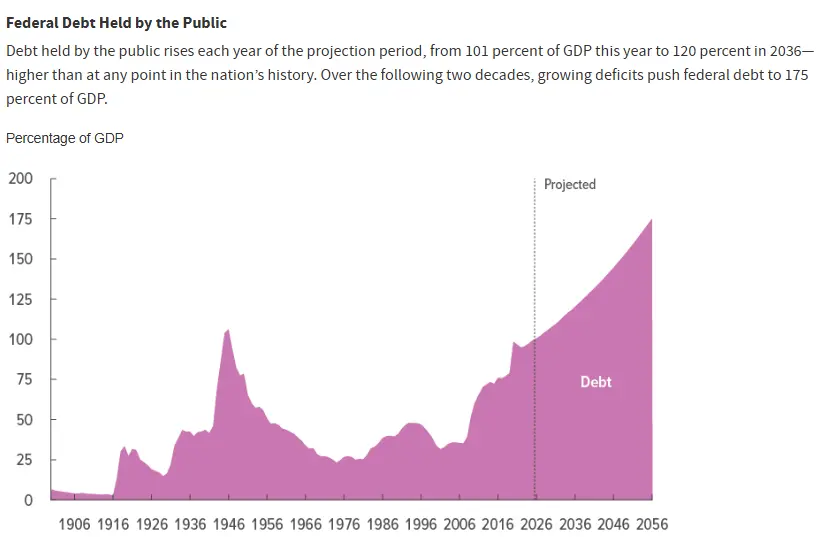
High borrowing and rising interest costs keep pressure on Treasury yields, creating a tension for the dollar, where high yields attract capital even as long-term debt concerns build. With the labour market also showing recent weakness, tonight’s US inflation report becomes the swing factor: a surprise either way could quickly reshape rate expectations and move the dollar and Treasuries fast.
What Could It Mean for USD/JPY?
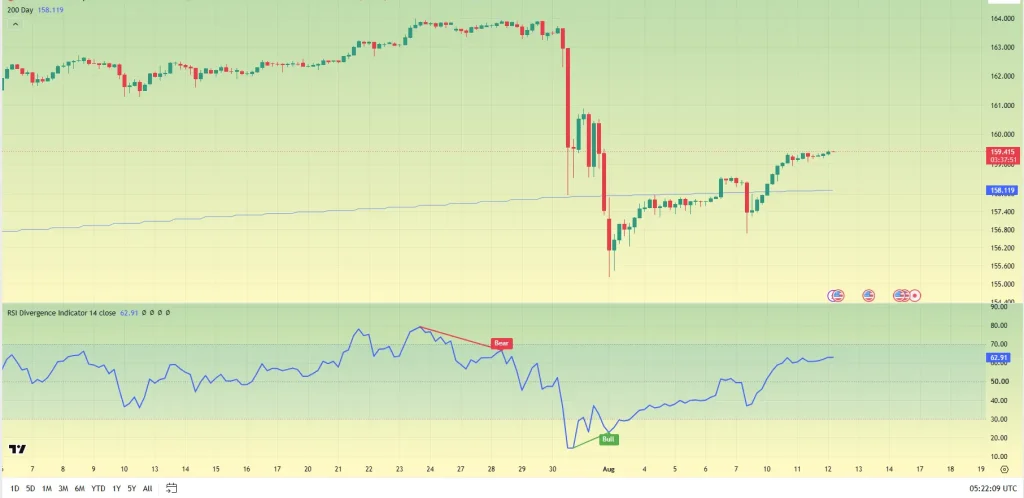
The 164 intervention shows authorities will act on extreme yen weakness, though it’s not a guaranteed line in the sand. A second, quieter force is also building: as Japanese bond yields rise, life insurers have been repatriating capital out of hedged US Treasuries into domestic assets, a structural, yen-positive shift that doesn’t depend on the Bank of Japan doing anything at all.
The bigger question is still the US-Japan rate gap. Elevated US yields should keep supporting the dollar against the yen; if inflation data starts pulling yields lower, that support fades, right as the repatriation-driven yen bid keeps building underneath.
Where Does Bitcoin Fit In?
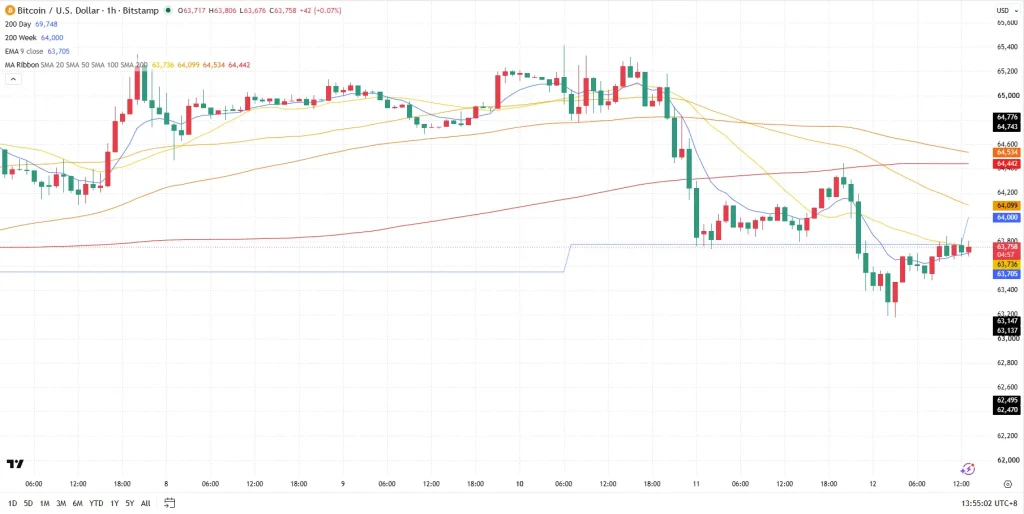
Bitcoin is trading around $63,700, sitting right at its 200-week moving average near $64,000, a level that’s acted as a magnet over the past week, with price whipsawing either side of it rather than breaking cleanly through. The shorter-term moving averages (the 20, 50 and 100-day) are all still stacked above current price in the $64,100–$64,500 zone, meaning Bitcoin needs to reclaim that cluster before the chart looks genuinely bullish again. Right now, it’s chopping just beneath it.
That technical hesitation mirrors the fundamental uncertainty.
Bitcoin’s reaction could depend less on whether the dollar falls and more on why it falls.
A weaker dollar combined with falling Treasury yields and expectations for easier monetary policy could be more supportive for Bitcoin.
But if the dollar weakens while yields remain elevated because of inflation or fiscal concerns, financial conditions could remain challenging.
In other words, a weaker dollar does not automatically mean a stronger Bitcoin.
With US inflation due tonight, Treasury yields, the dollar, USD/JPY and Bitcoin could all be worth watching for the next signal.
What to Watch Next
The next direction for these markets could come down to US inflation, employment and Treasury yields.
Stronger inflation could keep pressure on the Fed to maintain restrictive policy, while further labour-market weakness could strengthen the argument for caution.
For traders, that makes DXY, USD/JPY, long-term Treasury yields and Bitcoin worth watching together, as each could provide a different signal about where US monetary policy and the dollar are heading next.
Disclaimer: The material provided here has not been prepared in accordance with legal requirements designed to promote the independence of investment research and as such is considered to be a marketing communication. Whilst it is not subject to any prohibition on dealing ahead of the dissemination of investment research we will not seek to take any advantage before providing it to our client. No representation or warranty is given as to the accuracy or completeness of this information and therefore it shouldn’t be relied upon as such. Any research provided does not have regard to specific financial situations, needs or investment objectives. Vantage accepts no responsibility for any use that may be made of these comments and for any consequences that result. Consequently, any person acting on it does so entirely at their own risk. We advise any readers of this material to seek professional advice where necessary. Without the approval of Vantage, reproduction or redistribution of this information isn’t permitted.
-

Open Trading Account
Discover the endless trading possibilities with our cutting-edge platform, designed to empower our traders. Practice trading the markets with a free demo account today.
-

Download Vantage App
Trade on the go with the Vantage All-In-One Trading App, where smooth execution and market access come together in the palm of your hand.
-

Start Trading
Are you an existing user? Login to your account to start trading 1,000+ CFD products including forex, indices, gold, shares and more.