Register
 Login
 Register





Nvidia Q2 Preview: A Beacon of Solace or a Sobering Test of AI Financial Realities?

Hebe Chen >
Senior Market Analyst
Hebe Chen >
Senior Market Analyst
 Updated Fri, 2026 August 21 07:32

Nvidia will report its second-quarter fiscal 2027 results after the US market closes on Wednesday, August 26. The company enters earnings with AI demand still running at extraordinary levels, but the conversation around the sector is becoming more complicated. With the cost of building AI infrastructure spreading from Big Tech balance sheets into the broader financial system, this earnings print becomes a reality check on whether the economic returns generated by AI can justify the sheer scale of capital structures built to chase it.
Nvidia Q1 Earnings Review
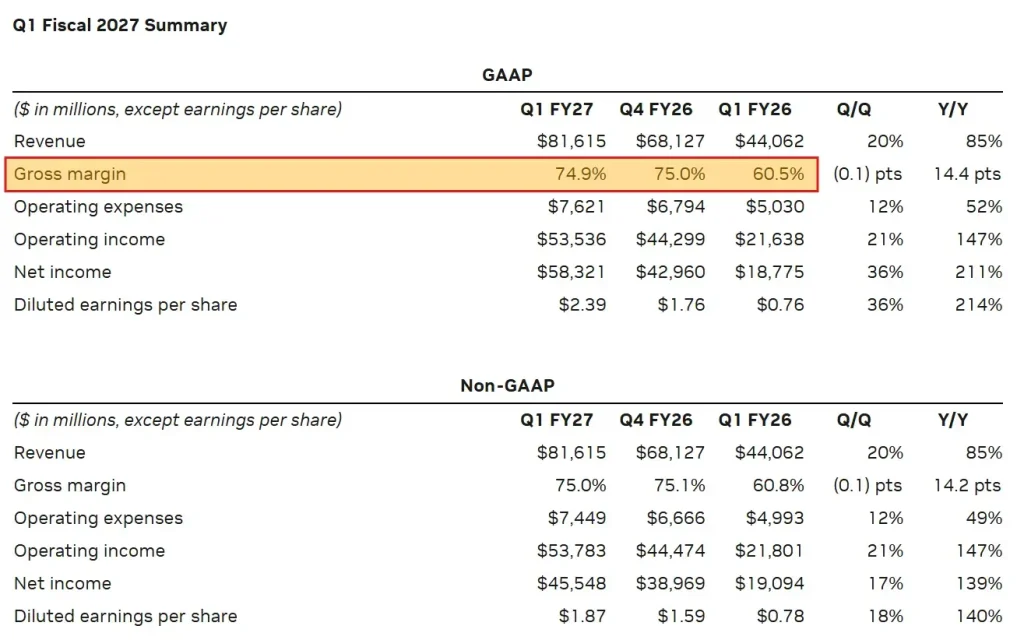
Nvidia delivered another record quarter in Q1. Revenue surged 85% year-on-year to US$81.6 billion, including a record US$75.2 billion from Data Center, up 92%. Non-GAAP earnings reached US$1.87 per share, while GAAP operating income climbed 147% to US$53.5 billion.
Margins remain one of Nvidia’s strongest cushions. GAAP and non-GAAP gross margins stood at 74.9% and 75.0%, respectively. That remains exceptionally high and substantially above year-ago levels, but the margin expansion has started to lose momentum compared with the peaks reached earlier in the AI cycle. With the Blackwell ramp, Vera Rubin development and increasingly complex AI systems adding to the cost base, investors will be watching closely for any sign that extraordinary growth is beginning to demand a higher price.
Source: Nvidia
Nvidia Q2 Earnings Expectations
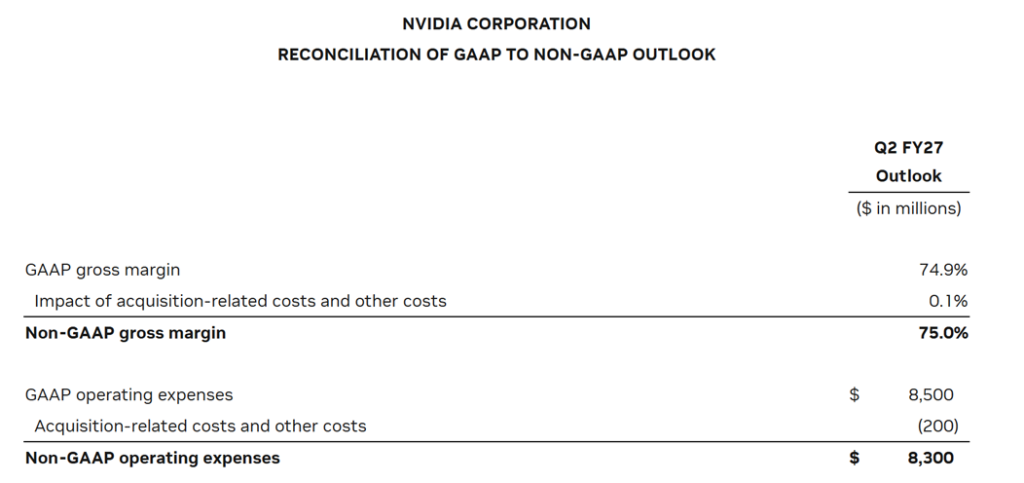
For Q2, Nvidia has guided for revenue of US$91 billion, plus or minus 2%, representing another sizeable sequential increase. GAAP and non-GAAP gross margins are expected at approximately 74.9% and 75.0%, plus or minus 50 basis points. Notably, the guidance assumes no Data Center compute revenue from China, leaving some potential upside if conditions improve but also highlighting the geopolitical constraint hanging over one of Nvidia’s largest potential markets.
Source: Nvidia
The bigger story, however, now extends well beyond Nvidia’s own numbers.
Earlier this month, Nvidia announced partnerships with Apollo, BlackRock, Blackstone, Brookfield, Goldman Sachs and KKR aimed at creating independent financing platforms capable of mobilising more than US$500 billion of third-party capital for AI infrastructure over time. The ambition is significant: turning AI compute into an investable infrastructure asset class and opening the door for institutional capital to fund the next stage of the buildout. The memorandums of understanding remain subject to final agreements.
That could extend the runway for Nvidia’s demand, but it also shows how dramatically the AI funding story is changing. The capital burden is moving beyond hyperscalers and technology companies into private credit, infrastructure funds and the wider financial system. That makes this earnings season a test not only of demand, but of whether the economic returns generated by AI can continue justifying the increasingly large pool of capital chasing it.
For Nvidia, strong revenue alone may no longer be enough. Investors will want evidence that Blackwell demand remains robust, gross margins can stay around the mid-70% level and forward orders are strong enough to support the enormous funding ambition building around the ecosystem.
Nvidia Share Price
Source: Tradingview
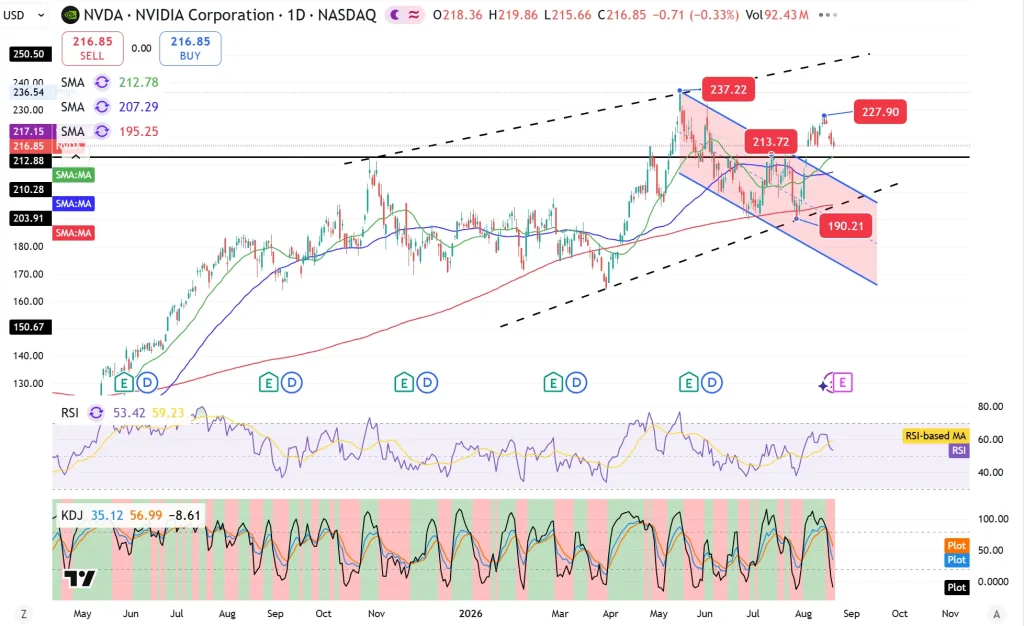
Nvidia shares are trading around the US$210-$220 area at the moment, after pulling back from the recent high near US$237. The broader trend remains constructive, with the stock still holding above its major medium- and long-term moving averages, but momentum has clearly cooled from the previous run.
Initial support sits around US$210–213, where shorter-term moving averages are converging, followed by a stronger support zone around US$195–203.
On the upside, US$228 is the first resistance before the record-high region near US$237. A decisive break above that zone could reopen the bullish trend, while a move below US$210 would leave the shares vulnerable to a deeper reset.
Summary
Nvidia remains the most powerful earnings engine at the centre of the AI buildout, but the financial architecture supporting that boom is becoming much larger and more complicated. Another strong result could provide the market with much-needed solace, but any meaningful crack in margins or forward demand could deliver a far more sobering message about the financial realities behind the AI boom.
Disclaimer: The material provided here has not been prepared in accordance with legal requirements designed to promote the independence of investment research and as such is considered to be a marketing communication. Whilst it is not subject to any prohibition on dealing ahead of the dissemination of investment research we will not seek to take any advantage before providing it to our client. No representation or warranty is given as to the accuracy or completeness of this information and therefore it shouldn’t be relied upon as such. Any research provided does not have regard to specific financial situations, needs or investment objectives. Vantage accepts no responsibility for any use that may be made of these comments and for any consequences that result. Consequently, any person acting on it does so entirely at their own risk. We advise any readers of this material to seek professional advice where necessary. Without the approval of Vantage, reproduction or redistribution of this information isn’t permitted.
-

Open Trading Account
Discover the endless trading possibilities with our cutting-edge platform, designed to empower our traders. Practice trading the markets with a free demo account today.
-

Download Vantage App
Trade on the go with the Vantage All-In-One Trading App, where smooth execution and market access come together in the palm of your hand.
-

Start Trading
Are you an existing user? Login to your account to start trading 1,000+ CFD products including forex, indices, gold, shares and more.