Register
 Login
 Register





Australia’s Economy and Markets: What to Watch for the Rest of 2026

Ludmila Insaurralde >
Market Analyst
Ludmila Insaurralde >
Market Analyst
 Updated Tue, 2026 August 18 03:20

Inflation remains above target, interest rates are at 4.35% and economic growth is losing momentum. With global energy risks and major tax changes ahead, the rest of 2026 could prove increasingly complex for Australian investors.
Australia is facing a difficult economic balancing act
Australia’s economy is entering a more challenging phase. Inflation remains stubbornly above the Reserve Bank of Australia’s target; economic growth has slowed and households are still feeling the effects of higher borrowing and living costs. At the same time, global risks, particularly energy prices and geopolitical uncertainty continue to threaten the inflation outlook.
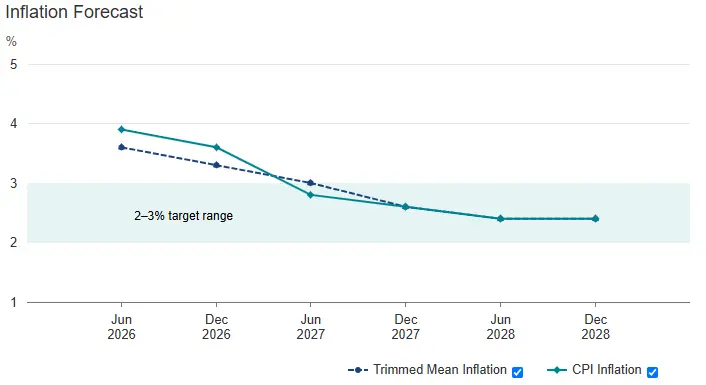
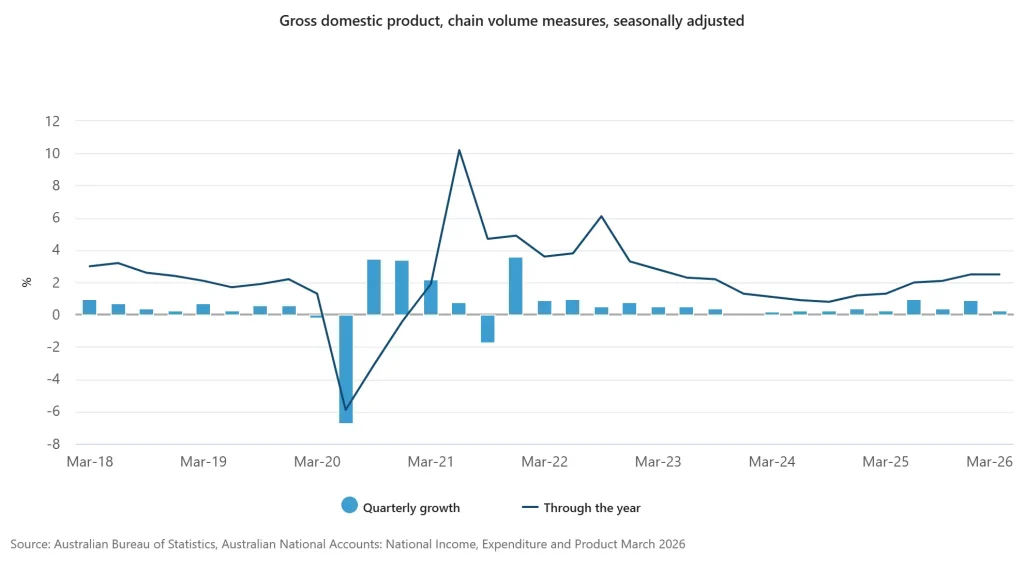
The numbers highlight the problem. Australian GDP expanded just 0.3% in the March quarter, slowing sharply from 0.9% in the December quarter, while GDP per capita declined 0.1%. Meanwhile, headline inflation stood at 3.9% in the June quarter and trimmed mean inflation at 3.6%, leaving underlying price pressures well above the RBA’s 2–3% target.
For the RBA, this creates an uncomfortable trade-off: inflation remains too high to declare victory, but higher interest rates are increasingly weighing on economic activity.
Three rate hikes later, inflation remains the problem
The RBA has already increased interest rates three times in 2026, taking the cash rate to 4.35%, before leaving rates unchanged at its August meeting. The tightening cycle is now flowing through mortgage repayments, borrowing costs and business financing, but inflation is proving slower to retreat than policymakers would like.
The RBA’s August forecasts show inflation returning towards the midpoint of its target only gradually, with underlying inflation expected to reach around 2.5% by early 2028. This suggests the conversation for markets may no longer simply be about when rates will fall. Instead, investors may need to consider how long restrictive monetary policy remains in place, and whether another inflation shock could force the RBA to tighten again.
One potential source of that shock remains energy. Oil prices surged above US$100 earlier in the Middle East conflict before retreating, but geopolitical risks have not disappeared. Higher energy costs also reach much further than petrol prices. The RBA estimates conflict-related costs added a little over 0.1 percentage points to trimmed mean inflation in the June quarter, while road freight costs increased by more than 15% over the quarter.
That matters because higher fuel and transport costs can eventually feed into groceries, construction, manufacturing and other goods and services, making the final stage of Australia’s inflation fight more difficult.
Growth is slowing, but Australia is developing a two-speed economy
Higher rates are already showing up in economic activity. Household consumption increased only 0.5% in the March quarter, while the household saving ratio declined from 7.0% to 6.2%. Consumers remain selective with spending as mortgage costs and elevated prices absorb a larger share of household budgets.
Business investment, however, tells a different story. Private business investment rose 6.0% in the March quarter, driven by a 16.3% jump in machinery and equipment as data-centre expansion accelerated across New South Wales and Victoria. The result is an increasingly two-speed economy: households and rate-sensitive sectors are slowing, while investment continues to flow into technology infrastructure and data centres.
The labour market is also showing signs of gradual cooling. Unemployment stood at 4.4% in June, although employment increased strongly during the month. Some moderation in labour demand could help reduce wage and services inflation, but a sharper deterioration would create another challenge by putting further pressure on household consumption
Australia’s tax landscape is about to change
While inflation and interest rates dominate the immediate outlook, Australian investors also have another major change approaching: a significant overhaul of how some investments are taxed.
From 1 July 2027, the government plans to restrict negative gearing on residential property largely to new builds and replace the 50% capital gains tax discount with inflation-based indexation alongside a minimum 30% tax rate on capital gains. A separate 30% minimum tax for discretionary trusts is due to apply from 1 July 2028, with some exceptions. The reforms could have implications not only for property investors, but also for how Australian capital is allocated across different assets and investment structures.
This is particularly relevant at a time when investors are already navigating higher interest rates and slower growth. Changes to the relative tax treatment of income and capital gains could potentially influence the appeal of property, dividend-paying shares, growth companies and different investment structures.
What does it mean for Australian markets?
For the ASX 200, the outlook is becoming increasingly sector-specific. Banks could benefit from elevated rates but face the counterweight of weaker credit demand and potentially higher bad debts if the economy deteriorates. Resources remain closely tied to China and global commodity demand, while energy companies remain sensitive to geopolitical developments and oil prices. Consumer-facing businesses, meanwhile, remain exposed to pressure on household spending.
The Australian dollar faces a similar tug-of-war. Higher domestic interest rates can provide support through yield differentials, but weaker Australian growth and deteriorating global risk sentiment can work in the opposite direction. China, commodity prices and expectations for the RBA will therefore remain important drivers.
Gold could also remain sensitive to the same forces, with persistent inflation and geopolitical uncertainty supporting safe-haven demand, while higher-for-longer interest rates may provide a counterweight. For Australian investors, AUD/USD movements add another layer to local gold-price dynamics.
The bigger picture
Australia isn’t simply dealing with slower growth. It is dealing with slower growth while inflation remains too high, a much more difficult environment for policymakers and markets. Add elevated interest rates, geopolitical energy risks, changing investment taxation and an increasingly uneven domestic economy, and the second half of 2026 could look very different from the first.
For markets, the key question is whether inflation can fall fast enough to give the RBA room to eventually ease policy without the economy weakening significantly first. The answer could help determine the next major direction for Australian equities, the Australian dollar and interest-rate expectations.
Disclaimer: The material provided here has not been prepared in accordance with legal requirements designed to promote the independence of investment research and as such is considered to be a marketing communication. Whilst it is not subject to any prohibition on dealing ahead of the dissemination of investment research we will not seek to take any advantage before providing it to our client. No representation or warranty is given as to the accuracy or completeness of this information and therefore it shouldn’t be relied upon as such. Any research provided does not have regard to specific financial situations, needs or investment objectives. Vantage accepts no responsibility for any use that may be made of these comments and for any consequences that result. Consequently, any person acting on it does so entirely at their own risk. We advise any readers of this material to seek professional advice where necessary. Without the approval of Vantage, reproduction or redistribution of this information isn’t permitted.
-

Open Trading Account
Discover the endless trading possibilities with our cutting-edge platform, designed to empower our traders. Practice trading the markets with a free demo account today.
-

Download Vantage App
Trade on the go with the Vantage All-In-One Trading App, where smooth execution and market access come together in the palm of your hand.
-

Start Trading
Are you an existing user? Login to your account to start trading 1,000+ CFD products including forex, indices, gold, shares and more.