Register
 Login
 Register





RBA Meeting Preview: A March Hike or May Hike. That’s a Question.

Hebe Chen >
Senior Market Analyst
Hebe Chen >
Senior Market Analyst
 Updated Fri, 2026 March 13 09:15

The RBA has made its position crystal clear.
Inflation pressures re-accelerated in the second half of 2025, capacity constraints are resurfacing and the labour market remains historically tight. February’s move to lift the cash rate to 3.85% was not a one-off adjustment — it marked the reopening of a tightening cycle.
The next question isn’t whether another hike is coming. It’s when.
The RBA’s own forecasts project underlying inflation peaking near 3.7% in mid-2026, with price growth remaining above the 2–3% target band well into 2028. That profile is difficult to reconcile with a central bank that is finished tightening. Governor Michele Bullock has repeatedly signalled discomfort with inflation persisting above target, and the February meeting minutes reinforced that message, noting that risks to both inflation and the labour market had shifted in a direction warranting tighter policy.
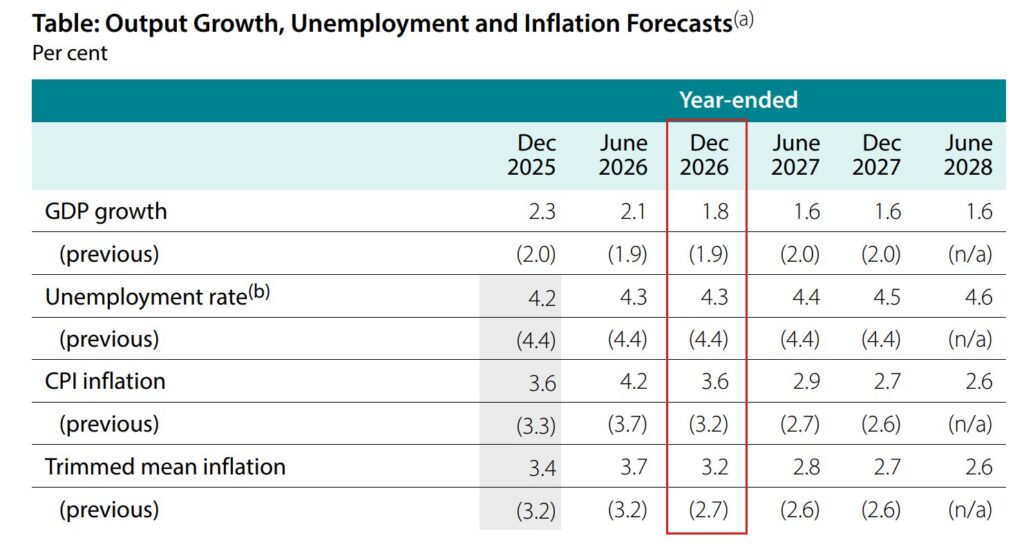
Source: RBA February Monetary Policy Statement
A further increase in the cash rate therefore remains firmly on the table. The question facing policymakers and anxious investors is simply whether the next step arrives in March or in May.
The Case for March
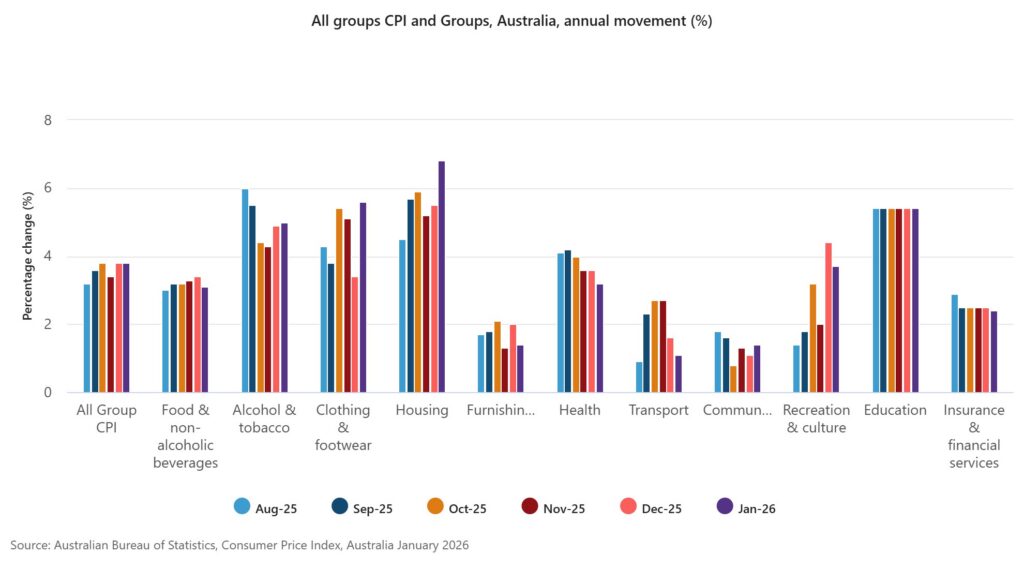
The hawks will argue: why wait? The January 2026 CPI data is a toxic cocktail. Housing inflation surged to nearly 6.8% — the highest reading in the series — with alcohol, tobacco, clothing and education all running hot above 5%. The contribution chart tells the same story. Housing, health, and recreation are doing the heavy lifting on the upside, and there’s no sign of relief. Underlying pressures are broadening, not narrowing. Every month the RBA holds, it risks letting expectations drift. A March move signals conviction. It anchors credibility.
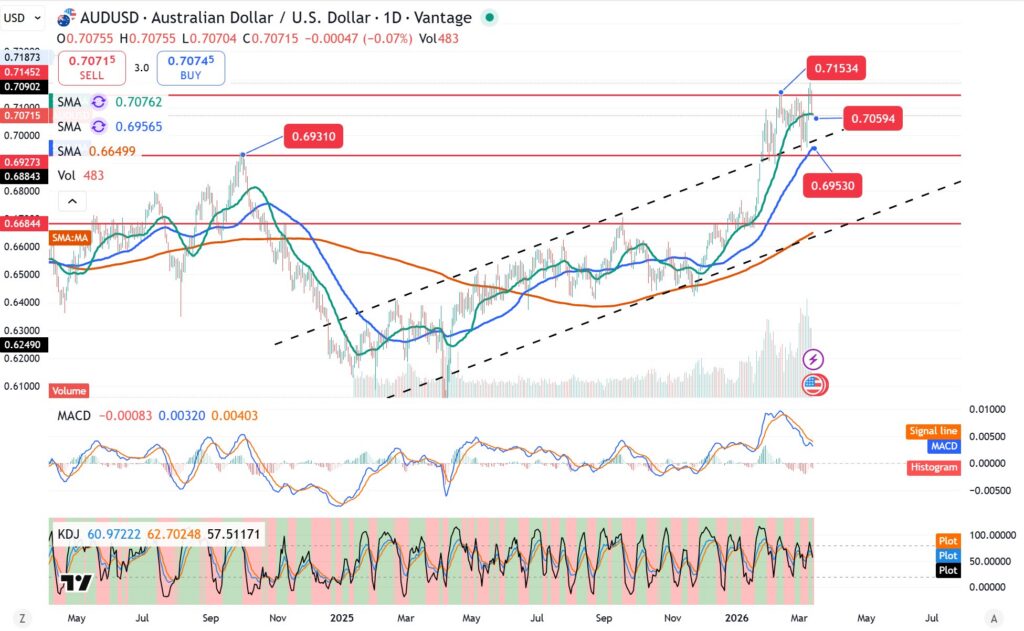
The AUD dynamic also matters. The currency has rallied sharply from 0.6249 lows all the way to a three-year high above 0.7100 — a near-vertical repricing that partly reflects the market’s hawkish re-rating of the RBA. Holding policy steady in March could temper that momentum and risk sending a signal that external volatility is influencing the Board’s reaction function even as domestic inflation remains elevated.
The Case for May
The dovish case centres on uncertainty and central bank’s data-dependent policy transmission.
The escalation of geopolitical tensions in the Middle East has introduced a genuine wildcard. Higher energy prices could add modest upward pressure to headline inflation in the near term. However, CBA economists estimate that even if Brent crude remained elevated through the first quarter, fuel costs alone would add only around 0.1 percentage points to CPI. That represents a supply shock rather than a signal of domestic demand overheating — precisely the type of “transitory” volatility central banks typically look through.
More importantly, monetary policy works with long and variable lags. The cumulative tightening delivered over the past two years is still filtering through the economy. Household consumption softened late in 2025, and wage growth has yet to show a fresh acceleration.
Waiting until May would also give the Board access to the Q1 CPI release, due in late April — the cleanest signal of whether underlying inflation pressures are genuinely becoming entrenched or beginning to moderate.
In that sense, May provides policymakers with both more data and more clarity.
What the Market Says
Futures currently price roughly 66% probability of a March hike, with an 80% implied chance of May being live regardless of what happens next week.
NAB, CBA and Westpac all anticipate another 25 bp hike in May 2026, taking the cash rate to 4.10%. ANZ stands apart, still treating February’s increase as the peak of the tightening cycle.
That distribution suggests markets have partially priced a March move, but still treat May as the higher-conviction meeting.
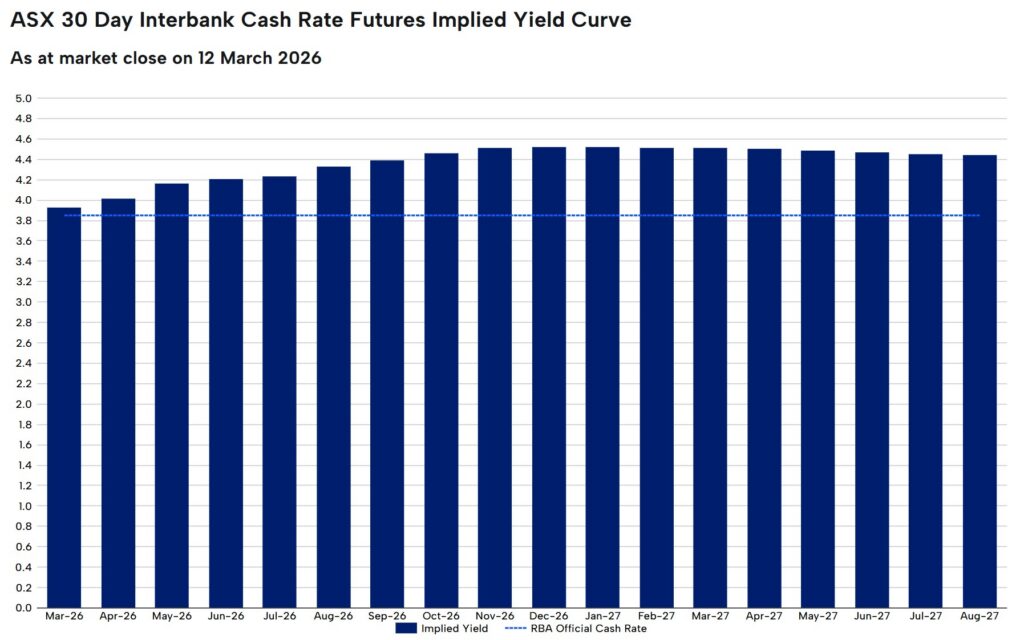
Source: ASX Rate Tracker
AUD Technical Picture
The chart is constructive, but stretched. AUD/USD has broken decisively above the 0.6956 resistance, cleared both the 20-day and 200-day SMA, and posted a cycle high at 0.7153. The upward channel is intact. But MACD momentum is rolling over after an extended run, and the KDJ oscillator is cycling lower from overbought territory. A pullback to the 0.6953–0.7059 zone would be technically healthy. A March hold could trigger that reset. A March hike keeps the rally alive and puts 0.7200+ in play.
The bottom line: the RBA is in a tightening posture with no off-ramp yet visible. Whether they pull the trigger in March or May, the direction is the same. The only question is whether Bullock blinks at geopolitical noise — or treats it as exactly the kind of short-term volatility the Board was built to look through.
My call: May is the higher-conviction trade. But don’t sleep on March.
Disclaimer: The material provided here has not been prepared in accordance with legal requirements designed to promote the independence of investment research and as such is considered to be a marketing communication. Whilst it is not subject to any prohibition on dealing ahead of the dissemination of investment research we will not seek to take any advantage before providing it to our client. No representation or warranty is given as to the accuracy or completeness of this information and therefore it shouldn’t be relied upon as such. Any research provided does not have regard to specific financial situations, needs or investment objectives. Vantage accepts no responsibility for any use that may be made of these comments and for any consequences that result. Consequently, any person acting on it does so entirely at their own risk. We advise any readers of this material to seek professional advice where necessary. Without the approval of Vantage, reproduction or redistribution of this information isn’t permitted.
-

Open Trading Account
Discover the endless trading possibilities with our cutting-edge platform, designed to empower our traders. Practice trading the markets with a free demo account today.
-

Download Vantage App
Trade on the go with the Vantage All-In-One Trading App, where smooth execution and market access come together in the palm of your hand.
-

Start Trading
Are you an existing user? Login to your account to start trading 1,000+ CFD products including forex, indices, gold, shares and more.