Register
 Login
 Register





FOMC meeting preview: A Half-Blind Decision with Eyes on 2026

Hebe Chen >
Senior Market Analyst
Hebe Chen >
Senior Market Analyst
 Updated Wed, 2025 December 10 03:07

The Federal Reserve’s final meeting of the year is set for December 9–10 — and unusually, it may be one of the most consequential in recent years. Uneven growth, missing economic inputs, and elevated political noise leave policymakers heading into the decision table only partially informed, yet fully aware that their messaging could reset expectations for 2026.
A 25-Basis-Point Cut: The Path of Least Resistance
The Fed’s September projections guided the federal funds rate around 3.6% by year-end. After back-to-back cuts in September and October, the benchmark now stands at 3.75%–4.00%, meaning another quarter-point reduction this week would neatly align policy with that forecast.
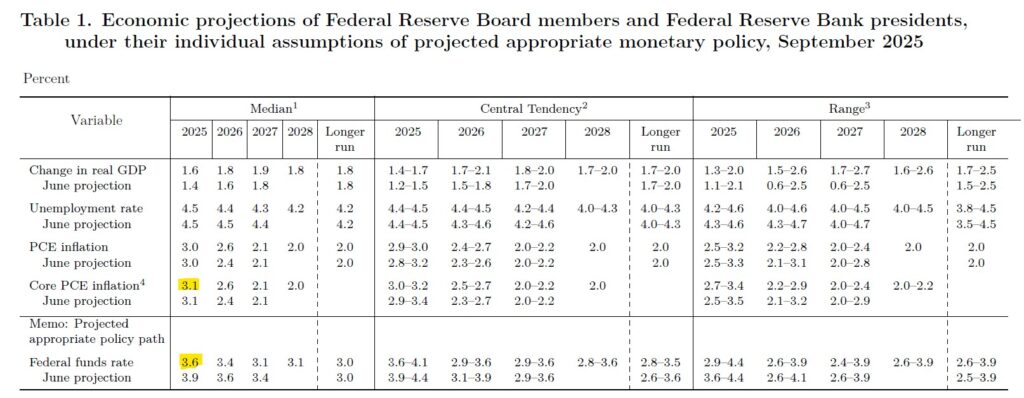
Source: FOMC
From an economic standpoint, there’s little reason to deviate. The latest core PCE price index, the Fed’s preferred inflation gauge, held steady at 2.8% y/y in September — comfortably within the central bank’s forecast zone. Meanwhile, wage pressures continue to ease, and activity indicators show neither recessionary urgency nor overheating pressure.
Market pricing tells the same story: futures traders assign roughly an 88% probability of a December cut, according to the CME FedWatch Tool.
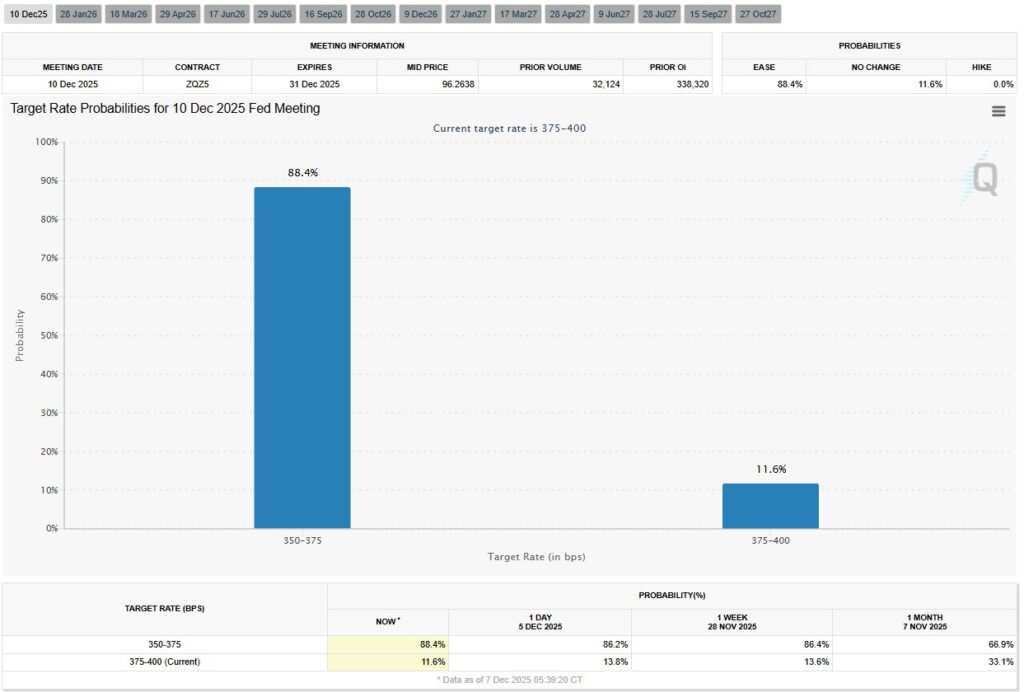
Source: CME FedWatch
Flying Half-Blind into the Decision and Projection
What complicates this meeting is not the rate — it’s the information vacuum behind it.
The 43-day government shutdown froze key data collection, eliminating October’s employment and inflation reports entirely. November’s figures — jobs on December 16 and inflation on December 18 — will only surface after the Fed votes.
In practice, a central bank that brands itself as data-dependent is being forced into a half-blind decision. Policymakers must lean harder on private-sector inputs, credit surveys, and market-based expectations — indicators that illuminate direction but not precision.
This elevates the communication risk and the probability of policy error, as the most-watched projection for 2026 will be set without a single official employment or inflation datapoint from Q4 2025.
The December Combo — Three Scenarios, Three Possible Market Reactions
Markets are already braced for a small policy move, but tone and projections could define very different outcomes:
1. No Cut + Data-Dependent Guidance
If the Fed pauses to await the missing data, it would likely lean into a “wait-and-see” message. Such a move would reinforce the independence narrative — a deliberate pause despite political pressure to ease faster — but it also shifts the weight of market reaction to the projections and the press conference, rather than the rate decision itself.
Possible Market Reaction:
- Equities could retreat, reflecting caution
- USD: Likely to strengthen on higher real-rate expectations
- Gold & Crypto: Would face short-term pressure as liquidity bets fade
2. Hawkish Cut + Unchanged 2026 Projection
A 25-bps reduction paired with unchanged dots (only one more cut in 2026) would be seen as a “hawkish cut.” This would signal that the Fed sees inflation risks as uncertain and is cutting only to stay aligned with its September trajectory.
Possible Market Reaction:
- Equities: Likely a risk-off tone; equities soften.
- USD: Supported by expectations that easing will stay limited.
- Gold & Crypto: Slip modestly as yields hold firm.
3. Neutral Cut + Additional Cuts in 2026
If policymakers trim rates and revise their 2026 projection lower — signalling a broader easing cycle — markets would quickly reprice. Such guidance would suggest confidence that inflation is under control and policy can shift toward supporting growth.
Possible Market Reaction:
- Equities and bonds rally
- USD: Weakens towards October low
- Commodities & Crypto: Jump on improved risk appetite and dollar weakness
Bottom Line
The December FOMC isn’t just a policy call — it’s a test of judgement in the absence of verification. Making a half-blind decision will expose how comfortable the Fed is relying on judgement over data. For investors, the difference between a cautious “one-and-done” move and an early signal of a 2026 easing path could define how markets close out 2025 — and set the tone for the year ahead.
Disclaimer: The material provided here has not been prepared in accordance with legal requirements designed to promote the independence of investment research and as such is considered to be a marketing communication. Whilst it is not subject to any prohibition on dealing ahead of the dissemination of investment research we will not seek to take any advantage before providing it to our client. No representation or warranty is given as to the accuracy or completeness of this information and therefore it shouldn’t be relied upon as such. Any research provided does not have regard to specific financial situations, needs or investment objectives. Vantage accepts no responsibility for any use that may be made of these comments and for any consequences that result. Consequently, any person acting on it does so entirely at their own risk. We advise any readers of this material to seek professional advice where necessary. Without the approval of Vantage, reproduction or redistribution of this information isn’t permitted.
-

Open Trading Account
Discover the endless trading possibilities with our cutting-edge platform, designed to empower our traders. Practice trading the markets with a free demo account today.
-

Download Vantage App
Trade on the go with the Vantage All-In-One Trading App, where smooth execution and market access come together in the palm of your hand.
-

Start Trading
Are you an existing user? Login to your account to start trading 1,000+ CFD products including forex, indices, gold, shares and more.