
-

-


Download App
-


-

-

-
Search query too short. Please enter a full word or phrase.
-

Keywords
- Forex Trading
- Vantage Rewards
- Spreads
Popular Search
- Trading Accounts
- MT4
- MT5
- Copy Trading
- Promotions





Language


Economic News TodayFeatured NewsFederal Reserve NewsForex NewsInterest Rate NewsMarket News TodayTrending NewsUSD NewsUSDX NewsVantage News
What the Fed’s July Decision Means for USD Pairs

Vantage Editorial Team >
21 August 2026 | Market Analysis | 14 min read
Vantage Editorial Team >
Vantage is a global, multi-asset broker with a team of in-house writers and market analysts who produce educational and insightful trading content for traders of all levels.
The Fed held rates at 3.50%–3.75% on 29 July 2026 as three regional presidents dissented for a hike, not a cut. Markets read the hold as removing hike risk, and USD pairs, led by EURUSD, moved accordingly. September’s meeting is now the one to watch.
Here’s the strange part about the Fed’s 29 July FOMC decision: the Committee held rates exactly where everyone expected, and USD pairs still moved. That’s the tell that something more interesting than a simple hold happened underneath.
Three regional Federal Reserve presidents, Beth Hammack of Cleveland, Neel Kashkari of Minneapolis, and Lorie Logan of Dallas, dissented in favour of a quarter-point hike rather than a cut. The last time three FOMC members leaned the same hawkish direction on a single vote was September 2016. [1][2]
As of 08:00 UTC / 16:00 (GMT+8) on 21 August 2026, that vote split is still the reference point USD pairs are trading around ahead of the next FOMC meeting, a two-day session scheduled for 15–16 September 2026 that will include a fresh Summary of Economic Projections. [3]
This piece breaks down the FOMC rate decision itself, what CME FedWatch and the wider market are now pricing for September, and how the US dollar rate and its major crosses actually reacted. If you’re checking in on federal reserve news today, this is the throughline: a FOMC interest-rate decision that held on paper but still moved the US dollar/USDX – index underneath it. Every price reference below is past tense or present positioning; nothing here is a forecast.
Key points
- The FOMC voted 9–3 to hold the federal funds rate at 3.50%–3.75% on 29 July 2026, with three regional presidents dissenting in favour of a quarter-point hike, not a cut.
- July wasn’t a Summary of Economic Projections meeting, so markets are still working from June’s dot plot until the next fomc minutes and fresh projections land on 16 September 2026.
- The US Dollar Index traded near 101.2 in the hours before the decision and eased afterwards, while EURUSD pushed into the upper 1.1470s and held most of that move.
- For FOMC news and Federal Reserve interest rates tracking beyond this piece, September 16 2026 is the date that matters most.
Before and after: how the decision reshuffled the picture
If you only have time for one table, make it this one. It lines up where things stood heading into the statement against where they landed once the dust settled.
| Metric | Before the 29 July decision | After the 29 July decision |
| Fed funds target range | 3.50%–3.75% (unchanged since the prior meeting) | 3.50%–3.75% (held, 9–3 vote) |
| Hike odds priced for the meeting | Roughly one-in-three, per futures pricing [6] | Resolved to zero; focus shifts to 16 September |
| USDX (DXY) | 101.208, below its 50- and 200-period moving averages [6] | Eased from pre-decision levels as hike risk unwound |
| EURUSD | Capped below a level it had tested for about a week | 1.14578, above both its 50- and 200-period moving averages [7] |
| Dissent direction | N/A | 3 members wanted to hike; first same-direction 3-vote split since Sept 2016 [1][2] |
Table 1: Levels and positioning as reported in the sourced articles. Sources: Vantage USDX and EURUSD CFD analysis, CME FedWatch. Indicative only, not trade signals.
What the Fed decided and how the vote broke down
Quick refresher for anyone still parsing the FOMC meaning behind the acronym: it stands for the Federal Open Market Committee, the rate-setting arm of what is the US Federal Reserve system, the US central bank. The FOMC sets the federal funds rate, the benchmark that ripples through everything from mortgage costs to what USD pairs do on a Wednesday afternoon. Talk of federal reserve rate cuts, and federal reserve interest rate cuts more broadly, has faded for now; this cycle’s live debate is whether the Committee needs to hike, not ease.
At this meeting, the Committee kept the target range at 3.50%–3.75%, saying economic activity was expanding at a solid pace despite elevated uncertainty it linked, in part, to the conflict in the Middle East. Job gains were described as keeping pace with the workforce; inflation was described as elevated relative to the Committee’s 2% goal, partly reflecting supply shocks in certain sectors, including energy. [4]
The 9–3 vote is unusual for what it wasn’t: a split over easing. All three dissents favoured tightening further, not loosening, the reverse of the more familiar pattern where dissenters push for cuts. Fed Chair Kevin Warsh, who has favoured shorter statements since taking the chair in May 2026, called the internal debate “a real family fight,” and didn’t pretend the disagreement wasn’t there. [5]
Ian Lyngen, head of U.S. rates at BMO Capital Markets, summed up the mood bluntly: “We’re reading this as a Committee with vocal hawks,” he said of the split. [2]
That reading lines up with where J.P. Morgan’s house view had already landed months earlier. Chief U.S. economist Michael Feroli wrote in a 9 January client note: “We now expect the Fed to hold rates throughout 2026,” with the bank penciling in the next move as a hike rather than a cut, a standing call that looked increasingly on the mark by the time the July dissents landed. [10]
July isn’t one of the four 2026 meetings with an updated dot plot, so there’s no fresh projection to parse from this decision alone. The Committee’s most recent projections, from June, penciled in one additional quarter-point increase by year-end, a reminder that this cycle’s live debate is about whether the Fed needs to tighten further, not when it might ease. [3][4]
What markets are now pricing (CME FedWatch, dated)
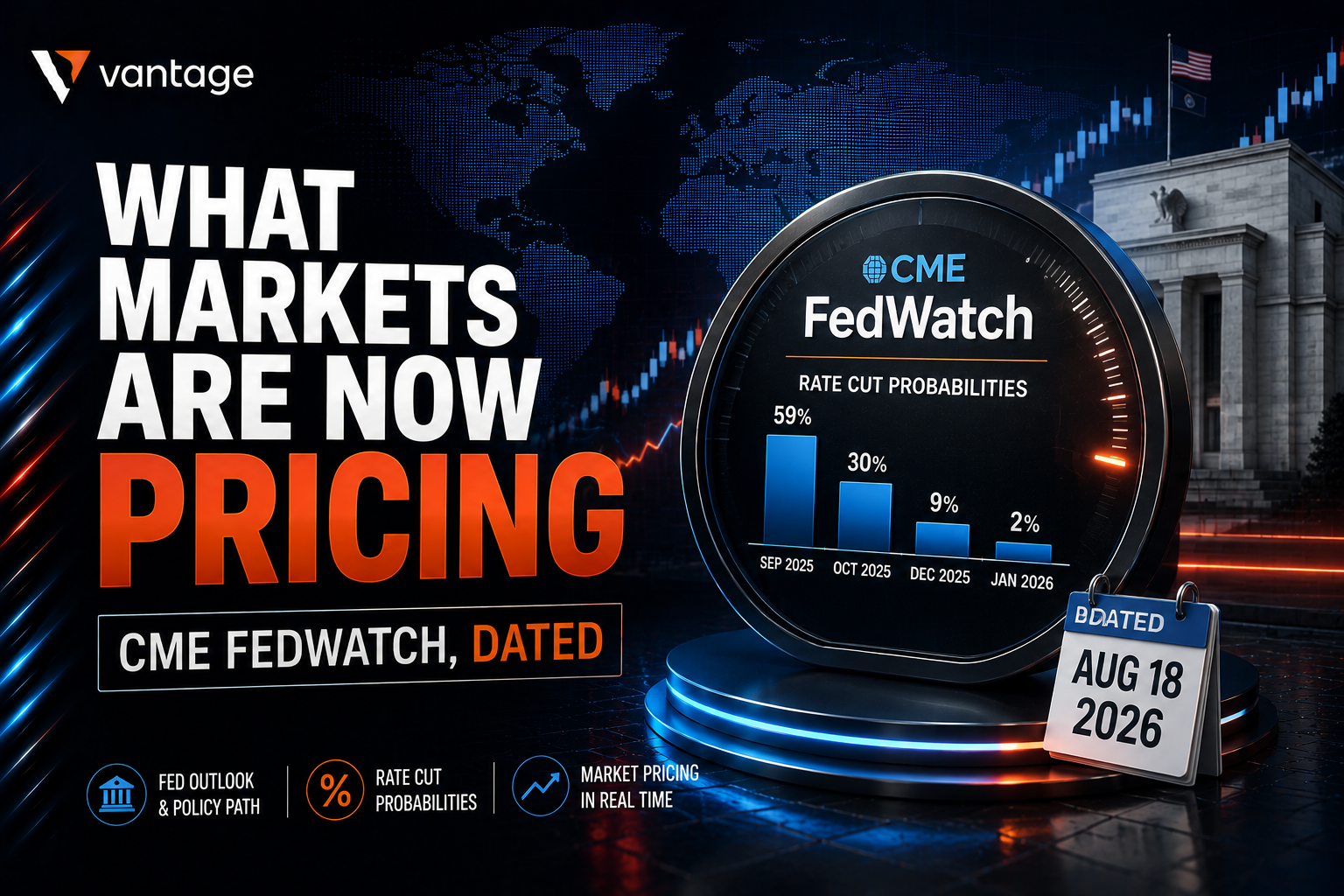
Heading into the July decision, futures-implied pricing had the odds of a hike at that meeting around one-in-three, with a higher probability assigned to a possible move in September, consistent with firmer US data and the hawkish tilt in the Fed’s June projections. [6]
With July resolved as a hold, attention has shifted entirely to 15–16 September and its accompanying Summary of Economic Projections. As of the third week of August 2026, CME FedWatch data pointed to a hold as the more likely September outcome, though hike pricing was still running meaningfully above zero given the inflation backdrop tied to elevated energy costs. [8]
Futures-implied pricing like this moves daily as new data lands, so the figure above is a snapshot, not a forecast; check CME’s FedWatch tool directly before publication for the live read. Vantage isn’t predicting what the Committee decides in September, only reporting what the market, collectively, is pricing right now. [8]
How USD pairs reacted
The US Dollar Index (DXY) traded near 101.208 as of 10:07 (GMT+8) / 02:07 UTC on 29 July 2026, sitting just below both its 50- and 200-period moving averages, a position that reads like a market waiting for the statement rather than betting on it. [6]
EURUSD moved with more conviction. The pair broke through a level that had capped it for roughly a week and held most of that gain into the next session, trading at 1.14578 as of 01:17 GMT on 30 July, above both its 50-period (1.13941) and 200-period (1.14293) moving averages. Its 14-period RSI eased to 55.35 against an RSI moving average of 64.42, consistent with the initial burst of momentum cooling even as price held its ground. [7]
The dollar softening despite three hawkish dissents isn’t really a contradiction once you separate the signal from the vote count. What markets had priced in heading into the meeting mattered more than what the Committee actually did; the hold removed hike risk that had built up beforehand, and price action responded to that removal rather than to the dissents themselves. [7]
USDJPY told a smaller version of the same story, easing roughly 0.3% intraday as the yen found a little breathing room, though the pair’s broader uptrend, and Japan’s standing intervention risk, stayed firmly in the background. [9]
Risk considerations and what to watch next
FOMC decisions are exactly the kind of event that can move USD pairs sharply within minutes of the statement and the press conference that follows it. Standard intraday range assumptions carry less weight in that window than on an ordinary session.
The calendar between now and the next decision is dense: US CPI and PCE inflation prints, plus further labour-market data, will land before the Committee meets again, each capable of shifting how much weight the market puts on June’s projections. The 15–16 September meeting is the next point where that gets tested directly. [3]
On risk management: with the DXY sitting close to both its major moving averages and USD pairs reacting quickly to Fed headlines, Stop Loss placement is worth revisiting against the ranges each pair has shown around this decision. A Stop Loss doesn’t prevent a loss; it limits losses to a planned size, and that discipline matters more, not less, when one scheduled event can move several correlated USD pairs at once. Anyone holding more than one dollar pair should check combined exposure rather than looking at each position on its own.
Leverage stays double-edged around events like this one: it magnifies gains as easily as losses, without preference for either. Position sizing relative to account equity, rather than conviction about the Fed’s next move, remains the steadier approach heading into September and the data prints along the way.
Internal reading: What Is the US Dollar Index (DXY)? · What Are Non-Farm Payrolls (NFP)? · What Is a Stop Loss? · What Is Leverage in Trading?
Related coverage: USD News · USDX News · Federal Reserve News · EURUSD News · USDJPY News · GBPUSD News
RISK WARNING: CFDs are complex financial instruments and carry a high risk of losing money rapidly due to leverage. You should ensure you fully understand the risks involved and carefully consider whether you can afford to take the high risk of losing your money before trading.
Disclaimer: The information is provided for educational purposes only and doesn’t take into account your personal objectives, financial circumstances, or needs. It does not constitute investment advice. We encourage you to seek independent advice if necessary. The information has not been prepared in accordance with legal requirements designed to promote the independence of investment research. No representation or warranty is given as to the accuracy or completeness of any information contained within. This material may contain historical or past performance figures and should not be relied on. Furthermore estimates, forward-looking statements, and forecasts cannot be guaranteed. The information on this site and the products and services offered are not intended for distribution to any person in any country or jurisdiction where such distribution or use would be contrary to local law or regulation.
References
[1] “2026 FOMC Press Releases – Board of Governors of the Federal Reserve System” https://www.federalreserve.gov/newsevents/pressreleases/2026-press-fomc.htm Accessed on 21 August 2026.
[2] “Fed rate decision July 2026: Divided Fed holds interest rates steady – CNBC” https://www.cnbc.com/2026/07/29/fed-rate-decision-july-2026.html Accessed on 21 August 2026.
[3] “September 2026 – Federal Reserve Board Calendar” https://www.federalreserve.gov/newsevents/2026-september.htm Accessed on 21 August 2026.
[4] “Fed’s Interest Rate Decision: July 29, 2026 – Advisor Perspectives” https://www.advisorperspectives.com/dshort/updates/2026/07/29/feds-interest-rate-decision-july-29-2026 Accessed on 21 August 2026.
[5] “Fed meeting recap: July 2026 – CNBC” https://www.cnbc.com/2026/07/29/fed-meeting-today-live-updates.html Accessed on 21 August 2026.
[6] “US Dollar Index (DXY): Below Key Averages Before Fed Decision – Vantage Markets” https://vantagemarektsdev.canglankeji.com/market-analysis/us-dollar-index-dxy-today-fed-decision-july-29-2026/ Accessed on 21 August 2026.
[7] “EURUSD Forecast Today: Euro Jumps After Fed Holds Rates – Vantage Markets” https://vantagemarektsdev.canglankeji.com/market-analysis/eurusd-forecast-today-euro-fed-hold-july-30-2026/ Accessed on 21 August 2026.
[8] “FedWatch Tool – CME Group” https://www.cmegroup.com/markets/interest-rates/cme-fedwatch-tool.html Accessed on 21 August 2026.
[9] “Post-FOMC USD Price Action Setups: EUR/USD, USD/JPY – Forex.com” https://www.forex.com/en-sg/news-and-analysis/post-fomc-usd-price-action-setups-eur-usd-usd-jpy/ Accessed on 21 August 2026.
[10] “J.P. Morgan Predicts the Fed Will Make No Interest Rate Cuts in 2026 – Yahoo Finance” https://finance.yahoo.com/news/j-p-morgan-predicts-fed-035700750.html Accessed on 21 August 2026.
Key Points In This Article

Latest Financial Market News


Market News Tags
- # USD News
- # USDCAD News
- # USDJPY News
- # USDX News
- # Forex News
- # Forex News Today
- # GBPUSD News
- # EURUSD News
- # Currency Trading News
- # AUDUSD news
Related Articles
- US Dollar Index Falls to 98.55 as Yields Ease, Fed Splits
- [DAILY TRADING] Pfizer Stock Price Today 21 August 2026 – $27.82 After CEO’s $1M Share Purchase
- [DAILY TRADING] AUD/USD Analysis 21 August 2026 — AUD/USD Hits 0.7150 as Dollar Slides, Aussie Jobs Miss
- [DAILY TRADING] Nasdaq 100 21 August 2026 – Climbs Back to 29,347 as Wall Street Waits on Jackson Hole
- PLTR Stock Price Today: August 2026 Chart Breakout & Key Levels
- [DAILY TRADING] Oracle Stock 21 August 2026 – ORCL Holds $142 as Pipeline Delay Meets Debt Fears
- [DAILY TRADING]: EUR/USD Analysis 21 August 2026 — EUR/USD Holds 1.1697, Near 3-Month High, ECB Hike Bets Firm
- [DAILY TRADING] Alibaba 21 August 2026 – BABA Stock Price Rebounds to $130.57 After Earnings Miss