






 Updated
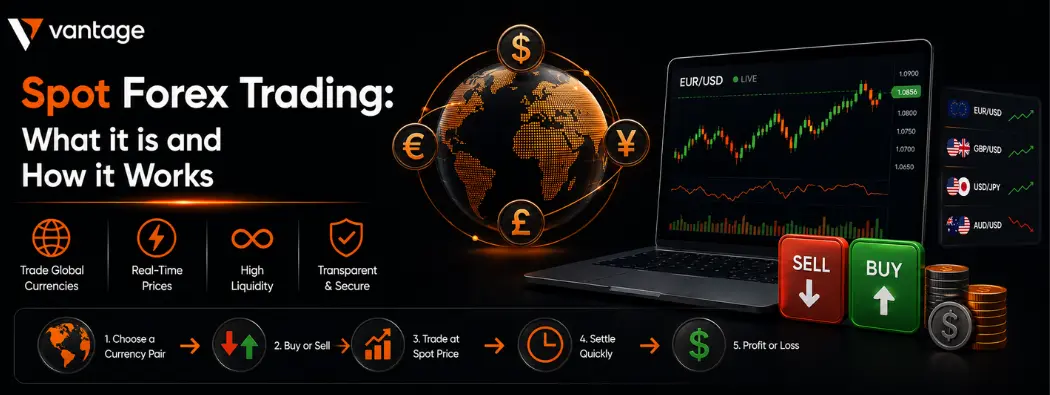
The spot market for forex trading involves the direct purchase or sale of currencies at current prices.
To reiterate, traders are exchanging one currency for another. They engage in this because they believe that one currency is appreciating or depreciating against the other.
Let’s look at it this way: if a trader thinks that the euro will appreciate against the US dollar, they may buy EUR/USD. If they believe the euro will lose value when compared to the US dollar, they may sell EUR/USD.
Spot, the trade occurs at the current in-time rate (exchange). Spot FX transactions in the formal FX market are generally settled via actual currency delivery two business days later.
In retail trading, by contrast, many who claim to trade ‘spot forex’ are really trading leveraged products that track currency prices. They are not usually taking delivery of real euros, pounds, dollars, or yen.
That difference matters. It influences the costs, risk, settlement, and mechanics of the trade.
Key takeaways
- Spot forex is one type of forex transaction based on current exchange rates and near-term settlement.
- Traders widely use spot forex for its high activity, weekday access, two-way price exposure, broad currency coverage, and role in global trade.
- Forex trading is a broad category; spot forex is one type within that market.
- It is linked to currency exchange, while CFDs track price movements through derivative contracts.
- Spot forex focuses on current rates; forwards lock in a rate for a future date.

What Is Spot FX Trading?
Spot forex trading means the purchase of currency ‘on the spot’; that is, the exchange of one currency for another, which takes place at the exact point a trade settles.
Forex stands for foreign exchange. It is the global market where currencies are bought and sold. Currencies are always traded in pairs. One currency is bought, while the other is sold.
For example
| Currency Pair | Meaning |
| EUR/USD | Euro against the dollar |
| GBP/USD | British pound against the dollar |
| USD/JPY | US dollar against the Japanese Yen |
| USD/CAD | US Dollar against the Canadian dollar |
| AUD/USD | Australian dollar against the US dollar |
If EUR/USD is trading at 1.0900, one euro is worth 1.0900 US dollars.
A trader who buys EUR/USD expects the euro to rise against the dollar. A trader who sells EUR/USD expects the euro to fall against the dollar.
Why Spot Forex Trading Matters
The forex market is vast, which is why it is regarded as one of the world’s largest financial markets. A Triennial survey conducted in 2025 shows that global over-the-counter (OTC) FX trading is valued at trillions of dollars in daily transactions. Spot FX accounts for a significant share of the overall turnover.
This size draws in banks, corporations, funds, central banks, and retail traders.
The large firms may operate in the spot forex market to manage currency risk. An importer, for instance, may be buying goods from a supplier and thus requires US dollars. An international firm might convert overseas sales into its domestic currency.
But retail traders typically trade spot forex to speculate on price movements. They try to profit from short-term or long-term changes in currency values.
How Spot Trading Works
Spot forex trading allows market participants to trade in two directions.
A trader may buy a currency pair when expecting the base currency to rise against the quote currency. A trader may sell a currency pair when expecting the base currency to fall against the quote currency.
Trading takes place through currency pairs, such as EUR/USD, GBP/USD, and USD/JPY.
In any given currency pair, the first currency is usually called the base currency, while the second is called the quote currency.
For example, a EUR/USD price of 1.1000 means one euro equals 1.1000 US dollars.
Prices in the spot forex market are shown with a bid and an ask. The bid is the price available for selling the base currency. The Ask Price is the price at which the base currency can be bought. The gap between the two prices is known as the spread.
Forex price changes are commonly measured in pips. For most currency pairs, one pip is the fourth number after the decimal point.
A move in EUR/USD from 1.1000 to 1.1001 equals one pip. For yen-based pairs, one pip is usually the second number after the decimal point.
Trade size is usually measured in lots. In forex, a standard lot represents 100,000 units of the base currency in a pair. Smaller sizes include mini lots, micro lots, and nano lots. The lot size affects how much each pip movement is worth.
Liquidity is an important feature of the spot forex market. Major currency pairs tend to have deeper liquidity because they attract high trading activity from banks, companies, funds, and retail traders.
Example of a Spot Forex Trade
A spot forex trade can be explained using the EUR/USD currency pair. Assume EUR/USD is quoted as:
| Price type | Price |
| Bid | 1.000 |
| Ask | 1.1002 |
| Spread | 2 pips |
The bid is the price at which EUR/USD can be sold. The ask is the price at which to buy EUR/USD. The spread is 2 pips.
A trader expects the euro to rise against the US dollar. Based on that view, a buy position is opened at the ask price of 1.1002.
Assume the trade size is one mini lot, which equals 10,000 euros. For EUR/USD, one pip on a mini lot is usually worth about $1.
Later, EUR/USD rises, and the new quote is:
| Price type | Price |
| Bid | 1.1052 |
| Ask | 1.1054 |
The position is closed by selling at the bid price of 1.1052.
The entry price was 1.1002. The exit price was 1.1052. The difference is 50 pips. Since one pip is worth about $1 on a mini lot, the gross profit is about $50 before any extra trading costs.
NOTE: Pip value may vary across pairs and account currencies.
A loss example works the same way. If EUR/USD falls and the position is closed at 1.0952, the trade moves 50 pips against the buyer. With a mini lot, the gross loss would be about $50 before costs.
This example shows how spot forex profit or loss depends on price movement, trade direction, lot size, spread, and any other trading charges.
Features of Spot Forex Trading
Spot forex trading has several features that explain its wide use.
1. High Market Activity: The foreign exchange market has high daily trading activity. Major currency pairs often have deep liquidity.
2. Weekday Market Access: The forex market operates across global time zones from Monday to Friday. Trading begins in the Pacific region and moves through Asia, Europe, and North America.
3. Two-Way Price Exposure: Currency pairs can be bought or sold. A market participant may take a position based on a rising or falling exchange rate.
4. Broad Currency Coverage: Forex markets include major, minor, and exotic currency pairs. Each group has different liquidity, spread, and volatility traits.
5. Use in Global Trade: Spot forex plays a role in international payments, travel, trade, and business operations. Companies and institutions use the market for practical currency conversion and risk control.
Risk Associated with Spot Forex Trading
Spot forex trading carries significant risk, especially when leverage is used.
1. Risk of Leverage: Leveraging can turn small migrations in price into massive changes in account. One of the main reasons traders lose money quickly is that they often use excessively high leverage.
2. Market Risk — Often, currency prices move sharply in the wake of news events, speeches, or surprise actions. It is a common misconception that stops fill at the exact price they are quoted; however, this is not always true.
3. Liquidity Risk – a few pairs may appear to be thin during inactive hours. Wider and poorer fill in thin markets.
4. Counterparty Risk: Much of the forex trading done in retail applications is through a broker. Trader protections vary depending on the broker, regulator, and legal structure.
5. Cost Risk: Returns can be decreased by spreads, commissions, swaps, and slippage. These costs can add up quickly with frequent trading.
Spot Forex vs Forex Trading
Forex trading means purchasing and trading currencies in the forex market. There are different types of transactions in the forex market, including spot trades, forwards, futures, swaps, and options.
Spot forex is one of the main types of forex trading. This is where one currency is traded for another at the prevailing market price (the spot rate). Spot transactions in the wholesale foreign exchange market usually settle within 48 hours of the trade date.
The main difference is scope. Forex trading refers to the entire currency market, while spot forex refers to trades based on current exchange rates and near-term settlement.
Another difference is timing. Spot forex focuses on the current price. Other forex products, such as forwards and futures, involve agreed prices for a future date.
Spot Forex vs Forex Futures
Forex futures are standardised contracts traded on regulated exchanges. A futures contract sets a price for buying or selling a currency at a future date.
Spot forex is usually traded over-the-counter, while futures are exchange-traded contracts with fixed terms.
| Feature | Spot Forex | Forex Futures |
| Price basis | Current exchange rate | Future contract price |
| Trading venue | Banks, businesses, and traders | Regulated exchange |
| Contract Structure | More flexible | Standardised |
| Settlement | Near term | Future date |
| Common users | Banks, businesses, traders | Banks, businesses, and traders |
Spot Forex vs Forex CFDs
Forex CFDs, or contracts for difference, are derivative products based on the price movement of currency pairs. The trader does not own or exchange the actual currencies. Profit or loss is based on the difference between the contract’s opening and closing prices.
Forex CFDs are commonly traded with margin. That means a smaller deposit can control a larger market position. While margin can increase market exposure, losses can also grow quickly if prices move against the position.
Key Differences
The main distinction between Forex CFDs and Spot Forex is ownership and structure. Spot forex is linked to direct currency exchange, while forex CFDs track currency price movements through a contract.
Spot forex is rooted in the wider foreign exchange market. Forex CFDs are products offered by brokers under specific trading terms. Costs may also differ, including spreads, overnight charges, and execution rules.
Spot Forex vs Forex Forwards
Forex forwards differ because they involve an agreement to exchange two currencies on a specific future date at a fixed rate set at the start of the contract. Forward contracts are usually traded over-the-counter, and their terms can be more personalised than those of standardised futures contracts.
Businesses often use forwards to manage future currency exposure, such as payments or receipts due at a later date.
How To Start Learning Spot Forex Trading
Learning spot forex trading usually begins with the basic structure of the foreign exchange market. Spot forex is executed through currency pairs, with one priced relative to the other. Key terms, including base currency, quote currency, bid price, ask price, spread, pip, lot size, leverage, and margin, form the foundation of forex knowledge.
Market pricing is another area of learning. Prices rise and fall based on the appetite of buyers and sellers in response to interest rates, inflation expectations, monetary policy coming from central banks, economic data releases, liquidity conditions, news events, etc.
Generally, more liquid and deeper currency pairs tend to have narrower spreads, which favour price movement.
Price charts show how currency pairs have moved over time. Common chart concepts include candlesticks, support and resistance, trendlines, and moving averages. These tools describe past price behaviour, but they do not guarantee future outcomes.
Risk is another major part of learning FX spot. Retail forex often involves leverage, which allows a larger position to be controlled with a smaller margin amount. Leverage can increase both gains and losses, so it is one of the main risk factors in forex trading.
How Vantage Supports Forex Learning
Some brokers, such as Vantage, support forex education through a mix of learning materials and practice-based tools. Its Academy provides resources such as online courses, webinars, e-books, and trading glossaries that explain key market ideas in a structured format.
The learning content covers topics such as forex basics, currency pairs, market analysis, trading platforms, and risk awareness. These learning resources have been designed to help users better understand how the forex market works, including how prices move and how trading platforms display market information.
Start Trading Risk-Free with Virtual Funds
Vantage also offers demo trading accounts for traders who want to practice risk-free trading. These accounts allow traders to make use of virtual funds for trading. With these funds, users can explore the trading platform and understand its features, order types, price charts, and market conditions in a simulated environment.
Demo accounts can help explain how trades are opened, managed, and closed without using real funds.
The broker’s educational support combines theory and platform practice. Articles and guides explain the concepts behind forex trading, while webinars and demo tools show how those ideas appear in a trading environment.
Vantage’s forex learning resources are educational. They provide market knowledge, platform familiarity, and general risk awareness, but they do not eliminate the risks associated with leveraged forex trading.
Frequently Asked Questions
What is forex spot trading?
It is trading one currency against another at the current market exchange rate.
What is a forex spot rate?
It is the current quoted price for exchanging one currency for another.
Is forex spot the same as forex trading?
Forex trading is a broad activity. Spot forex is one type of forex transaction.
Is forex spot the same as CFD?
No. A CFD tracks price movement without physical currency delivery.
What is a typical forex spot settlement?
BIS defines spot FX transactions as settling within 2 business days.
Should beginners test a demo first?
Yes. Demo testing helps users learn order flow and risk controls before live funds.
Risk Warning: CFDs are complex financial instruments and carry a high risk of rapid loss of money due to leverage. You should ensure you fully understand the risks involved and carefully consider whether you can afford to take the high risk of losing your money before trading.
Disclaimer: The information is provided for educational purposes only and doesn’t take into account your personal objectives, financial circumstances, or needs. It does not constitute investment advice. We encourage you to seek independent advice if necessary. No representation or warranty is given as to the accuracy or completeness of any information contained within.
This material may contain historical or past performance figures and should not be relied on. Furthermore, estimates, forward-looking statements, and forecasts cannot be guaranteed. The information on this site and the products and services offered are not intended for distribution to any person in any country or jurisdiction where such distribution or use would be contrary to local law or regulation