





 Updated
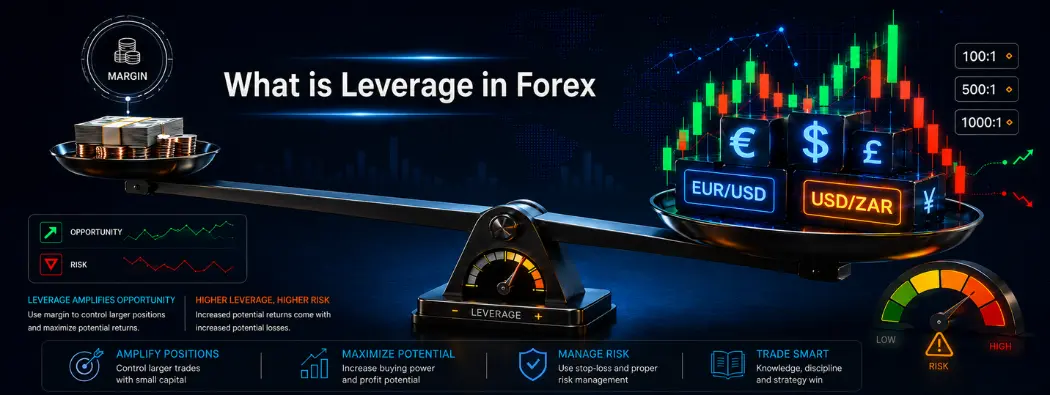
Leverage can be an essential feature, especially when trading foreign currencies via Contract for Difference (“CFD”). Leverage allows you to open larger positions with relatively little capital. But how does it work, and how can you benefit from it?
Leverage in forex lets traders control a larger trade size with a smaller amount of margin. For example, 100:1 leverage means a trader may control a position 100 times larger than the margin used. Leverage can increase both gains and losses, so it should be used with careful risk control.
Read on to learn more about Forex, leverage, and margin, and how these concepts can enhance your FX trading experience.
Key Takeaways Box
- Forex leverage lets traders open larger positions with less upfront margin.
- Leverage is shown as a ratio, such as 50:1, 100:1, 200:1, or 500:1.
- Margin is the amount needed by a trader to open and hold a leveraged trade.
- Higher leverage lowers the margin needed, but it can also increase risk.
- A slight market move can lead to larger gains or losses when leverage is used.
What is forex?
Forex trading means buying one currency, usually called the base currency, while selling another, called the quote currency. Currencies are traded in pairs, such as EUR/USD or GBP/USD. Traders look at price changes between the two currencies and decide whether the pair may rise or fall.
Forex prices can move because of interest rates, inflation, jobs data, central bank news, political events, and market sentiment. Since currency prices can change quickly, traders need to understand both the opportunities and the risks before opening a trade.
If you’ve attempted to buy something from online stores or travelled the world, you may have made at least one foreign exchange transaction or currency conversion. That’s the practical use for forex.
There are plenty of terms you’ll encounter while trading currency pairs, and some of them include margin and leverage. Let’s explore them further.

What is margin?
In FX, margin is the initial deposit required by the broker to fund your trading account. Margin is also a small amount of capital you need to put up to open and maintain any forex position [2].
This small capital requirement acts as a guarantee or collateral to assure your broker that you can open and maintain a trade until you close it.
Margin is often expressed as a percentage of the full position size you intend to open. Moreover, margin requirements will differ across brokers and currency pairs. However, it normally falls between 0.25% and 10% or higher.
As you’ll see later in this guide, your broker’s margin requirement directly relates to the leverage you get.
Some other terms you’ll encounter include:
- Used margin – this is the margin tied up and is needed to keep all your current positions open.
- Free margin – This is the margin available to open new FX positions in your trading account.
- Margin call – Your broker issues a margin call to deposit additional funds into your trading account to keep your current positions open.
Margin is the amount of money a trader needs to open and hold a leveraged position. It is not a fee. It is a portion of the account funds set aside while the trade is open.
For example, if a trader opens a $100,000 position with 100:1 leverage, the margin needed may be $1,000. The broker uses this margin to support the open trade. If the market moves against the position, the account may need more funds to keep the trade open.
The rules governing margin vary by instrument, account type, the broker, and market conditions. Traders should always check the margin terms that apply to their account before trading.
What is leverage?
Leverage allows you to open a bigger position using a fraction of your capital while borrowing the rest from your broker. Usually, leverage is based on your broker’s margin requirement and is often represented as a ratio [3].
Every broker has unique margin requirements to support their leverage ratios. Leverage will also vary from broker to broker and across asset classes.
A higher margin requirement means you may get a lower leverage multiplier of your capital, while a lower margin requirement may come with a higher leverage multiplier.
What is leverage in forex trading?
Leverage in forex is a tool that lets a trader control a larger position than their account balance alone would allow. It is shown as a ratio. For example, 100:1 leverage means $1 of margin may control $100 in market exposure.
This does not mean the trader owns extra money. It means the trade size exceeds the margin used to open it. Because the position is larger, both profits and losses are based on the full trade size, not only the margin amount.
That is why leverage can be useful, but also risky. It can make small price moves matter much more to the trading account.
How Does Leverage Work in Forex?
If the idea of forex trading is new to you. Leverage is one of the terms you must understand before you make any decision to start a career in trading.
Leverage works by reducing the margin required to open a trade. The higher the leverage ratio, the lower the margin required for the same position size.
Here is a simple way to explain how a trader might decide to use leverage:
- The trader chooses a currency pair.
- He decides and selects his preferred trade size.
- The trading platform evaluates and calculates the required margin for that trade.
- The system initiates and opens the trade if the account has enough available margin.
- Profit or loss changes as the market price moves.
The key point is simple: leverage affects the size of the position a trader can open. It also affects how quickly gains or losses can change the account balance.
How to Calculate Forex Leverage
You can calculate leverage by comparing the full trade size with the margin used to open the trade.
Formula
Leverage = Total position size/Margin required.
Margin required = Total position size/Leverage
Let’s look at this example together: A trader opens a $100,000 forex position with 100:1 leverage. The margin required is calculated by dividing
$100,000/100 = $1,000 margin required
This means the trader needs $1,000 in margin to control a $100,000 position. The profit or loss is still based on the full $100,000 position size. You can use the Vantage forex margin calculator to help you calculate the margin required for any trade size.
Common Forex Leverage Ratios
| Leverage ratio | What it means | Margin needed for a $100,000 position |
| 20:1 | Controls $20 for every $1 of margin | $5,000 |
| 50:1 | Controls $50 for every $1 of margin | $2,000 |
| 100:1 | Controls $100 for every $1 of margin | $1,000 |
| 200:1 | Controls $200 for every $1 of margin | $500 |
| 500:1 | Controls $500 for every $1 of margin | $200 |
Further example using the leverage ratio table
Let us say a trader has a $1,000 account and opens a $10,000 position using 100:1 leverage.
| Item | Example |
| Account balance | $1,000 |
| Trade size | $10,000 |
| Leverage | 100:1 |
| Margin required | $100 |
| Price move | 1% |
| Possible gain or loss before costs | $100 |
In this example, a 1% market move equals $100. That is 10% of the $1,000 account. This shows why leverage should be used with a clear risk plan.
Leverage vs Margin in Forex
Leverage and margin are closely linked, but they are not the same thing. It is the ratio that increases market exposure. Margin is the amount of funds in an account needed to open and hold a trade.
| Term | Meaning | Simple example |
| Leverage | The ratio that controls a larger trade size | 100:1 leverage |
| Margin | The amount needed to open and hold a trade | $1,000 margin for a $100,000 position |
| Margin requirement | Margin shown as a percentage | 1% margin requirement |
| Used margin | Funds already tied to open positions | Margin locked in current trades |
| Free margin | Funds still available in the account | Available funds for new trades or market moves |
Maximum Leverage vs Real Leverage
Maximum leverage is the highest leverage ratio available on an account or instrument. Real leverage is the amount of leverage the trader actually uses based on their trade size and account balance.
For example, an account may allow 500:1 leverage. But a trader does not have to use the full amount. A smaller position size may create much lower real leverage.
This is important because risk depends on the actual trade size. A trader with high maximum leverage can still trade with lower risk by using smaller positions. A trader with lower maximum leverage can still take high risk if their position size is too large for their account.
Benefits of leverage in forex trading
Leverage can be useful when it is used with a clear plan. It can help traders access larger positions without putting up the full trade value. It may also help traders manage capital across several markets or strategies.
However, leverage does not reduce risk. A larger position means a larger gain or loss for the same price move. Traders should choose position size based on their risk plan, not just on the highest leverage available.
Increase your rate of return
The primary role of leverage in forex trading is to amplify a trader’s return on investment.
Using leverage on your trades can boost your potential upside, provided risks are properly managed.
Free your capital
Leverage can help you manage your capital. With a solid trading plan, you can use borrowed capital from a broker to grow your trading account.
Using part of your capital to enter a position lowers the barrier to entry (in this case, capital), enabling traders to open positions. This also allows you to allocate your limited resources more flexibly by diversifying your investments across other asset classes and trading instruments.
Boost returns on low volatility
Currency markets may experience periods of lower volatility more often than stocks, ETFs, or Index Funds. In times of low volatility, leverage plays a role in enhancing your exposure, potentially giving you higher returns per trade, although this also means great potential for losses if the market moves against your position.
Related Articles
- What is a commission in Forex Trading?
- What Does Forex Trading Really Cost?
- How to Use a Lot Size Calculator in Forex
- Learn how to Choose a CFD Broker With a Deposit Bonus
Risks of Using Leverage
Leverage can increase both profit and loss. The main risk is that a small market move can have a large effect on the account because the trade size exceeds the margin used.
Traders should also watch for over-leveraging. This happens when the trade size exceeds the account balance or risk plan.
Amplify losses
Leveraging is a double-edged sword.
While it may help enhance your potential upside, it can take you out of the game quicker than you would expect. A small change in currency prices can wipe out your account, leading to significant losses that exceed your invested capital.
More fees
The fees and commissions you pay may vary across brokers. Expensive margin rates slowly cut your upside, even with winning trades.
Risk of over-leveraging
Leverage can be tempting and lead you to over-leverage your account, resulting in overtrading and poor risk management that could wipe out your capital.
Increased volatility
Leverage can also increase the volatility of your trades, leading to larger, more rapid price movements. This can lead to rapid depletion of your trading account if not closely monitored, and a risk management plan is not in place.
Signs You May Be Over-Leveraged
- A small price move could wipe out a large part of the account.
- Most of the account equity is tied up as used margin.
- There is not enough free margin to handle normal market movement.
- A stop-loss would risk more than the trader is comfortable losing.
- The trade size is based on available leverage, not on a clear risk plan.
How to Reduce Leverage Risk
- Use smaller position sizes.
- Avoid using all available margin.
- Set a clear risk amount before entering a trade.
- Use stop-loss orders where suitable.
- Track free margin and margin level.
- Practise with a demo account before using higher leverage.
What Happens During a Margin Call?
A margin call can occur when an account no longer has sufficient equity to cover open positions. This may happen when the market moves against a leveraged trade. When margin levels fall too low, the platform or broker may warn the trader, restrict new trades, or close open positions. The exact process can vary by broker, account type, and product.
A margin call is not just a technical term. It is a risk warning. It means the account may not have enough funds to keep the trade open if the market continues to move against it.
Simple ways to reduce margin call risk
- Use smaller trade sizes.
- Keep enough free margin in the account.
- Avoid opening too many leveraged trades at once.
- Use stop-loss orders where they fit the plan.
- Check margin requirements before opening a trade.
Leverage limits and margin rules vary by country, broker, account type, client type, and instrument. Traders should always check the margin terms that apply to their account before opening a position.
The maximum leverage available on an account should not be treated as a recommended level. Traders should choose a trade size and leverage level that fit their risk plan.
What Leverage Should Beginners Use in Forex?
If you are just starting out in forex trading, you should avoid choosing leverage only because it allows larger trades. Lower leverage and smaller position sizes can make it easier to manage risk while learning how forex markets move.
Before using higher leverage, a trader should understand margin, position size, stop-loss placement, free margin, and how quickly losses can grow. A demo account can help beginners test different leverage settings without risking real funds.
Can You Trade Forex Without Leverage?
Some traders may decide to use little or no leverage. This can reduce exposure, but it also means the trader needs more capital to open the same position size.
Trading without leverage does not remove risk. Currency prices can still move against the position. The main difference is that the trade size is not increased by borrowed exposure or margin-based buying power.
How does leverage work in forex?
Leverage is a dynamic tool in forex trading. It empowers traders to take on much larger positions than they would otherwise be able to with their margin.
By putting down a fraction of the trade’s full value, the broker loans you the remaining capital needed to trade a larger position [6].
Many brokers present leverage as a ratio. Some common leverage ratios you’ll encounter include 50:1, 100:1, and 500:1 (according to applicable regulations).
What do these ratios mean?
Let’s say you want to control a $100,000 forex position. Under normal circumstances, that may be a difficult ask. However, when you use an account with leverage, your broker sets aside a margin (such as $500) from your account and loans you the difference, which allows you to control a $100,000 position. In this case, your leverage ratio is 200:1.
One key thing to remember about leverage is that it can be a double-edged sword. Although a leveraged position can magnify your returns, it can also magnify your losses beyond your invested capital. Only use leverage you’re comfortable with, and if you’re a beginner, start with lower leverage [7].
Trade Forex with Vantage
Ready to explore the forex markets? Open an account with Vantage Markets today and get started with an industry-leading margin requirement and leverage. You’ll also access hundreds of currency pairs that you can select based on your trading strategy.
Want to estimate your margin before placing a trade? Use the trading calculator to check margin, pip value, profit, loss, and position size before opening a position.
Calculator results are estimates. Actual results may vary due to spreads, swaps, account type, market conditions, and instrument settings.
What is leverage in Forex Trading?
Leverage in forex lets a trader control a larger position with a smaller amount of margin. It is shown as a ratio, such as 50:1 or 100:1. Leverage can increase both gains and losses.
How does leverage work in forex?
Leverage reduces the margin needed to open a trade. For example, with 100:1 leverage, a trader may control a $100,000 position with $1,000 in margin. Profit and loss are still based on the full trade size.
What does 100:1 leverage mean?
100:1 leverage means $1 of margin can control $100 in market exposure. A $1,000 margin may control a $100,000 position. This can increase both possible profit and possible loss.
What does 500:1 leverage mean?
1:500 leverage means $1 of margin may control $500 in market exposure. For example, a $200 margin may control a $100,000 position. This level of leverage carries high risk if position size is not controlled.
How do you calculate leverage in Forex?
Divide the full position size by the margin required. For example, a $100,000 trade with a $1,000 margin equals 100:1 leverage.
What is the difference between margin and leverage?
Leverage is the ratio that increases market exposure. Margin is the amount of funds in an account needed to open and hold a trade.
Can beginners use leverage in forex?
Beginners can use leverage, but they should use it with care. Smaller position sizes, clear stop-loss planning, and demo practice can help reduce risk while learning
Can you trade forex without leverage?
Some traders can choose little or no leverage, depending on the broker and account setup. Without leverage, the trader needs more capital to open the same trade size. Risk still remains.
RISK WARNING: CFDs are complex financial instruments and carry a high risk of rapid loss of money due to leverage. You should fully understand the risks involved and carefully consider whether you can afford to take the high risk of losing your money before trading.
Disclaimer: The information is provided for educational purposes only and doesn’t take into account your personal objectives, financial circumstances, or needs. It does not constitute investment advice. We encourage you to seek independent advice if necessary.
The information has not been prepared in accordance with legal requirements designed to promote the independence of investment research.
No representation or warranty is given as to the accuracy or completeness of any information contained within. This material may include historical or past performance figures and should not be relied on.
Furthermore, estimates, forward-looking statements, and forecasts cannot be guaranteed. The information on this site and the products and services offered are not intended for distribution to any person in any country or jurisdiction where such distribution or use would be contrary to local law or regulation.
References
- “What Is Forex Trading – The Motley Fool” https://www.fool.com/investing/how-to-invest/what-is-forex-trading/ Accessed 5 Jan 2023
- “What is Margin & Should You Invest On It? – The Motley Fool” https://www.fool.com/investing/how-to-invest/stocks/margin/ Accessed 8 Jan 2023
- “Leverage and Margin Explained – BabyPips” https://www.babypips.com/learn/forex/leverage-defined Accessed 5 Jan 2023
- “Leverage and Margin Explained – BabyPips” https://www.babypips.com/learn/forex/leverage-defined Accessed 5 Jan 2023
- “Forex: Pros and cons of high leverage trading – a must know for beginner traders – LincolnshireWorld” https://www.lincolnshireworld.com/business/forex-pros-and-cons-of-high-leverage-trading-a-must-know-for-beginner-traders-3855567 Accessed 5 Jan 2023
- “Leverage and Margin Explained – BabyPips” https://www.babypips.com/learn/forex/leverage-defined Accessed 5 Jan 2023
- “Forex Leverage: A Double-Edged Sword – Investopedia” https://www.investopedia.com/articles/forex/07/forex_leverage.asp Accessed 5 Jan 2023