






 Updated
Many traders see commissions listed on an account page or in a cost comparison and wonder what it actually means.
Some forex accounts charge a commission, while others advertise no commission at all. This can make it difficult to understand the true cost of trading.
If you have ever asked what commission in forex trading is, the short answer is that it is a separate fee charged on certain account types when a trade is executed.
This article explains how forex commissions work, how they are calculated, how they compare with spread-based pricing, and what South African traders should know before choosing an account.
Forex commission is a trading fee charged by some brokers when you open and close a position. It is usually charged per lot traded and is separate from the spread. Commission-based pricing is commonly used for Raw ECN-style accounts, whereas Standard accounts often include the cost in the spread.
To see how commission fits into different pricing models, compare the available forex account types or test the pricing structure in a demo account before trading live.
What is a commission in Forex Trading?
Commission in forex trading is a fee that a broker charges to execute a trade. It is separate from the spread and is usually charged on specific account types.
In simple terms, commission is the cost of placing a trade. Instead of building all trading costs into the spread, some brokers charge a separate fee each time a position is opened and closed.
This pricing model is commonly used on Raw ECN-style accounts. These accounts often provide access to lower market spreads, with the commission charged separately and shown as its own trading cost.
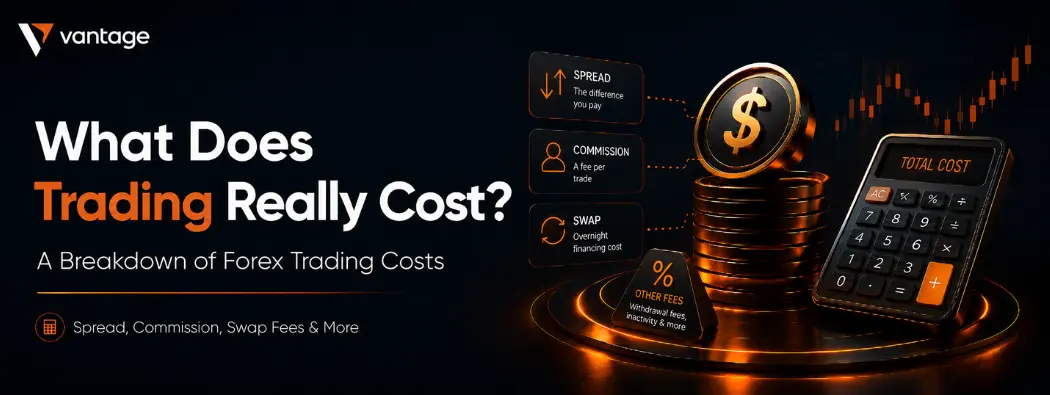
A useful way to think about commission is that it is one part of the total cost of trading. The spread is another cost, and overnight swap charges may also apply if a position is held overnight.
If you are new to forex trading, it is important not to confuse commission with the spread. The spread is the difference between the buy and sell price of a currency pair. Commission is a separate fee charged by the broker.
To learn more about spreads, read our guide on what spread is in forex trading.

How Is Forex Commission Charged and Calculated?
Forex commission is usually charged per lot traded and may be applied when you open and close a position.
To understand how commission works, it helps to know three common terms:
- Per lot: The commission charged for each standard lot traded.
- Per side: The commission charged when opening or closing a trade.
- Round turn: The total commission paid for both opening and closing the trade.
A simple way to calculate commission is:
Trade Size (Lots) × Commission Rate × Number of Sides
Consider the following illustrative example:
A trader opens a position of 1 standard lot.
The commission rate is $3 per side.
The trade is opened and later closed.
| Calculation | Result |
| 1 lot × $3 × 2 sides | $6 total commission |
In this example, the total commission paid is $6.
Commission is typically visible in the platform’s trade history, account statement, or position details after a trade has been executed. Traders who place frequent trades tend to notice commissions quickly, as they form part of the running costs of each position.
The exact commission charged depends on the broker, account type, and market being traded. Always check the latest fee schedule before trading.
Commission vs Spread: Two Ways Brokers Charge
Commission and spread are the two main ways brokers charge for forex trading.
Some accounts use spread-based pricing, where most of the trading cost is built into the bid and ask prices. These accounts are often marketed as low-spread, no-commission accounts because there is no separate commission charge visible on the trade.
Other accounts use raw spread-plus-commission pricing. In this model, traders receive access to tighter market spreads, and the broker charges a separate commission for executing the trade.
The table below shows the difference between the two approaches.
| Pricing Model | How Costs Are Charged |
| Spread-Based Pricing | Trading costs are mainly included within the spread |
| Raw Spread + Commission | Lower spreads combined with a separate commission charge |
Cost Model Diagram
Spread-Based Account → Wider Spread → No Separate Commission Displayed
Raw Spread Account → Lower Spread + Separate Commission → Costs Shown Individually
The key point is that neither model removes trading costs. The total cost of a trade may include the spread, any commission charged, and overnight swap fees if the position remains open beyond the trading day.
If you want to learn more about commission-based pricing models, see our guide to the zero-spread account concept and how it works in practice.
What Does No Commission Really Mean?
No commission usually means the trading cost has been built into the spread rather than charged separately.
This is one of the most common misunderstandings among new traders. Seeing “no commission” on an account page can create the impression that trading is free. In reality, brokers still need a way to cover the cost of providing access to the market.
With spread-based pricing, the cost is typically included within the difference between the buy and sell price. With commission-based pricing, part of the cost is charged separately on the trade. According to local guidelines from the Financial Sector Conduct Authority (FSCA), authorised financial institutions must maintain absolute clarity in their disclosure documents so that traders can see how fees affect their actual trading capital.
This distinction matters when comparing accounts. Looking only at whether a commission is charged can lead to an incomplete comparison. A more useful approach is to compare the total cost of trading under each pricing model.
The important takeaway is simple: no commission does not automatically mean lower costs, nor does it mean free trading.
For a deeper explanation of this pricing model, read our guide to zero brokerage trading.
Which Accounts Charge Commission?
Raw or ECN-style accounts usually charge a commission, while standard accounts typically include the trading cost within the spread.
The purpose of commission-based pricing is to separate the spread from the broker’s execution fee. This gives traders a clearer view of how trading costs are structured.
For example, a Raw ECN account may provide access to tighter market spreads and apply a separate commission for each trade. The commission is displayed as its own cost rather than being fully built into the spread.
By comparison, a Standard STP account generally combines the broker’s costs into the spread. Traders do not see a separate commission charge on each position, although the cost is still reflected in the pricing model.
Neither account structure is automatically better than the other. The most suitable option depends on factors such as trading frequency, position size, and personal preference.
When comparing accounts, it is useful to review both the spread and any applicable commissions. Looking at the all-in trading cost provides a more complete picture than focusing on a single fee.
To learn more, compare the pricing models of the Raw ECN and Standard STP accounts and review the available forex account types.
Who Pays Less With Commission-Based Pricing?
Commission-based pricing may appeal to active traders who place trades frequently and pay close attention to spreads.
Because Raw ECN-style accounts often offer tighter spreads, some high-volume traders prefer to view the spread and commission as separate costs. This can make trading expenses easier to measure and compare across different markets.
Spread-based accounts may appeal to traders who prefer a simpler pricing structure. Rather than calculating both the spread and the commission, the trading cost is primarily reflected in the spread itself.
Neither pricing model is automatically cheaper in every situation. The total cost depends on factors such as trading volume, position size, market conditions, and the duration of open positions.
This is why many experienced traders compare the all-in cost of trading rather than focusing on commission or spread in isolation.
The key point is that different pricing models may suit different trading styles. The most useful comparison is the total cost paid over time, not whether a commission is charged.
Commission and Your Other Trading Costs
Commission is only one part of the total cost of trading forex.
A complete cost assessment should also include the spread, any overnight swap charges, and potential slippage during periods of market volatility. Looking at commission in isolation can give an incomplete picture of what a trade actually costs.
For example, a trade may have a low commission but a wider spread. Another trade may have a tight spread but incur overnight swap charges if it remains open for several days.
This is why many traders focus on the all-in cost of a position rather than a single fee. The all-in cost reflects the combined impact of spread, commission, swap fees, and execution-related costs.
Understanding how these costs work together can make account comparisons more meaningful and help traders evaluate pricing models more accurately.
To learn more about these trading costs, see our guides on what spread is in forex trading, swap fees, and slippage in trading.
How to Check Commission Before You Trade
The easiest way to check commission is to review the account specifications and fee schedule before placing a trade.
Most brokers publish commission information on their account pages, contract specifications, or dedicated commission fee pages. These resources explain how commission is charged and which account types it applies to.
The commission is also visible on the trading platform. On many platforms, it appears in the trade history, account statement, or position details after a trade has been executed.
From practical experience, reviewing completed trades is one of the quickest ways to understand how commission affects overall trading costs. A platform screenshot or a trade ticket example can also help traders see exactly where the commission is recorded.
A demo account can be useful here as well. Testing an account in a demo environment allows traders to become familiar with pricing, order tickets, and commission displays before committing real funds.
Conclusion
Commission is a real trading cost that some forex accounts charge separately from the spread.
Understanding how commission works, how it is calculated, and how it fits into the total cost of trading can make account comparisons more meaningful.
It is also important to remember that no commission does not automatically mean lower costs. In many cases, the cost is simply built into the spread instead.
Before choosing an account, review the pricing model, check the commission schedule, and compare the all-in cost of trading. A demo account can also help you see how commission appears in practice before trading with real funds.
Frequently Asked Questions
What is a commission in forex trading?
Commission in forex trading is a fee charged by a broker to execute a trade. It is usually charged separately from the spread and is commonly found on Raw ECN-style accounts.
How is forex commission calculated?
Forex commission is typically calculated using the trade size, the commission rate per lot, and the number of sides involved in the trade. A round-turn trade includes both the opening and closing transactions.
Is commission the same as the spread?
No. The spread is the difference between the buy and sell price of a currency pair. Commission is a separate fee charged by the broker for executing the trade
What does no commission mean in forex?
No commission usually means the trading cost is built into the spread rather than charged separately. It does not mean that trading is free.
Which Vantage account charges commission?
The Raw ECN account uses commission-based pricing, subject to current account terms. The Standard STP account typically includes trading costs in the spread rather than charging a separate commission, subject to current account terms. Always verify the latest pricing structure on the broker’s account pages
Do all forex brokers charge commission?
No. Some brokers charge a separate commission, while others include the cost within the spread. The pricing model depends on the broker and account type.
Is a commission account cheaper than a spread account?
Not always. The total cost depends on the spread, commission, swap fees, and trading activity. Comparing the all-in cost provides a more accurate assessment.
How do I see my commission?
Commission is usually displayed in the trading platform’s trade history, account statement, position details, or transaction records after a trade has been executed.
Does the commission apply per trade or per lot?
Commission is commonly charged per lot traded. Depending on the account type, it may be charged per side or as a round-turn cost covering both the opening and closing of a trade.
Risk Warning: CFDs are complex financial instruments and carry a high risk of rapid loss of money due to leverage. You should ensure you fully understand the risks involved and carefully consider whether you can afford to take the high risk of losing your money before trading.
Disclaimer: The information is provided for educational purposes only and doesn’t take into account your personal objectives, financial circumstances, or needs. It does not constitute investment advice. We encourage you to seek independent advice if necessary. No representation or warranty is given as to the accuracy or completeness of any information contained within.
This material may contain historical or past performance figures and should not be relied on. Furthermore, estimates, forward-looking statements, and forecasts cannot be guaranteed. The information on this site and the products and services offered are not intended for distribution to any person in any country or jurisdiction where such distribution or use would be contrary to local law or regulation.
References
- https://vantagemarektsdev.canglankeji.com/en-za/trading/fees/spreads/ – Vantage spreads.
- https://vantagemarektsdev.canglankeji.com/en-za/academy/what-is-spread-in-forex-trading/ – Vantage: What is spread in forex trading?
- https://vantagemarektsdev.canglankeji.com/en-za/trading/accounts/raw-ecn/ – Vantage raw ECN account.
- https://vantagemarektsdev.canglankeji.com/en-za/academy/zero-brokerage-trading/ – Vantage: What is zero brokerage trading?
- https://vantagemarektsdev.canglankeji.com/en-za/trading/accounts/raw-ecn/ – Vantage raw ECN account.
- https://vantagemarektsdev.canglankeji.com/en-za/trading/accounts/stp/ – Vantage standard STP account.
- https://vantagemarektsdev.canglankeji.com/en-za/academy/what-is-spread-in-forex-trading/ – What is spread in forex trading?
- https://vantagemarektsdev.canglankeji.com/en/trading/fees/swap-rates/ – Vantage swap rates.
- https://vantagemarektsdev.canglankeji.com/en-za/academy/what-is-slippage-in-trading/ – Vantage: What is slippage in trading?