





 Updated
Understanding when to trade is important in finding success as a trader. This is especially so for forex trading, owing to the time sensitivity of the foreign exchange markets. This is because specific time bands throughout the day offer traders optimal trading opportunities. Outside of these time bands, however, the potential for profitable trades tends to be muted.
This is a property unique to the forex markets, but before we get into the exact reasons why, it is important to first understand what forex trading is.
Simply put, forex stands for foreign exchange, the exchange of one currency for another for trade or tourism.
The exchange rate between pairs of currencies does not remain fixed; it fluctuates over time, sometimes by quite a bit. This fluctuation is what forex traders utilise to potentially capture profits from the foreign exchange markets. For more details, read our forex beginners’ guide.
Key Points
- Forex trading sessions are specific periods during the day when trading activity is heightened due to the operations of major financial centres worldwide, leading to increased market volatility and liquidity.
- The most significant forex trading overlaps occur during the New York and London sessions, when about 70% of all forex trades take place, offering the highest liquidity and trading opportunities.
- Optimal times for trading specific currency pairs are during their respective major market sessions, which align with the business hours of their primary financial centres, ensuring high market activity and liquidity.
Understanding Forex Market Hours
As mentioned, forex trading hours are important to pay attention to. This is because while the forex markets are open 24 hours on weekdays, trading activity tends to congregate during times when major financial centres around the world are active.
The trading activity carried out by banks and corporations, the real market movers, increases volatility and liquidity. This also attracts more forex speculators to come online.
Why is volatility important to forex traders? Because it is the mechanism by which traders can make potential profits (or losses).
You see, when you trade forex, you are making bets on one currency strengthening against another by taking long (to buy) or short (to sell) positions. If the currency pair moves in the direction you picked (long or short), you will reap a profit. The larger the difference, the larger your profit (or loss, if the currency pair went against the direction you picked).
This means that traders can potentially profit when the markets are moving up or when they are moving down. But when the forex market is moving neither up nor down, traders will be hard-pressed to find any meaningful trading opportunities.
In practice, this means that forex traders should pay attention to the peak periods of trading activity in financial centres around the world and time their trades accordingly.

Global Forex Market Sessions [1]
The global forex market can be split into four major trading sessions, based on the market hours of four of the world’s most important financial centres. These are the Sydney, Tokyo, London and New York sessions.
Of these four major trading sessions, there are traditionally three peak forex trading sessions: the Asian (Tokyo), European (London), and North American (U.S.) sessions. This is popularly known as the Forex 3-session System.
Opening and Closing Times of Major Forex Market Sessions Around the World [2]
| Session | Local time | UTC |
| Sydney | 7 am to 4 pm | 9 pm to 6 am |
| Tokyo | 9 am to 6 pm | 12 am to 9 am |
| London | 8 am to 5 pm | 7 am to 4 pm |
| New York | 8 am to 5 pm | 1 pm to 10 pm |
As you can see, forex market sessions are not fixed worldwide. Each region’s market opening and closing hours are based on local business hours, which may vary according to prevailing customs and events such as major holidays. Note that markets are closed on Christmas and New Year’s Day.
Daylight Saving Time and Forex Trading Sessions
Forex trading sessions are affected by Daylight Saving Time (DST), which is instituted during March/April and October/November. This means that forex markets in the affected regions (Europe, the United States, New Zealand, and Sydney) will open and close earlier or later than they do during non-DST.
Note that UTC in the chart above ignores DST. It may be more helpful to use local times as your reference when determining the corresponding market trading hours in your own time zone.
Making use of an online timezone converter is recommended to help you pin down the right forex trading sessions.
Trading Session Overlaps [3]
You may also have noticed that there are overlaps among the three peak trading sessions that occur daily.
The following graphic will help you visualise these overlaps.
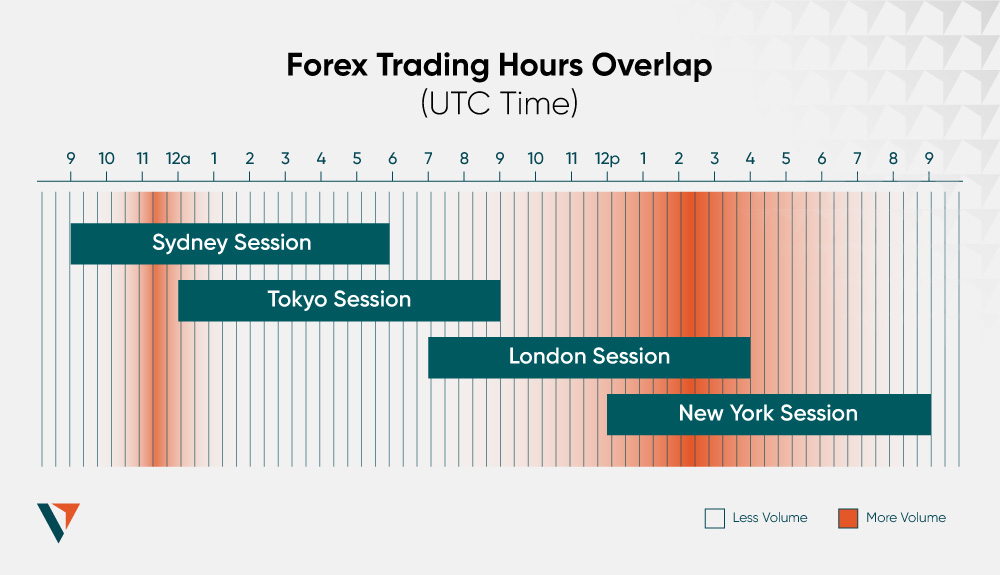
Trading session overlaps are considered prime forex trading sessions. When two forex markets are active at the same time, trading activity tends to shift into overdrive, resulting in greater price movements, higher trade volumes and increased liquidity.
Let’s take a closer look at the characteristics of the three forex trading session overlaps.
New York and London overlap (1 pm to 4 pm UTC)
This is the most significant overlap among the three, typically featuring the highest volatility and liquidity. During the overlap of the New York and London forex trading sessions, over 70% of all forex trades take place. This is due to the USD and the EUR being two of the most popular currencies to trade.
As such, this is the most popular trading period for forex traders interested in pairs like USD/EUR or EUR/GBP.
Sydney and Tokyo overlap (12 am to 6 am UTC)
The Sydney/Tokyo fires session overlap is generally less volatile than the previously discussed overlap, but it still offers some robust trading opportunities. The main currencies affected are EUR and JPY, so traders of EUR/JPY would typically be active during this period.
London and Tokyo overlap (7 am to 9 am UTC)
This is the shortest overlap of the three, and also usually sees the least action. This is due to the odd hours and the low likelihood of large fluctuations occurring within the 2-hour time frame.
Trading Strategies for Overlap Hours
As previously stated, session overlap hours are highly sought after among forex traders due to increased volatility and higher liquidity. During these periods, forex trading activity can accelerate, prompting traders to deploy short-term strategies to make the most of it.
Some short-term forex trading strategies that rely on quick trades include:
Day trading
In this strategy, forex positions are held from a few hours to less than a day – but never overnight. This is to avoid overnight risk, in which unexpected events or developments may cause a price gap to form while markets are closed.
Discipline should be maintained to reduce the risk of emotional trading decisions that lead to costly mistakes.
Breakout trading
Breakout trading seeks opportunities that occur just before a price “breaks out” of a previously established range. The idea is to enter the market just before the breakout and then continue to ride the trade until volatility dies down.
Given how it works, this strategy is well-positioned to capitalise on the increased volatility in forex markets during session overlaps. The downside is that it takes solid skills and experience to properly identify a breakout, and beginners may find success elusive with the strategy.
Practise Risk Management When Trading Session Overlaps
Due to heightened volatility, the forex markets offer greater profit potential during overlap sessions. But the wild swings in the prices of currency pairs can also mean a bigger loss should the trade go against you.
This is further complicated by the use of leverage, which is common in forex, since trades typically involve very small movements in the currency pair’s price. As you are probably aware by now, leverage amplifies your trading outcome, whether profits or losses.
The bottom line is, when trading during overlap sessions, it is crucial to practise proper risk management. Be sure to follow a trading plan, choose your trading strategies wisely, adopt proper trade sizing, and resist the temptation to ignore predefined limits and rules.
Best times to trade forex
During High Liquidity
One of the best times to trade forex is when market liquidity is high. As discussed earlier, the New York/London overlap session is when the forex market tends to be most liquid. Thus, many forex traders focus their efforts during this time band.
To understand why, let’s take a look at what liquidity is and how it impacts the market.
Liquidity is a measure of how easily and efficiently a currency pair can be bought or sold without causing drastic price fluctuations. It indicates the depth and availability of market participants, and their ability or willingness to execute trades promptly at competitive prices.
“Competitive prices” mean prices that are closest to the perceived value of the asset being sold. For instance, if a stock perceived to be worth USD 100 is easily sold at USD 100, we can say the market is at perfect liquidity.
When the forex market is highly liquid, many buyers and sellers swiftly execute trades at prices that reflect current market perceptions. Also, the bid-ask spread is tighter, reducing the risk of slippage, which is when the execution price differs vastly from the expected price.
When the forex market is low in liquidity, there are fewer buyers and sellers, making it more difficult to execute trades. Slippage is also higher, exposing traders to the risk of settling the trade at a significantly higher or lower price, which can turn a breakeven into a loss or widen a loss.
For these reasons, forex traders prefer to trade during periods of high liquidity for their targeted currency pairs.
Currency-specific Best Times
So, what are the best trading times for specific currency pairs?
Generally speaking, currencies are most active during their respective trading sessions. That’s to say, the Yen is most active during the Tokyo session, and thus, good pairs to trade then would be currency pairs that contain the Yen.
Since we already know the timings of the three peak forex sessions, we can thus surmise the best trading times for major currencies, as follows:
| Forex session | Timing (UTC) | Most active currencies | Examples of currency pairs to trade |
| Asian | 12 am to 9 am | JPY, AUD, NZD | JPY/USD, JPY/AUD, AUD/USD, AUD/EUR |
| European | 7 am to 4 pm | GBP, EUR, CHF | GBP/USD, EUR/CHF, USD/CHF, GBP/JPY |
| North American | 12 pm to 9 pm | USD, CAD | EUR/USD, USD/CAD, EUR/CAD |
One reason why the best time to trade a specific currency is during its specific trading session is that the forex market is the largest market in the world, with daily volume reaching USD 6.6 trillion according to the 2019 Triennial Central Bank Survey of FX and OTC derivatives markets. This is far larger than the stock market. [4]
As such, major currency pairs experience high trading activity and deep market liquidity throughout their respective trading sessions.
Liquidity and trading activity peak during the New York/London overlap, but the US and European sessions remain highly active and far from dead outside the overlap.
During News Releases
As currencies can be affected by economic news and developments, forex traders should monitor important news releases, which may create trading opportunities.
Major news announcements can accelerate trading activity in the forex markets, and the release of economic data – especially when it deviates from expectations – can cause currencies to gain or lose value quickly.
Given that news reports are released every day around the globe, forex traders should develop the ability to filter out irrelevant information and focus only on important news. This can be enhanced with an economic calendar that lets you customise the news you want to track.
Generally, positive news about economic growth leads to a currency strengthening against another, creating a trading opportunity to go long on the pair. Conversely, if news were to break that would cause a currency to weaken, it may prove beneficial to go short the relevant currency pair.
Some examples of significant news events that forex traders should pay attention to include, but are not limited to:
- Central bank interest rate announcements
- Inflation measures such as the Consumer Price Index
- Trade deficits, which translate to more cross-border capital flows, impact exchange rates
- Consumer confidence and consumption levels
- Gross Domestic Product, which measures the sum total of goods and services produced
- Unemployment rates, as high unemployment can drag down economic growth, leading to a weaker currency
Read our article, ‘News Trading: A Deep Dive into “Buy the Rumour, Sell the News,”‘ to understand and dissect this strategy’s concept.
Conclusion
Understanding forex trading sessions is key, as it helps you capitalise on periods of high market liquidity and trading activity, which are crucial to successfully executing your trades with minimal disruption.
The good news is that picking the most suitable trading session is straightforward, and most traders can do well simply by following peak trading sessions.
Remember that while the New York/London overlap session is noted to have the highest activity and deepest liquidity, it also means higher volatility. This heightened volatility may not be suitable for every forex trader, and you may well find yourself preferring to trade when the markets are more sedate.
In any case, knowing the major forex sessions and which currency pairs to trade should be fundamental knowledge. You will likely find this useful as you increase your experience and skills as a forex trader.
Frequently Asked Questions (FAQ)
Q. What’s the forex market open timing?
The global forex markets trade 24 hours a day, five days a week. In forex, there are four major trading sessions, as follows:
- Sydney: 9 pm to 6 am UTC
- Tokyo: 12 am to 9 am UTC
- London: 7 am to 4 pm UTC
- New York: 1 pm to 10 pm UTC
Q. What time is the forex market most active?
The forex market is noted to have the highest activity and deepest liquidity when the London and New York sessions overlap. This takes place from 1 pm to 4 pm UTC, and roughly 70% of forex trades occur during this period.
Q. When is the London session in forex?
The London session takes place during business hours on weekdays. In local time, the London forex markets are active from 8 am to 5 pm. This translates to 7 am to 4 pm UTC.
References
- “The Forex 3-Session System – Investopedia”. https://www.investopedia.com/articles/forex/08/3-market-system.asp. Accessed 22 April 2024.
- “Forex Trading Sessions – BabyPips”. https://www.babypips.com/learn/forex/forex-trading-sessions. Accessed 22 April 2024.
- “The Best Times to Trade the Forex Markets – Investopedia”. https://www.investopedia.com/articles/forex/08/forex-trading-schedule-trading-times.asp. Accessed 22 April 2024.
- “Forex Market: Who Trades Currencies and Why – Investopedia”. https://www.investopedia.com/articles/forex/11/who-trades-forex-and-why.asp. Accessed 22 April 2024.