





 Updated
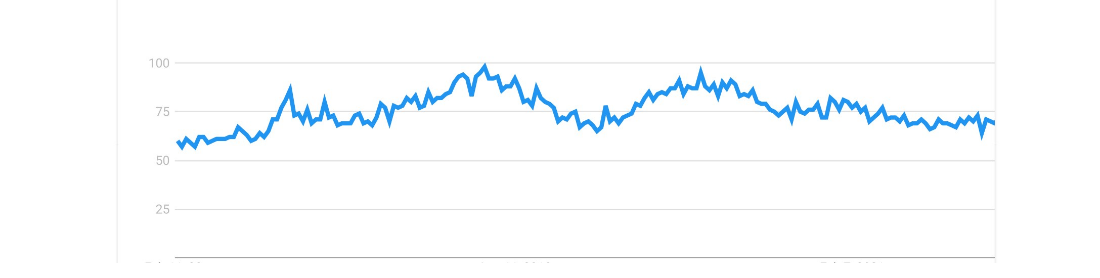
Forex trading has been around since the 1970s, but with advances in technology and the rise of online trading platforms, its popularity has grown exponentially. This is evidenced by Forex peaking in global popularity every year, according to Google Trends [1].
As interest in Forex trading continues to grow, this article serves as an introductory guide for aspiring traders.
What is Forex?
So, let’s begin with a simple question: What is Forex trading? Forex (FX) is the short form for foreign exchange, which represents the global currency markets. There is an array of entities that participate in the FX markets, including central banks, financial institutions, hedge funds, and individual investors or traders [2].
Hence, Forex trading involves market participants buying or selling currencies, primarily to seek monetary gain. In response to exchange-rate fluctuations, market participants speculate on whether one currency will appreciate or depreciate against another. This is fundamental to forex trading.
Even though there are more than 160 official currencies globally [3], only 4 are widely traded. These currencies are:
- US Dollar (USD)
- Great British Pound (GBP)
- Japanese Yen (JPY)
- Euro (EUR)
What is the Forex market?
Now that we have a basic understanding of Forex, let’s delve deeper into the Forex market itself and expand on how Forex trading works at a structural level. The Forex market is the decentralised global marketplace where currencies are traded. It operates 24 hours a day, 5 days a week, allowing participants to trade currencies from around the world. There are a few different types of markets where Forex can be traded, primarily via spot, forwards, and futures markets[4]. This is essential knowledge for anyone who wants to understand how to trade forex.
Unlike traditional stock markets, which operate on centralised exchanges, the Forex market operates through an interbank market. This means that transactions are conducted directly between participants, such as banks, financial institutions, and individual traders, without a physical location or exchange floor.

Why Trade Forex?
As the world’s largest financial market by trading volume, liquidity, and value, the FX market offers countless opportunities for traders.
Over the years, the total value of the FX market has been increasing, with no signs of slowing. As of 2022, the average daily trading volume was USD 6.6 trillion. Increasing liquidity enables faster, easier transactions with lower spreads for traders [5]. These advantages are critical to understanding the basics of forex trading.
The trading hours of the FX markets are another good reason to be trading Forex. Open 24 hours on all 5 weekdays, this gives traders the convenience of selecting a time that suits them. The ability to both buy and sell also creates more trading opportunities across various market conditions. Not only can traders take advantage of the rising currency prices, but they can also make a winning trade by selling when one currency depreciates against another [6].
Last but not least, you can employ leverage when trading forex to make larger trades with a smaller amount of capital. When used appropriately and coupled with adequate risk-management tools, leverage can magnify your returns. However, you should keep in mind that leverage is a double-edged sword and can also lead to significant losses.
Interested in trading with the best conditions a broker can offer? Vantage offers forex spreads as low as 0.0, with $0 deposit fees, and a leverage of up to 500:1. Sign up with a demo account here.
How does forex trading work?

Understanding how forex trading works is similar to exchanging currency while travelling abroad. Just like in those situations, forex trading involves buying one currency and selling another. The exchange rate between currencies fluctuates in response to supply and demand. In forex trading, traders execute transactions across currency pairs, potentially earning profits from changes in exchange rates.
What moves the rate
Supply and demand set the rate, and several forces push them around. Interest-rate decisions and inflation data tend to move them most, while central-bank policy steers both. The rand also responds to commodity prices and SARB decisions, which is important for any USD/ZAR position. These same forces can turn a trade against you, so it can lose value as fast as it gains.
Currency pairs
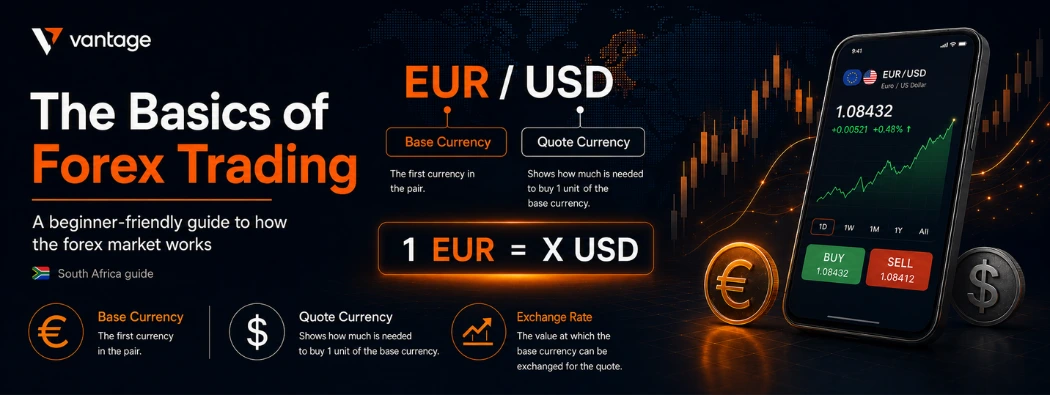
When engaging in forex trading, traders always deal with currency pairs. Each pair consists of a base currency and a quote currency. The base currency is the first currency in the pair, while the quote currency is the second. Together, they form a unique trading instrument that reflects the exchange rate between the two currencies.
Some of the commonly traded currency pairs include EUR/USD (Euro/US Dollar), GBP/USD (British Pound/US Dollar), USD/JPY (US Dollar/Japanese Yen), and USD/CHF (US Dollar/Swiss Franc). These pairs dominate the forex market, boasting high liquidity and active trading volumes [7].
South African traders often watch USD/ZAR, the US dollar quoted against the rand. As a CFD, it tracks that rate without you owning either currency, and losses scale with the position size.
Reading a forex quote
A forex quote always carries two prices at the same time. The price on the left is the bid, where you sell the base currency. The price on the right is the ask, where you buy it. The distance between them is the spread, and it forms part of every trade’s cost.
If EUR/USD is trading at 1.0850/1.0851, you sell at 1.0850 and buy at 1.0851. A trader who reads both prices before entering avoids accidentally paying a wider spread.
How to start trading forex
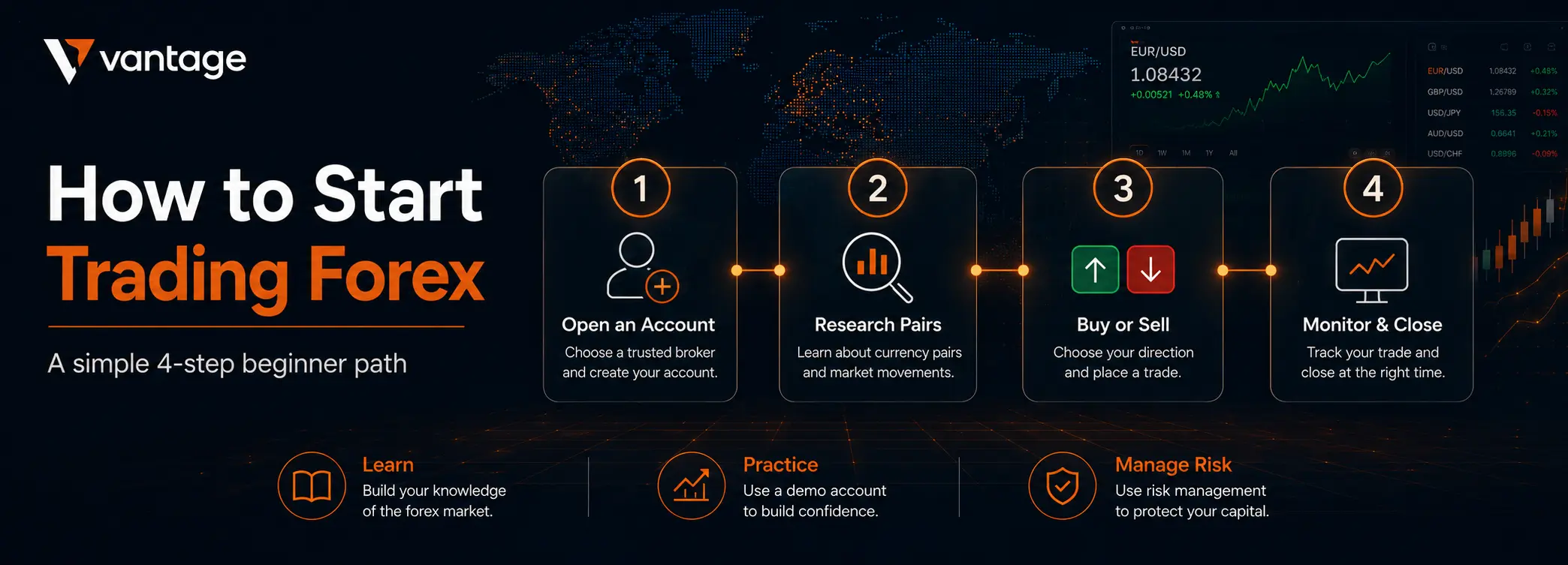
Here are a few steps to help you get started with your forex trading journey, serving as a beginner-friendly forex trading guide:
1. Start by opening an account with a well-established broker such as Vantage.
2. Begin researching the currency pairs that you want to trade. Read market news to familiarise yourself with the factors that influence currency movements.
3. Open a position for currency pairs. Go long and “buy” if you believe the currency pair will strengthen, or go short and “sell” if you think it will weaken.
4. Monitor your trade and close your position when you think the time is right.
Forex trading strategies
Traders use Forex trading strategies to provide structure to their trading efforts and define how they will enter and exit trades. There are various methods traders use to identify entry and exit points. Here are a few examples of forex trading strategies traders can use in their future trades:
Swing Trading [8,9]
Swing trading is an approach focused on identifying upcoming trend changes and executing trades before they occur to capitalise on the resulting profits. This strategy is typically implemented over a medium-term timeframe, ranging from a couple of days to several weeks, depending on the trend’s duration.
Implementing this forex trading strategy requires traders to be comfortable holding positions for extended periods, as prematurely closing trades can result in missed opportunities for future gains.
It is important to note that swing trading can be challenging because it requires navigating short-term market volatility and a larger capital base to absorb price fluctuations that may occur during the trend.
Day Trading [10,11]
Day trading is the practice of executing trades within a single day, opening and closing positions without holding them overnight. This approach is employed for various reasons. Firstly, day trading leverages the forex market’s inherent volatility, enabling traders to capitalise on sudden price movements throughout the day.
Additionally, it helps mitigate risks from substantial market fluctuations or overnight price gaps that may arise when markets are closed, depriving traders of the ability to react. Successful day trading requires a comprehensive understanding of market dynamics and global events, the discipline to adhere to a predetermined trading routine, and the ability to adapt quickly to changes.
Range Trading [12,13]
Range trading is a strategic approach in which multiple trades are executed while a currency pair moves horizontally, oscillating between support and resistance levels for an extended period. When the market remains in a consolidation phase, characterised by sideways movement, it is referred to as a range-bound market in the forex trading community.
This method entails taking both long and short positions: traders buy when the price approaches the support level and sell when it approaches the resistance level.
Learn more about all the top forex trading strategies here.
Forex trading terminology
When trading forex, there are a few technical forex jargons that one must know before starting to trade. Here are some trading jargons that all traders should learn to trade with confidence:
Margin
Margin is the money you need to deposit with your broker when you want to start trading. It’s like a deposit that shows you can cover any potential losses.
Pip
Pip stands for “point in percentage”, which is a currency pair’s smallest unit of price movement. It helps determine whether a trade has made a profit or incurred a loss. For most currency pairs, a pip is the fourth decimal place; for the Japanese yen, it’s the second (e.g., USD/JPY = 86.51).
Lot
A lot is a standard unit of measure for the number of financial instruments you can trade. The size of a lot depends on the specific market and asset. Buying or selling a lot means trading a specific number of units of the asset.
Spread
Spread is the difference between the highest price a buyer is willing to pay (bid price) and the lowest price a seller is willing to accept (ask price) for a security or asset.
Leverage
Leverage is the use of borrowed capital to increase the size of your trade. It allows traders to control a larger amount with a smaller amount of their own funds. While leverage can increase potential profits, it also increases potential losses.
Base currency/Quote currency
The base currency is the first currency in a currency pair. It’s the currency being compared to the value of the second currency, known as the quote currency. For example, in a USD/JPY currency pair, USD is the base currency, and JPY is the quote currency. This shows how many JPY are needed to buy 1 USD.
Interested in learning more about all these terms? Read our top 30 forex terms all traders should know.
When Can You Trade Forex?
The FX markets are available 24 hours a day, open 5 days a week. Each day is dissected into four major sessions: Sydney, Tokyo, London, and New York. Table 1 lists the opening and closing times for each session.
| Session | Timing (UTC / GMT +0) |
| Sydney | 0800 to 1700 |
| Tokyo | 1200 to 2100 |
| London | 2000 to 0500 |
| New York | 0100 to 1000 |
Traders typically align session times with the currency pairs they trade. For example, if one were to trade the USDJPY pair, the Tokyo or New York session would be ideal.
Conclusion
As an individual trader, it may seem daunting to go up against other market participants, such as large institutions, but fret not. The opportunities in the FX market are never in short supply, and with consistent practice and discipline, traders can excel across a range of market conditions.
Now that you have learned about the basics of Forex trading, let’s dive into the types of Forex markets available next.
Frequently Asked Questions
Where can I learn forex trading?
You can learn by starting with the basics of forex trading, understanding what is forex trading and using a trusted forex trading guide. Beginner resources, videos, and demo accounts can also help you practise how to do forex trading effectively.
How to start forex trading in South Africa?
Begin with a reliable broker, study how forex trading works, and follow a step-by-step forex trading guide. Beginners in South Africa can learn to trade forex here at Vantage SA Academy.
What is the best forex trading platform?
The best platforms make it easy to understand what forex trading is, support beginners with the basics of forex trading, and offer tools that help you learn how to do forex trading confidently.
What factors affect the forex market?
Forex markets move due to interest rates, inflation, and economic news. Understanding how forex trading works means knowing these drivers, which are key to the basics of forex trading and to any forex trading guide.
How do I make money from Forex trading?
You earn by buying and selling currency pairs based on market movement. Learning how forex trading works and following a structured forex trading guide helps you develop strategies for success.
Is forex trading income taxable?
Yes, forex income may be taxable depending on your country’s rules. Knowing how forex trading works and its basics helps traders accurately record earnings as they learn to trade.
References
- “Forex – Google Trends” https://trends.google.com/trends/explore?q=forex Accessed 16 June 2026
- “Forex Market: Who Trades Currencies and Why – Investopedia” https://www.investopedia.com/articles/forex/11/who-trades-forex-and-why.asp Accessed 16 June 2026
- “List of all currencies worldwide – WorldData.info” https://www.worlddata.info/currencies/ Accessed 26 June 2023
- “What Is Forex Trading? A Beginner’s Guide – Investopedia” https://www.investopedia.com/articles/forex/11/why-trade-forex.asp Accessed 16 June 2026
- “Forex Trading Statistics – Compare Forex Brokers” https://www.compareforexbrokers.com/forex-trading/statistics/ Accessed 26 June 2023
- “Why trade forex – Forex.com” https://www.forex.com/en/education/education-themes/trading-concepts/why-trade-forex/ Accessed 16 June 2026
- “Major Pairs: Definition in Forex Trading and How to Trade – Investopedia” https://www.investopedia.com/terms/forex/m/majors.asp Accessed 26 June 2023
- “What Is Swing Trading? – Investopedia” https://www.investopedia.com/terms/s/swingtrading.asp Accessed 16 June 2026
- “Swing Trading: What It Is & How It Works – Seeking Alpha” https://seekingalpha.com/article/4452707-swing-trading Accessed 16 June 2026
- “Day Trading: The Basics and How to Get Started – Investopedia” https://www.investopedia.com/articles/trading/05/011705.asp#toc-day-trading-strategies Accessed 16 June 2026
- “10 Day Trading Tips for Beginners – Investopedia” https://www.investopedia.com/articles/trading/06/daytradingretail.asp Accessed 16 June 2026
- “What Is Range-Bound Trading? Definition and How Strategy Works – Investopedia” https://www.investopedia.com/terms/r/rangeboundtrading.asp Accessed 16 June 2026
- “What is a Range-Bound Market? – BabyPips” https://www.babypips.com/learn/forex/what-is-a-ranging-market Accessed 16 June 2026
- “Forex Market Hours – Babypips” https://www.babypips.com/tools/forex-market-hours Accessed 16 June 2026