






 Updated

To start learning about Forex CFD Trading, let’s look at the following scenario. Suppose you’ve had any reasons in the past to exchange your local currency for US dollars, Euros, or British pounds while travelling out of your country of residence.
Or complete a transaction to facilitate an international payment. If so, you’ve already participated in the foreign exchange market. This foreign exchange market is commonly referred to as the Forex market.
Every day, trillions of dollars worth of trade move through this global market as people, businesses, and governments buy and sell currencies.
For many, Forex CFD trading may seem complex or out of reach. But with the right guidance and forex education, you can learn how the forex market works and begin exploring it further via a forex CFD demo account.
This beginner-friendly guide will break down everything you need to know about what Forex is, how it operates, and why so many people are already developing an interest in trading.
If you’re looking to understand global markets or diversify your financial knowledge, this guide is your starting point.
Open your free CFD demo account today and explore live markets risk-free.
Key Takeaways
- Forex CFD trading means trading currency price moves, not owning the currency. You trade currency pairs like EUR/USD and try to profit from price changes.
- The Forex market is huge, global, and open 24/5. It runs across major sessions like Sydney, Tokyo, London, and New York, with the London/New York overlap often being the busiest.
- Beginners need to know core terms first. Key terms include base currency, quote currency, spread, liquidity, volatility, leverage, margin, pip, stop-loss, and take-profit.
- Leverage can boost gains, but it also raises risk fast. It lets traders control larger positions with small capital, but losses can grow just as quickly.
- Start with a demo account and focus on risk control. A demo helps you learn the platform, test strategies, and build skills before using real money.
What is Forex CFD Trading?
Forex trading, also known as foreign exchange or FX trading, is the process of exchanging one currency for another. It happens every time someone converts naira to dollars, euros to pounds, or any other currency pair.
The Forex market is the largest financial market in the world, with over $7 trillion traded daily. Unlike the stock market, which has a central exchange, Forex is a decentralised, global market that operates 24 hours a day, five days a week.
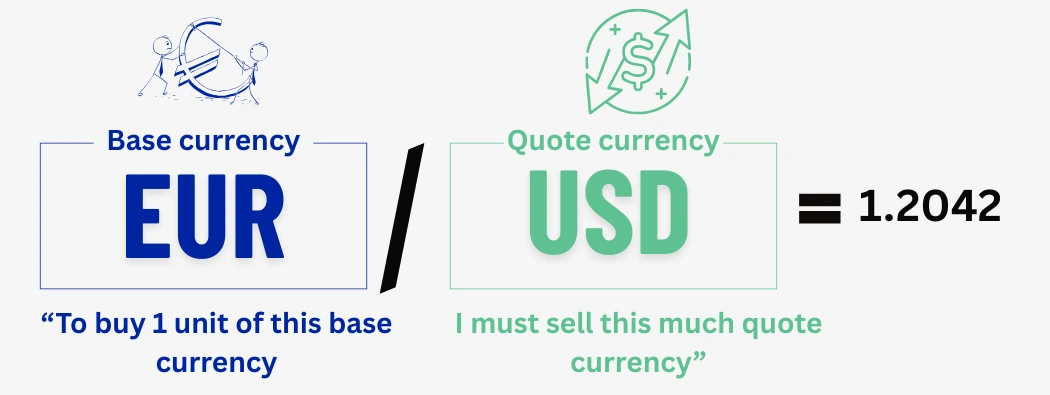
Currencies are always traded in pairs. For example, in the EUR/USD pair, the euro is the “base currency” and the U.S. dollar is the “quote currency.”
If the price of EUR/USD is 1.1000, it means one euro equals 1.10 U.S. dollars. When you buy a currency pair, you’re buying the base currency and selling the quote currency.
This simple structure makes Forex trading easy to understand once you get the basics. As prices move, traders try to profit by buying low and selling high, or selling high and buying low.
When trading Forex CFDs, you do not own the underlying currencies but speculate on price movements.
Related Article: What Is Forex (FX) Trading: A Beginner’s Guide
Key Forex CFD Trading Terms
1. Major Currency Pairs
These comprise the most popular currencies traded in the financial market. They always include the US dollar (USD) and another strong currency, such as the Euro (EUR), the British pound (GBP), or the Japanese yen (JPY). Because many people trade them, they are easy to buy and sell, and trading costs are usually lower than for other pairs.
2. Minor Currency Pairs (Cross Currency Pairs)
These pairs include two major currencies but exclude the almighty US dollar. Examples of minor currency pairs are EUR/GBP or AUD/JPY. They aren’t traded as much as major pairs, so they can be a bit more expensive to trade and slower to buy or sell.
3. Exotic Currency Pairs
These include one major currency and one currency from a smaller or growing economy, such as the Brazilian real (BRL) or the Turkish lira (TRY). These pairs can move a lot in price, so they can give higher rewards, but they also come with more risks and higher costs.
4. Base Currency
This is the first currency listed in a pair. It’s the one you are buying.
For example, in EUR/USD, the euro (EUR) is the base currency.
5. Quote Currency
This is the second currency in the pair. It shows how much of it you need to buy one unit of the base currency.
In EUR/USD, the US dollar (USD) is the quote currency.
6. Currency Pairs
A currency pair shows how much one currency is worth compared to another.
For example, if EUR/USD = 1.10, it means 1 euro is worth 1.10 US dollars.
7. Liquidity
Liquidity refers to how easily and quickly you can buy or sell a currency pair without a significant price change. The major pairs have higher liquidity, which means it’s easier to trade them at any time.
8. Spread
This is the difference between the buying price (ask) and the selling price (bid) of any given currency.
A small spread means lower trading costs. Major pairs usually have smaller spreads.
9. Volatility
Volatility simply refers to how much a currency pair’s price moves up and down.
The more volatility a currency experiences, the larger the price changes, which can lead to higher profits but also higher risks.
10. Correlation Between Currency Pairs
This means that some currency pairs move in similar ways, while others move in opposite ways.
For example, when EUR/USD rises, GBP/USD might also rise. Knowing this helps traders manage their risk.
11. Trading Strategy
A trading strategy is a plan that helps a trader decide when to buy or sell. It is usually based on patterns, news, or timing. A good strategy helps reduce guesswork.
12. Risk Appetite
This is how much risk a trader can comfortably take in forex trading.
If you prefer lower-risk trades, you might want to focus on major currency pairs, which tend to be more stable and liquid.
If you have a higher risk tolerance, you may consider exotic pairs, but keep in mind they often involve greater volatility and higher trading costs.
Understanding Forex CFD Trading
Forex CFD trading is based on a simple idea: you buy and sell two different pairs at the same time. These currencies, such as EUR/USD, are traded through the global financial market. The goal is to earn a profit from the difference in value between the two currencies.
Let’s say you buy EUR/USD at 1.2000. If the price later increases to 1.2200 and you choose to sell, the difference would reflect a 200-pip move, demonstrating how traders track price changes
That brings us to a key question: Who are the drivers of activity in the Forex market? First, central banks and governments of several countries play a major role. They trade currencies to stabilise or strengthen their national economy.
Next are large financial institutions, such as investment banks. They trade large volumes and provide liquidity to the market.
The Role of Forex CFD Trading Brokers
Then, there are Forex brokers. They give retail traders access to the market through platforms such as MT4 and MT5. Finally, retail traders, people like you, can trade from home or on mobile using these platforms.
Supply and demand forces heavily drive the Forex market. If more people want to buy a currency, its value goes up. If more people are selling it, the value goes down.
But what influences this supply and demand? Economic news is a key driver of liquidity in the forex market. Central bank decisions, inflation reports, and unemployment data can trigger rapid price movements, which in turn lead to significant daily volatility in the market.
Political instability also heavily impacts currency prices. For example, if a country faces uncertainty, its currency often weakens.
In addition, market sentiment matters. Traders react to fear and greed. This is especially true during major announcements.
Economic News on Market Sentiments
A clear example of how market sentiment matters was witnessed in June 2025, when the U.S. Federal Reserve Chair, Jerome Powell, suggested that interest rate cuts might be possible later in the year.
The market responded swiftly, with traders adjusting their positions based on expectations of a weaker dollar. This led to increased activity in currency pairs involving the U.S. dollar, such as the U.S. dollar/South African rand (ZAR) and U.S. dollar/British pound (GBP).
Even before any actual policy changes were made, the anticipation of monetary easing influenced currency valuations.
This example illustrates how economic signals can influence trader sentiment and lead to significant price movements—even in the absence of immediate policy action.
Traders use technical and fundamental analysis to decide when to enter or exit trades. Technical analysis looks at charts and price patterns. Fundamental analysis looks at economic news and global events.
In summary, Forex trading involves tracking price movements in currency pairs. It involves many players and is affected by a range of global factors. With the right tools, education, and practice, you can better understand price movements and navigate the markets more effectively.
Related Article: Everything You Need To Know about CFD Trading
Forex Market Hours and Sessions
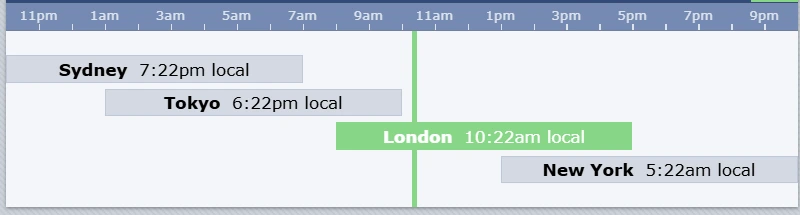
The Forex market doesn’t sleep. It’s open for trading 24 hours a day, five days a week (abbreviated 24/5). This makes it one of the most flexible financial markets in the world. But while the market is always open, it’s not always active. That’s where trading sessions come in.
There are four major Forex trading sessions based on key financial hubs:
- Sydney Session – Opens the global trading week. (7:30 pm local time)
- Tokyo Session – Represents Asian market activity. (6:39 pm local time)
- London Session – The most active and liquid session. (10:39 am local time)
- New York Session – Shares overlap with the London session, creating high volatility. (5:39 am local time)
Each session starts as the previous one winds down. This creates overlaps, which are the most active times to trade.
For example, the London/New York overlap (1:00 PM to 5:00 PM GMT) sees the highest trading volume and fastest price movements.
Different currency pairs are most active during specific sessions. For instance:
- JPY pairs like USD/JPY are most active during the Tokyo session.
- GBP and EUR pairs move more during the London session.
- USD pairs dominate the New York session.
Trading Forex CFDs during active sessions often leads to tighter spreads, faster execution, and better opportunities. On the other hand, trading during quieter hours might result in wider spreads and slower price changes.
Understanding when to trade can make a big difference in your strategy. It helps you choose the right time for your trading style.

Meet Londeka, a Forex CFD Trader based in Pretoria.
Let’s bring this to life with a real-world scenario: Meet Londeka, a Forex trader based in Pretoria. She likes to trade major currency pairs, especially EUR/USD. South Africa operates on South African Standard Time (SAST), which is GMT+2.
Every day, Londeka sets aside time between 3:00 PM and 5:00 PM SAST to trade. During this window, both the London and New York sessions are active. This overlap is when trading volume is highest, spreads are tightest, and Londeka can easily predict what may likely happen in the market.
It’s her favourite time to trade because she can enter and exit her positions with potentially better pricing and lower slippage.
However, if Londeka tries to trade around midnight (12:00 AM SAST) when the Sydney session is open, market liquidity is much lower. She notices that price movements are slower, spreads are wider, and it’s harder to find good trade setups.
Because of this, she avoids late-night trading and sticks to high-activity periods when she’s better positioned for profit-taking opportunities.
Trading during active sessions often leads to tighter spreads, faster execution, and better opportunities. On the other hand, trading during quieter hours might result in wider spreads and slower price changes.
What Makes Forex Trading Attractive?
People trade Forex for various reasons. One big reason is accessibility. You don’t need a lot of money to start. Many CFD brokers, like Vantage Markets, let you open an account with as little as $5.
Fexibility
Another key reason is flexibility. The Forex market is open 24 hours a day, five days a week. This means you can trade before work, during lunch, or at night, whatever fits your schedule.
High Liquidity
Trading the financial market also offers high liquidity. This simply means that there are always buyers and sellers waiting to meet demand and supply in the foreign exchange market. Because of this, it’s easy to enter or exit a trade quickly.
Leverage
Let’s talk about the concept of leverage and why it is important for any trader. This is the most talked-about concept in financial trading or e-trading.
Leverage, offered in CFD trading, is a major factor that attracts traders to forex markets compared to traditional stock trading. Leverage is the money your broker lends you to trade with.
How Leverage Works
Let’s just say a trader has a $ 2,000 account; you may be unable to open larger positions in the market without your broker providing leverage.
Now, imagine that your broker gives you a leverage of 1:500, which means that you are taking a position in the market using a fraction of your trading capital while you borrow the rest from your broker.
With a $2000 deposit and leverage of 1:500, you could open positions with a notional value of up to $1,000,000, but this also significantly increases your exposure to risk
Important: Leverage limits are subject to the regulations in your region. For example, retail clients in certain regulatory jurisdictions may be subject to lower leverage (e.g., 1:30). Please check with your broker for the applicable leverage in your country.
As much as leverage can help your trading, the flip side is that you could wipe out your entire trading account if you use it without caution.
Diversification
Another reason traders love Forex is diversification. Instead of relying on just stocks or other digital assets, Forex gives you another way to build your income strategy.
Technology
Finally, technology has made Forex more user-friendly. You can now trade on your phone, use trading apps, and access free education and analysis tools.
In short, Forex is fast, global, and offers plentiful opportunities. It’s no wonder more people are choosing to explore it, especially with the option to practice on a demo account first.
Join thousands of others who are exploring the Forex CFD market with a demo account
Choosing the Right Forex Broker
(Open a secure, regulated trading account in under 2 minutes.)
To trade Forex CFDs successfully, you need the right broker. This choice can affect your costs, trading speed, and overall experience.
First, check if the broker is regulated. In South Africa, look for brokers like Vantage Markets licensed by the FSCA. Globally, trusted regulators include the FCA in the UK and ASIC in Australia. Regulation means the broker follows rules to protect your money.
Next, look at the spreads and fees that each broker you are considering offers. A broker offering lower spreads means you pay less on each trade you place on their platform. Some brokers also charge a commission, while others don’t. Make sure you understand their pricing.
Another thing you can do is to check the trading platforms on offer. Platforms like MetaTrader 4 (MT4) and MetaTrader 5 (MT5), and TradingView are great for beginners. It’ll be good to try the demo version of each trading platform first. That way, you can practice without using real money.
Customer service is important too. When evaluating brokers, consider factors like customer support responsiveness. You can also explore trading platforms with a demo account to get familiar with the interface.
Lastly, check how easy it is to deposit and withdraw funds. A good broker should offer secure and flexible payment options, such as bank transfers, cards, and local payment methods.
Choosing a reliable broker is the first step towards boosting your confidence and trading with peace of mind.
How to Place a Trade

Placing a trade in the Forex market is simpler than you might think. Once your trading account is ready and your platform is set up, you can begin with just a few clicks.
First, choose a currency pair you want to trade. Let’s say you select EUR/USD. This means you are speculating on the value of the euro against the U.S. dollar.
Next, decide your trade direction:
- If you believe the euro will rise, you click Buy.
- If you think it will fall, you click Sell.
The Role of KYC in Forex CFD Trading
Before you can place your first trade, your broker will likely require KYC (Know Your Customer) verification. This step is mandatory for Forex CFD Trading with a regulated broker and helps protect your identity and funds. You’ll need to upload documents like a valid ID and proof of address.
Once you complete your verification, you are now ready to start trading. Select your trade size (also called “lot size”). This determines how much currency you’re buying or selling. For beginners, starting with a smaller loss size is safer.
Then, apply these time-tested risk management tools:
- Stop Loss (SL): Closes your trade automatically if the market moves against you.
- Take Profit (TP): Locks in profit once your target price is reached.
You can also choose the order type:
- A Market Order opens your trade immediately at the current price.
- A Limit Order opens your trade only when the price reaches a level you’ve set.
- A Stop Order is used to enter a trade once the price breaks through a specific level.
Finally, click Confirm or Place Order. Once you confirm your order, you’ll be able to watch your trade in real time and close it manually at any time.
Always double-check your settings before confirming. It only takes a second, but it could save you from costly mistakes.
Understanding Risks and Strategy Basics
(Before you proceed, you can read our comprehensive guide on risk management here.)
Trading Forex can be rewarding, but it also comes with risks. Before placing real trades, it’s important to understand the risks and how to manage them.
The biggest risk is leverage. While leverage allows you to control larger trade sizes with small deposits, it can also magnify losses.
For example, a small price move against your position could wipe out your balance if you’re over-leveraged. That’s why smart traders always trade within their means.
Another key risk is volatility. Currency prices can move quickly, especially during major economic news or political events. Sometimes, these moves are unpredictable.
That’s why it’s wise to avoid trading blindly during high-impact news unless you understand the risks.
To manage these risks, traders use risk/reward strategies. This simply means only risking a small part of your capital on each trade. Many traders use a 1:2 ratio, risking 1 unit to gain 2.
Stop-Loss and Take-Profit orders help you manage this. A Stop Loss prevents deep losses by closing your trade automatically if the price moves against you. A Take Profit locks in gains when your price target is hit.
Also, keep a trading journal. Write down your trades, your reasons, and the outcome. Over time, this will help you improve your strategy and avoid repeating mistakes.
Finally, use tools like a risk calculator to plan each trade before you place it. Thoughtful planning is what separates experienced traders from beginners.
Access your risk calculator tool inside our client portal.
Trading a Demo vs a Live Account
When you’re starting in Forex, it’s important to know the difference between a demo account and a live account. Each serves a different purpose in your trading journey.
A demo account lets you trade with virtual or free money. It’s a risk-free way to practice before going on a Live Account. You get access to real market conditions without using your funds. This helps you learn how to place trades, test strategies, and get used to the platform.
A live account, on the other hand, involves real money. This means you can make actual profits, but you can also lose your trading capital. Trading live introduces something new into how you feel when you trade: that’s your emotion. Fear, greed, and stress can all affect your decisions when real money is on the line.
Here’s a simple rule: start with a demo, grow with live. Use the demo account to learn the basics. Once you feel confident, switch to a live account with a small deposit. From there, increase your size slowly as your skills improve.
Still unsure which one to use? Here’s a quick comparison:
| Feature | Demo Account | Live Account |
| Risk Level | No financial risk | Real money at stake |
| Emotions Involved | None | High (fear, greed, stress) |
| Learning Experience | Practice with zero consequences | Real-time decision making |
| Trade Execution | Simulated, may differ slightly from the real | True execution with slippage and spreads |
| Best for | Beginners, strategy testing | Confident traders ready for real gains |
Test your strategy risk-free before going live. Open a demo trading account today.
Forex Glossary
As a new trader, you’ll come across certain words repeatedly. Here’s a quick glossary to help you understand the most common Forex terms:
- Pip: Short for “percentage in point.” It’s the smallest price change a currency pair can make. For most pairs, one pip equals 0.0001.
- Spread: The difference between the buying (ask) and selling (bid) price. Brokers earn from this difference.
- Leverage: Allows you to trade with more money than you have in your account. For example, 1:100 leverage lets you control $10,000 with just $100.
- Lot: The unit size of a trade. A standard lot is 100,000 units of currency. Beginners often trade micro lots (1,000 units).
- Margin: The amount of money needed in your account to open a trade. It’s your investment portion when using leverage.
- Slippage: When a trade is executed at a price different from the expected price, often due to market volatility or a slow internet connection.
- Stop Loss (SL): A risk tool that closes your trade automatically if the market moves against you.
- Take Profit (TP): A setting that automatically closes your trade once it reaches a desired profit level.
If you’d like a more complete list, check our full Forex Glossary of 30 essential terms explained in plain language.
Frequently Asked Questions
Is Forex CFD trading something I can start with no experience?
Yes. With a demo account and a solid understanding of how Forex CFD trading works, beginners can start practising without risking real money. However, it’s important to continue learning and understand the risks involved before trading with live funds
How much money do I need to begin Forex CFD trading?
You can begin trading Forex CFDs with a small amount, such as $10, depending on your broker’s minimum deposit. However, keep in mind that trading with limited capital may affect your ability to manage risk effectively. Always start with an amount you can afford to lose.
Can I trade Forex CFDs on my phone, or do I need a computer?
Yes, many CFD brokers offer mobile trading apps that let you place trades, monitor markets, and manage your account on the go. However, be mindful that trading on mobile devices may limit access to certain tools or features compared to desktop platforms.
What are the safest times to trade for beginners?
Overlaps like the London/New York session (3 PM – 5 PM SAST) offer higher liquidity and more consistent trading activity, which may help beginners better observe how the market reacts to global news, though price movements remain unpredictable.
What should I learn first before going live with my trades?
Before trading live, it’s important to learn the basics of how currency pairs work, how to manage risk, and how to use platform tools such as Stop-Loss and Take-Profit orders. These are essential concepts that can help you better understand and navigate market conditions.
Do I need to understand global economics to engage in international trade?
A deep understanding of global economics isn’t required to get started, but learning how economic news impacts currency prices can support more informed trading decisions.
Risk Warning: CFDs are complex financial instruments and carry a high risk of rapid loss of money due to leverage. You should ensure you fully understand the risks involved and carefully consider whether you can afford to take the high risk of losing your money before trading.
Disclaimer: The information is provided for educational purposes only and doesn’t take into account your personal objectives, financial circumstances, or needs. It does not constitute investment advice.
We encourage you to seek independent advice if necessary. The information has not been prepared in accordance with legal requirements designed to promote the independence of investment research. No representation or warranty is given as to the accuracy or completeness of any information contained within. This material may contain historical or past performance figures and should not be relied on.
Furthermore, estimates, forward-looking statements, and forecasts cannot be guaranteed. Th/ e information on this site and the products and services offered are not intended for distribution to any person in any country or jurisdiction where such distribution or use would be contrary to local law or regulation.,
References
-
“Best Times to Trade the Forex Markets: A Guide”- Investopedia. https://www.investopedia.com/articles/forex/08/forex-trading-schedule-trading-times.asp. Accessed 12 July 2025.
- “Currency Pair”- CFI. https://corporatefinanceinstitute.com/resources/foreign-exchange/currency-pair. Accessed 13 July 2025.
- “Understanding FX Quote Conventions”- CME Group. https://www.cmegroup.com/education/courses/introduction-to-fx/understanding-fx-quote-conventions.html. Accessed 10 July 2025.