






 Updated
Platinum vs gold is a common comparison for traders because both metals can be traded as CFDs, yet they behave differently. Gold (XAUUSD) is generally the deeper and more liquid market and is widely viewed as a safe-haven asset. Platinum (XPTUSD) is thinner, with prices driven more by industrial demand and supply.
Neither metal is better. The right choice depends on your trading goals, risk tolerance, and market outlook.
If you’re still deciding which metal suits you, a demo account lets you compare how both markets behave before trading with real money.
Key takeaways
- Gold (XAUUSD) and platinum (XPTUSD) are both traded as CFDs.
- Gold is typically the more liquid and established safe-haven market.
- Platinum prices are influenced more by industrial demand and supply conditions, particularly in South Africa.
- The two metals often respond to different market forces.
- The right choice depends on the type of exposure you want, rather than on one metal being better than the other.
Platinum vs gold: Differences
The table below compares the main differences between gold and platinum in CFD markets.
| Feature | Gold | Platinum |
| CFD ticker | XAUUSD | XPTUSD |
| Rough price level | Verify at publication. Often trades above platinum. | Verify at publication. Often trades below gold. |
| Volatility | Usually lower | Usually higher |
| Liquidity | Very high | Lower than gold |
| Main price drivers | Real interest rates, US dollar, central bank demand, safe-haven flows | Industrial demand, vehicle production, South African supply, palladium substitution |
| Safe-haven role | Strong | Limited |
| Supply | Globally diversified | Heavily concentrated in South Africa |
Gold is usually the steadier, more liquid market. Platinum often reacts more sharply to changes in industrial demand and supply.

Platinum vs Gold price: Which is more expensive?
| Feature | Gold | Platinum |
| CFD ticker | XAUUSD | XPTUSD |
| Spot price at 06:50 GMT, 4 August 2026 | $4,061.96 per troy ounce | $1,648.97 per troy ounce |
| Volatility | Usually lower | Usually higher |
| Liquidity | Very high | Lower than gold |
| Main price drivers | Real interest rates, US dollar, central-bank demand and safe-haven flows | Industrial demand, vehicle production, South African supply and palladium substitution |
| Safe-haven role | Strong | Limited |
| Mine supply | Spread across several countries | Concentrated in South Africa, which produced about 71% of global refined platinum in 2025 |
Price source: Reuters, 4 August 2026. Production source: WPIC Platinum Quarterly Q1 2026.
Gold usually trades at a higher price than platinum, though that has not always been the case. Platinum traded above gold for many years before the relationship reversed. Verify the current price relationship before publication, as prices change continuously.
The answer to which is more expensive, gold or platinum, depends on current market conditions. Gold’s higher price today reflects strong investment demand, central bank buying, and its long-standing role as a safe-haven asset. Platinum’s price is influenced more by industrial demand, particularly from the automotive sector, along with supply conditions.
For traders, the price difference is only part of the comparison. A higher price does not make one market better than the other. Gold and platinum respond to different drivers so that they can behave very differently during the same market event. Understanding why each metal moves is often more useful than comparing their headline prices alone.
What drives platinum and gold prices?
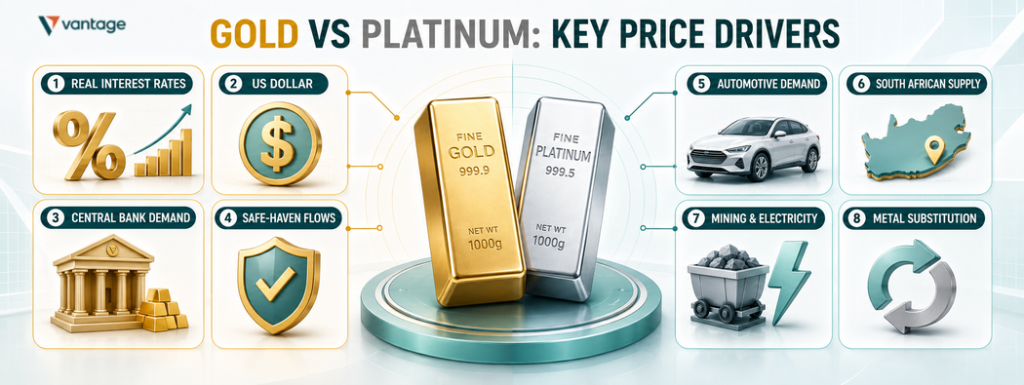
Gold and platinum respond to different market forces, so they don’t always move in sync.
Gold prices depend on several primary drivers. These include real interest rates and the strength of the US dollar. Investment demand also rises during times of economic or geopolitical uncertainty. Central banks also buy gold. They do this to protect against currency fluctuations and inflation. Together, these drivers reinforce gold’s status as a reliable safe-haven asset.
Industrial demand is the main factor driving platinum price. The automotive industry uses a lot of platinum, mainly for catalytic converters. South Africa supplies about 80% of the world’s platinum, so its mines greatly affect the market. These mines often deal with power shortages, worker strikes, and limits on refining.
Another influence is substitution within the platinum group metals market. Manufacturers might switch from palladium to platinum if prices make it worthwhile. Traders watch the move to electric vehicles. This shift might reduce long-term demand in the industry.
Understanding these different drivers helps explain why gold and platinum can react differently to the same economic event, even though both are precious metals.
Volatility and liquidity
Gold is one of the world’s most liquid financial markets, making it easier to enter and exit positions across different market conditions. High trading activity often supports tighter spreads and smoother price movements, though volatility can still increase during major economic events.
Platinum is a thinner market with lower trading volumes than gold. As a result, price swings can be sharper, spreads may be wider, and large orders can have a greater impact on the market. These characteristics can make platinum more challenging to trade, particularly during periods of lower liquidity.
Neither market is inherently better than the other. Gold may appeal to traders looking for a deeper market with more consistent reactions to macroeconomic events. Platinum may suit traders who are comfortable with faster price movements and understand the risks of a less liquid market.
Whichever metal you trade, risk management remains important. Position sizing, stop-loss orders, and a clear trading plan can help manage the effects of market volatility. For more on trading gold responsibly, see our guide to managing risk on XAUUSD.
Safe-haven role: How the metals behave
Gold is widely regarded as the benchmark safe-haven metal. When trading gold CFDs, traders are speculating on price movements rather than purchasing physical gold. During periods of market uncertainty, investors often turn to gold as a store of value, which can increase demand when financial markets become volatile or economic risks rise.
Platinum behaves differently. Although it is a precious metal, its price is influenced more by industrial demand than safe-haven buying. Demand from manufacturers, particularly the automotive sector, means platinum often follows the broader economic cycle rather than acting as a defensive asset.
This difference helps explain why the two metals do not always move together. Gold may strengthen during risk-off periods, while platinum can be more closely tied to expectations for economic growth and industrial activity.
Neither behaviour is better. Each metal reflects a different part of the global economy.
The South African supply story

South Africa plays a much larger role in the platinum market than it does in the gold market. The country produces around 80% of the world’s platinum supply, making local developments an important influence on global prices. Verify this figure before publication.
Events such as changes in mine output, electricity shortages, labour negotiations, and operational disruptions can affect platinum supply and influence market sentiment. This concentrated supply base makes platinum more sensitive to developments in South Africa than gold.
Gold production is spread across many countries, so supply risks are more diversified. Although South Africa remains an important mining nation, its share of global gold production has declined over time.
For traders, this means South African news can have a greater impact on platinum than on gold. Companies such as Anglo American Platinum, Impala Platinum, and Sibanye-Stillwater provide useful context for the country’s production. Still, they are not trade ideas or proxies for trading the metal itself.
Which metal suits which trader?
Neither platinum nor gold is the right choice for every trader. The better fit depends on your objectives, the market conditions you want to follow, and your level of trading experience.
Safe-haven or macro trader: Gold may be a better fit if you focus on interest rates, central bank policy, the US dollar, and periods of market uncertainty. Its deep liquidity and established role as a safe-haven asset often make price movements easier to follow.
Diversifier or industrial-cycle trader: Platinum may suit traders looking for different market exposure. Industrial demand, South African supply, and developments in the automotive sector can create trading opportunities that do not always mirror gold.
New trader: Gold is often the simpler market to start with because it is more liquid and typically has tighter spreads. Platinum’s lower liquidity and sharper price swings may require greater experience and careful risk management.
There is no universal choice between the two metals. Understanding what drives each market can help you decide which one better matches your trading plan, without assuming one is superior to the other.
How to trade platinum and gold CFDs
Gold and platinum can both be traded as CFDs through XAUUSD and XPTUSD. With CFDs, you speculate on whether the price will rise or fall without owning the physical metal. You can take both long and short positions, though leverage increases both potential gains and potential losses.
If you want to learn how each market works in more detail, see our guide on how to trade platinum in South Africa for XPTUSD and how to trade gold and silver for gold trading fundamentals. These articles explain the trading process, market hours, and the factors that influence each metal.
This page focuses on how the two markets compare. The linked guides explain how to trade them, helping you choose the market that best fits your trading objectives before opening a demo or live account.
Conclusion
Platinum and gold are both widely traded metals, but they serve different roles in financial markets. Gold is the established safe-haven market, while platinum is influenced more by industrial demand and South African supply.
Rather than asking which metal is better, consider which one best matches your trading plan, experience, and the market themes you want to follow. If you’re still deciding, a demo account can help you compare how XAUUSD and XPTUSD behave before trading with real funds.
Frequently Asked Questions
Is platinum better than gold for investment?
Neither metal is better for every trader. Gold is known for its safe-haven role, while platinum is influenced more by industrial demand. The right choice depends on your objectives, risk tolerance, and preferred market exposure.
Why is platinum cheaper than gold right now?
Gold often trades at a higher price because of investment demand and its safe-haven status. Platinum is driven more by industrial demand. Verify the current price relationship before publication, as it has changed over time.
Is platinum more volatile than gold?
Often, yes. Platinum is typically less liquid than gold, which can lead to wider spreads and sharper price swings. Gold is usually steadier, although both markets can become volatile during major economic events.
Do platinum and gold move together?
Sometimes, but not always. Both are precious metals, yet they respond to different drivers. Gold reacts more to macroeconomic conditions, while platinum is influenced more by industrial demand and supply.
Which metal is the better safe-haven?
Gold is widely regarded as the benchmark safe-haven metal. Platinum is more closely tied to industrial activity, so it does not usually behave the same way during periods of market uncertainty.
Should a beginner trade gold or platinum first?
Gold is often the simpler market for beginners because it is more liquid and generally has tighter spreads. Platinum’s sharper price movements may require greater experience and careful risk management.
Why does South Africa matter so much to platinum prices?
South Africa produces around 70-75% of the world’s platinum. Changes in mine output, electricity supply, or labour conditions can influence global platinum prices. Verify this figure before publication.
Can I trade platinum and gold without owning the metal?
Yes. Platinum (XPTUSD) and gold (XAUUSD) CFDs let you trade price movements without owning the physical metals. With CFDs, traders can take both long and short positions.
Risk Warning: CFDs are complex financial instruments and carry a high risk of losing money rapidly due to leverage. You should ensure you fully understand the risks involved and carefully consider whether you can afford to take the high risk of losing your money before trading.
Disclaimer: The information is provided for educational purposes only and doesn’t take into account your personal objectives, financial circumstances, or needs. It does not constitute investment advice. We encourage you to seek independent advice if necessary. No representation or warranty is given as to the accuracy or completeness of any information contained within.
This material may contain historical or past performance figures and should not be relied on. Furthermore, estimates, forward-looking statements, and forecasts cannot be guaranteed. The information on this site and the products and services offered are not intended for distribution to any person in any country or jurisdiction where such distribution or use would be contrary to local law or regulation.
References
- https://vantagemarektsdev.canglankeji.com/en-za/academy/how-to-trade-platinum-in-south-africa/ – How to trade platinum in South Africa.
- https://vantagemarektsdev.canglankeji.com/en-za/academy/how-to-trade-gold-and-silver/ – How to trade gold and silver.
- https://vantagemarektsdev.canglankeji.com/en-za/academy/xauusd-risk-management/ – Ultimate risk management guide: position size and leverage for gold traders.
- https://vantagemarektsdev.canglankeji.com/en-za/academy/gold-vs-silver-investment/ – Gold vs silver investment in 2026: Which performs better?