






 Updated
Yes, South African traders can trade platinum as a CFD through XPTUSD. Platinum tracks one troy ounce of platinum priced in US dollars. It is generally less liquid and more volatile than gold, and leverage increases both potential gains and potential losses. A demo account is a practical way to learn how the market behaves before trading with real funds.
If you’re wondering how to trade platinum in South Africa, it starts with understanding what moves the market. Platinum is both a precious and an industrial metal, so its price is shaped by manufacturing demand, investment flows, and South Africa’s dominant role in global supply.
If you’re new to precious metals, our guide on how to trade gold and silver explains the fundamentals before you move on to platinum. Once you’re ready, a demo account lets you practise trading XPTUSD in a risk-free environment.
Key Takeaways
- Platinum CFD instrument and ownership: Platinum is traded as a CFD via XPTUSD, allowing speculation on price moves without owning the metal, with leverage that can amplify gains and losses.
- Main drivers of platinum price: Prices are influenced by industrial and auto demand, South Africa’s supply role, and US dollar/investment demand, with palladium substitution also affecting demand dynamics.
- How to trade platinum CFDs: You can go long or short on XPTUSD to profit from rising or falling prices; costs include the spread and potential overnight financing, with leverage impacting risk and reward.
- Platinum vs gold in trading terms: Platinum is less liquid and more volatile, with stronger ties to industrial demand and wider spreads, whereas gold is typically more liquid and a safer benchmark.
- Getting started and risk management: Begin with a demo account to learn XPTUSD trading, then move to a live account, while applying careful risk management due to platinum’s liquidity and leverage-related risks.
Platinum as a tradeable instrument
Platinum is a precious metal and part of the platinum group metals (PGMs). It is widely used in industry, particularly in vehicle manufacturing, while also attracting investment demand. When trading platinum as a CFD, the instrument is quoted as XPTUSD, which tracks one troy ounce of platinum priced in US dollars.
Unlike physical platinum, a CFD lets you speculate on price movements without taking ownership of the metal. You can trade both rising and falling markets, though leverage increases both potential gains and potential losses.
The table below summarises the main features of the instrument.
| Feature | Platinum (XPTUSD) |
| Asset class | Precious and industrial metal |
| CFD ticker | XPTUSD |
| Tracks | One troy ounce of platinum in US dollars |
| Platinum group | Platinum group metals (PGMs) |
| Sister metal | Palladium (XPDUSD) |
| Liquidity | Lower than gold, with a thinner market |

What drives the platinum price
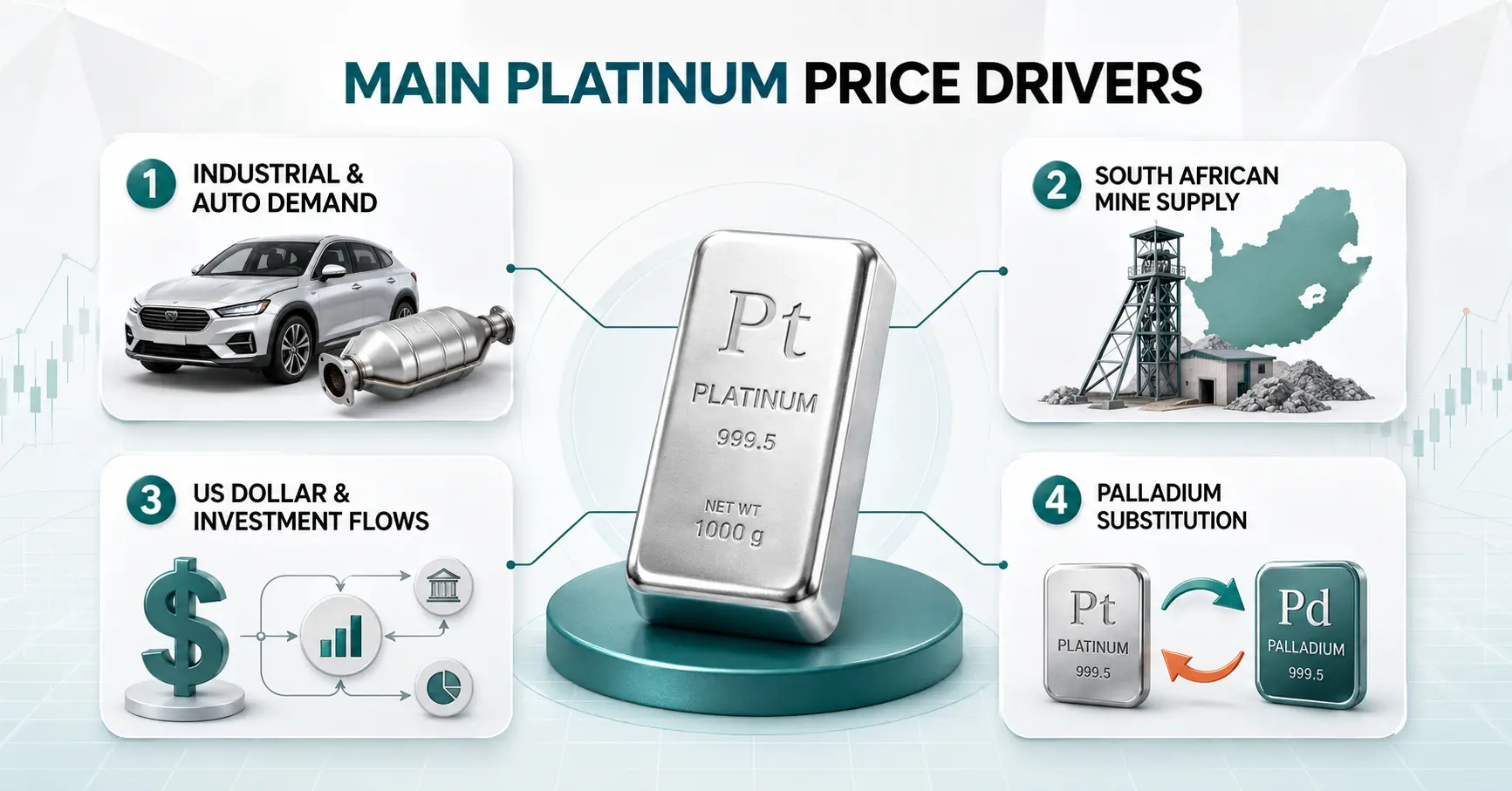
Several factors influence the platinum price, often at the same time. Understanding these drivers helps explain why the market moves without relying on price forecasts.
The table below summarises the main influences before each is explained in more detail.
| Price driver | Why it matters |
| Industrial and auto demand | Vehicle production and industrial activity affect platinum consumption. |
| Supply and South Africa’s role | Mine output and supply disruptions can influence global availability. |
| The US dollar and investment demand | Dollar strength, investment flows, and palladium substitution can affect prices. |
Industrial and Auto Demand
Industrial demand is one of the biggest influences on platinum prices. The automotive industry accounts for a large share of global platinum consumption because the metal is used in catalytic converters that help reduce vehicle emissions.
Demand can also change as vehicle production rises or falls in major manufacturing markets. Stricter emissions standards may increase the use of platinum in some applications, although technology and regulatory changes can alter demand over time.
Traders also watch longer-term developments such as the transition to electric vehicles. This could affect platinum consumption in the years ahead, but the timing and impact remain uncertain. Rather than focusing on predictions, it is more useful to monitor how industrial demand changes and how the market responds.
Supply, and South Africa’s role
According to the World Platinum Investment Council (WPIC), South Africa accounts for approximately 70-75% of global mined platinum production. This concentration means local developments can influence global prices more than they would for many other commodities.
Mine output is one of the main supply drivers. Production levels can change because of planned maintenance, operational disruptions, or reduced output from major mining regions. Electricity availability is another important factor, as mining operations depend on a stable power supply.
Labour negotiations and wage disputes can also affect production. If mining activity slows, the market may expect tighter supply, which can influence platinum prices.
Companies such as Anglo American Platinum, Impala Platinum, and Sibanye-Stillwater help illustrate where much of the world’s platinum is produced. They are relevant as supply context only and should not be viewed as trade ideas or substitutes for trading platinum through XPTUSD.
The Dollar and Investment Demand
Platinum is priced in US dollars, so movements in the dollar can influence its price. A stronger dollar can make platinum more expensive for buyers using other currencies, which may reduce demand. A weaker dollar can have the opposite effect. Investment flows also play a role, particularly when economic conditions or market sentiment change.
Traders also monitor palladium because the two metals can substitute for each other in catalytic converters. Changes in their relative prices may encourage manufacturers to favour one metal over the other, affecting platinum demand. These relationships help explain price movements, but they do not predict future market direction.
How to trade platinum via CFDs
There are several ways to gain exposure to platinum, though each works differently. Some involve owning the metal or a financial product linked to it. CFDs allow you to speculate on platinum’s price movements without taking physical ownership.
The table below compares the main ways to trade or invest in platinum.
| Method | How it works | Typical use |
| Bullion | Buy and own physical platinum | Long-term holding |
| Futures | Standardised exchange-traded contracts | Professional and institutional trading |
| ETF | Invest in a fund linked to platinum | Longer-term market exposure |
| CFD (XPTUSD) | Trade price movements without owning the metal, with the option to go long or short | Short- and medium-term trading |
Price source: Reuters, 4 August 2026. Production source: WPIC Platinum Quarterly Q1 2026.
For many retail traders, CFDs offer a practical way to access platinum because they remove the need to store or insure the physical metal. They also allow both buying and selling opportunities. Remember that CFDs use leverage, which increases both potential gains and potential losses.
Going long or short on XPTUSD
When trading XPTUSD, you can take a long position if you expect the platinum price to rise or a short position if you expect it to fall. Your profit or loss depends on the size of the price movement and your position size.
Because XPTUSD is traded as a CFD, you never own the physical metal. Instead, you speculate on changes in its price. Trading in both directions offers flexibility, though losses can increase just as quickly as gains, particularly when leverage is used.
What does a platinum CFD cost
The cost of trading a platinum CFD usually includes the spread between the buy and sell prices. If you keep a position open overnight, financing charges may also apply. The total cost depends on your account type, position size, and how long the trade remains open.
Because platinum is traded with leverage, a smaller deposit controls a larger position. This increases both potential gains and potential losses. Before trading, it is worth understanding how spreads, overnight financing, and other trading costs may affect your results. See our guide to the cost of trading for a detailed explanation.
Managing risk when trading platinum
Platinum is generally less liquid than gold and often experiences larger price swings, particularly during periods of lower market liquidity. Market conditions can also change quickly after major news or supply disruptions, making careful risk management especially important.
Start by deciding how much of your trading capital you are prepared to risk before entering a position. Your position size should be based on that risk amount and the distance to your stop-loss, rather than the size of your account alone.
It is also sensible to keep a margin buffer, as sudden price movements can increase margin requirements. Because platinum is generally less liquid than gold, traders should consider its wider spreads, sharper price movements and their own risk management approach when deciding whether it fits their trading strategy.
For more guidance on managing precious metals positions, see our article on managing risk on XAU/USD. Remember that CFDs use leverage, which increases both potential gains and potential losses.
Who platinum trading suits
Platinum can suit different traders, though it is not the right market for everyone. Your experience, trading style, and the type of market you want to follow all play a part.
New-to-commodities trader: A demo account is a good place to start. Gold is often the simpler first metal because it is more liquid. Platinum may not suit you if you are still learning how commodity markets respond to economic news.
Gold trader diversifying: Platinum offers exposure to different price drivers, particularly industrial demand and South African supply. Expect wider spreads and sharper price movements than XAUUSD. It may not suit you if you prefer the deeper liquidity of gold.
Experienced trader evaluating platinum: Platinum can provide opportunities linked to supply disruptions and changing industrial demand. Liquidity and slippage deserve close attention, especially when markets are moving quickly. It may not suit you if your strategy depends on consistently tight spreads or very large position sizes.
Platinum and palladium
Platinum and palladium are both members of the platinum group metals (PGMs) and share many industrial uses. Palladium is traded as XPDUSD, and traders often follow both markets because changes in one can influence demand for the other.
Both metals are widely used in catalytic converters. When the price difference between them changes, manufacturers may substitute one metal for the other where technically and economically feasible. This shift can affect industrial demand and influence platinum prices over time.
Although the two metals are closely related, they do not always move together. Each has its own supply, demand, and market dynamics, so traders should assess them individually.
How platinum compares to gold
Platinum and gold are both precious metals, but they behave differently in financial markets. Platinum is more closely tied to industrial demand, trades in a thinner market, and often experiences sharper price movements. Gold is generally more liquid and is widely regarded as the benchmark safe-haven metal.
For a detailed comparison of the two markets, including price drivers, volatility, liquidity, and which metal suits different trader types, see our Platinum vs Gold guide.
How to start on Vantage, and what’s next
A demo account is a practical place to begin trading platinum. It lets you practise with XPTUSD, become familiar with the platform, and understand how the market behaves before risking real funds. When you’re ready, you can move to a live account.
On the platform, you can find XPTUSD alongside other commodity CFDs and review its trading conditions before placing a trade.
To continue learning, you may also find these guides useful:
These resources provide broader context for trading precious metals and managing risk.
Conclusion
Platinum offers South African traders exposure to a market shaped by industrial demand, global economic conditions, and the country’s leading role in world supply. Trading XPTUSD as a CFD allows you to take long or short positions without owning the physical metal, though leverage increases both potential gains and potential losses.
Start with a demo account to learn how platinum behaves in different market conditions. Once you have a trading plan and understand the risks, you can move to a live account with greater confidence.
Frequently Asked Questions
Can you trade platinum in South Africa?
Yes. South African traders can trade platinum as a CFD through XPTUSD. This lets you speculate on price movements without owning the physical metal. A demo account is a good way to practise before trading with real funds.
What is the platinum ticker symbol?
The standard ticker for platinum CFDs is XPTUSD. It represents one troy ounce of platinum priced in US dollars and is commonly available on CFD trading platforms.
Is platinum more volatile than gold?
Often, yes. Platinum is generally less liquid than gold, which can result in wider spreads and sharper price movements. Both metals carry risk, though platinum can experience larger swings during periods of lower liquidity.
Is platinum a good metal for a beginner to trade?
It can be, but many beginners find gold easier because it is usually more liquid. If you choose platinum, practising on a demo account first can help you understand how the market behaves.
What is the difference between platinum and palladium?
Both are platinum group metals used in catalytic converters. Palladium is traded as XPDUSD, and manufacturers may substitute one metal for the other when relative prices change, affecting industrial demand.
Can I trade platinum without owning the metal?
Yes. Platinum CFDs let you speculate on price movements without buying or storing physical platinum. You can take both long and short positions through XPTUSD.
What affects platinum prices the most?
Industrial demand, South African mine supply, movements in the US dollar, and investment flows are among the main drivers of platinum prices. These factors often interact, so traders monitor them together rather than in isolation.
Risk Warning: CFDs are complex financial instruments and carry a high risk of losing money rapidly due to leverage. You should ensure you fully understand the risks involved and carefully consider whether you can afford to take the high risk of losing your money before trading.
Disclaimer: The information is provided for educational purposes only and doesn’t take into account your personal objectives, financial circumstances, or needs. It does not constitute investment advice. We encourage you to seek independent advice if necessary. No representation or warranty is given as to the accuracy or completeness of any information contained within. This material may contain historical or past performance figures and should not be relied on.
Furthermore, estimates, forward-looking statements, and forecasts cannot be guaranteed. The information on this site and the products and services offered are not intended for distribution to any person in any country or jurisdiction where such distribution or use would be contrary to local law or regulation.
References
- https://vantagemarektsdev.canglankeji.com/en-za/academy/how-to-trade-gold-and-silver/ – How to trade gold and silver: strategies, analysis and market mechanics.
- https://vantagemarektsdev.canglankeji.com/en-za/academy/xauusd-risk-management/ – Ultimate XAUUSD risk management guide: position size and leverage for gold traders.
- https://vantagemarektsdev.canglankeji.com/en-za/academy/forex-trading-cost/ – What does forex trading really cost? A breakdown of forex trading costs.
- https://vantagemarektsdev.canglankeji.com/en-za/academy/best-time-to-trade-gold-in-south-africa/ – Best time to trade gold in South Africa.