






 Updated
When you start trading forex, one of the first terms you will come across is “pip”.
A trader may say: “I made 40 pips today.” “My stop loss is 30 pips.” “The spread is 1.5 pips.”
At first, it sounds simple. But most beginners miss the real point.
A pip is not just about price movement. It is about how much money you gain or lose when price moves. That is why every new trader must understand pips before placing live trades.
Key Takeaways
- A pip measures price movement, not profit by itself.
- Pip value changes with position size and market type.
- USD pairs are usually easier for beginners to calculate.
- JPY pairs count pips differently from many major pairs.
- The Gold CFD pip value can depend on the platform’s symbol settings.
- Spread, slippage, and fees can affect the final trade result.
- Experienced traders focus on risk value, not pip count alone.
Forex and CFD trading involves risk. Pip value can help traders understand exposure, but it does not remove the risk of loss. Spreads, leverage, slippage, volatility, and execution conditions can affect the final result.
What is a PIP?
A pip represents a small change in the exchange rate of a currency pair. In many forex pairs, one pip equals 0.0001. Traders use pips to describe how far a currency pair has moved, how wide a spread is, or how large a stop-loss or take-profit is.
For example, if EUR/USD moves from 1.0850 to 1.0851, the pair has moved by 1 pip. If GBP/USD moves from 1.2700 to 1.2750, the pair has moved by 50 pips.
Japanese yen pairs are usually measured differently. For JPY pairs, one pip is often measured at the second decimal place.
For example:
- USD/JPY moves from 150.20 to 150.21
- EUR/JPY moves from 162.40 to 162.41
- GBP/JPY moves from 190.10 to 190.11
Each of these moves equals 1 pip. So, if USD/JPY moves from 150.20 to 150.70, that’s a 50-pip move.
JPY pairs use a different decimal format because the yen is quoted at a much lower unit value compared with many other major currencies.
A pip measures price movement, but pip value measures the money value of that movement.
Pip value depends on several factors:
- The market is being traded
- The lot size
- The account currency
- The exchange rate
- The contract details of the instrument.

Why does PIP value matter more than PIP movement?
To start with, A 20-pip move can be small for one trader and painful for another. The difference is not the number of pips. The difference is the pip value.
Pip count shows distance. Pip value shows impact.
Think of pips like distance on a road. If two people travel 20 kilometres, they cover the same distance. But one person may be walking, while another is driving a heavy truck. The distance is the same, but the effect is not.
Forex works in a similar way.
A trader using a small lot size may risk only $2 on a 20-pip move. Another trader using a larger lot size may risk $200 on the same 20-pip move. That is why experienced traders do not judge a trade by pip count alone. They look at how much each pip is worth.
Position size is the main reason. The bigger your lot size, the more each pip is worth. A small lot keeps the money impact low. A large lot makes every pip count much more.
Spread also matters. If your broker’s spread is 2 pips and your target is 10 pips, you are already paying a high cost before the trade works in your favour.
Stop distance matters too. A 30-pip stop loss with $1 per pip means $30 in risk. The same stop with $10 per pip means $300 risk.
So, do not judge a trade by pips alone. Always ask, “How much is each pip worth?” That answer shows the real risk.
Pip, Pipette, and Point
A pip is the basic unit traders use to measure price movement in forex. For most non-JPY pairs, one pip is the fourth decimal place, like EUR/USD moving from 1.0850 to 1.0851.
A pipette is smaller than a pip. It is one-tenth of a pip. If EUR/USD moves from 1.08501 to 1.08502, that is one pipette, not one full pip.
A point is a more flexible term. Some platforms use “points” to mean the smallest price movement shown on the chart. In gold, indices, or CFDs, points may not mean the same thing as forex pips.
Different symbols show different decimal formats because markets are priced differently. EUR/USD, USD/JPY, and XAU/USD do not use the same quote style.
Before calculating profit, loss, or stop distance, always check your platform’s contract details, tick size, and pip value settings.
| Term | What it means | Beginner note |
| Pip | Standard price movement unit | Used in many forex examples |
| Pipette | Fraction of a pip | Often, the fifth decimal in major pairs |
| Point | Platform-based price movement term | May vary by symbol |
The PIP Translation Framework
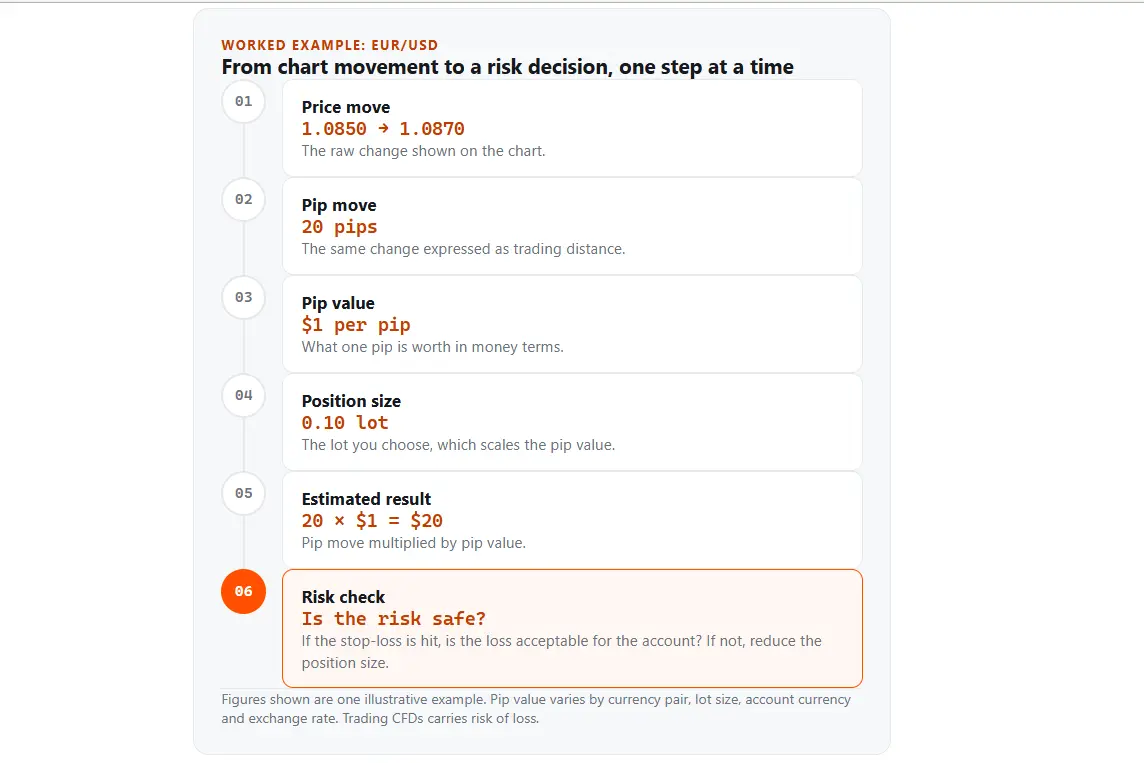
The PIP Translation Framework is a simple way to turn chart movement into real trading meaning. Many beginners only see price going up or down. An experienced trader learns to translate that move into pips, money, position size, and risk.
Use this flow:
Price move → pip move → pip value → position size → estimated result → risk check
Price move is the raw change on the chart. For example, EUR/USD moves from 1.0850 to 1.0870.
Pip move converts that price change into trading distance. In this case, the move is 20 pips. The pip count shows distance. The pip value shows impact.
The EUR/USD pip value tells you how much one pip is worth in monetary terms. A 20-pip move means little until you know whether each pip is worth $0.10, $1, or $10.
Position size is the lot size you choose. A bigger lot makes each pip heavier. A smaller lot keeps the impact lower.
The estimated result shows the likely profit or loss. If the move is 20 pips and each pip is worth $1, the result is about $20.
Risk check is the final step. Before entering, ask: If my stop-loss is hit, how much will I lose? If the amount feels too large for your account, reduce the position size.
Flow Diagram
EUR/USD PIP Calculation
EUR/USD is one of the easiest pairs to use when learning pip value. It is a USD-quoted pair, which means the U.S. dollar is the second currency. For traders with a USD account, the pip value is easier to understand.
For most non-JPY pairs, such as EUR/USD, one pip corresponds to the fourth decimal place. So, if EUR/USD moves from 1.0850 to 1.0851, that is a 1-pip move. Let’s use a simple trade example. A trader buys EUR/USD at 1.0850.
The trade is closed at 1.0870. The price moved up by 20 pips.
Now let’s add the lot size. If the trader used a 0.10 lot, that is a mini lot. On EUR/USD, a 0.10 lot is commonly worth about $1 per pip. So the result before costs is: 20 pips × $1 per pip = $20 profit.
Here is the full breakdown:
| Item | Example |
| Pair | EUR/USD |
| Entry price | 1.0850 |
| Exit price | 1.0870 |
| Pip movement | 20 pips |
| Lot size | 0.10 lot |
| Pip value | About $1 per pip |
| Result before costs | About $20 profit |
Now compare that with a larger lot.
If the same trader used a 1.00 lot, the pip value would be about $10 per pip.
So the result would be:
20 pips × $10 per pip = $200 profit
Same entry, exit, and same 20-pip move. The only major change is the lot size.
In real trading, the final result may be higher or lower due to spreads, commissions, slippage, swap fees, and execution conditions.
USD/JPY Pip Value Calculation
USD/JPY often confuses beginners because it does not look like pairs such as EUR/USD or GBP/USD. Most non-JPY pairs count one pip at the fourth decimal place. But JPY pairs often count one pip at the second decimal place.
So, if USD/JPY moves from 150.20 to 150.21, that is a 1-pip move. If it moves from 150.20 to 150.70, that is a 50-pip move.
Now, let’s talk about pip value.
Because USD/JPY is quoted with JPY as the second currency, the pip value is first linked to yen. If your account is in USD, that value must be converted back into dollars. Beginners do not need to stress over the full cross-currency maths. The key idea is simple: pip value changes based on the exchange rate and your lot size.
For example,
If USD/JPY is around 150.00, a standard lot may be worth about $6.67 per pip. A 0.10 lot may be worth about $0.67 per pip, while a 0.01 lot may be worth about $0.07 per pip.
So, if you trade a 0.10 lot and catch a 50-pip move, the result before costs may be around:
50 pips × $0.67 = $33.50
That is why JPY pairs need care. The pip count indicates distance, but the pip value reflects the monetary impact. Always check your platform’s pip value before placing the trade.
Gold CFD Price Movement and Pip Value
Gold CFDs need extra care because XAU/USD does not always behave like normal forex pairs. With EUR/USD, the pip value is usually easier to follow. With gold, you must check the symbol details first.
The main things to check are contract size, tick size, tick value, digits, and spread. These settings explain how the platform measures gold price movements and how much each movement is worth.
For example,
Assume XAU/USD moves from 2,350.00 to 2,351.00. That is a $1 gold price movement. Suppose your platform uses a 1.00 lot as 100 ounces, then a $1 move may equal about $100 before costs.
If you trade a 0.10 lot, the same $1 move may equal about $10 before costs. If you trade a 0.01 lot, it may equal about $1 before costs.
Same gold movement. Different result because of the lot size. Spread also matters. Gold spreads can widen during news or low-liquidity periods, so your final result may differ from the simple calculation.
Before trading gold, always open the platform’s symbol details and confirm the contract size, tick size, tick value, digits, and spread.
PS: Gold may appear as XAU/USD, GOLD, XAUUSD.m, or another symbol name. Do not assume the pip value is the same across all platforms.
Same Pips, Different Result
One thing in trading is that pips can be misleading. A trader may mention their pip gain, and it may sound impressive. But the more useful question is: with what lot size?
That is where the real story begins.
Pip count only tells us how far the price moved. It does not tell us how much money was made or lost. The main difference is position size. A smaller lot size makes each pip worth less. A larger lot size makes each pip worth more.
The market also matters. A pip move on EUR/USD is not always the same as a pip move on USD/JPY or gold. JPY pairs use a different pip format, while gold CFDs depend on the platform’s symbol settings.
That is why you should always check the symbol details, especially for gold. Contract size, tick size, tick value, digits, and spread can all affect the final result.
Spread and commission also matter. A trade may look good in pips, but the final account result can be lower after trading costs.
So, never judge a trade by pips alone. Ask how much each pip was worth.
How Pips Affect Stop-Loss Distance
A stop loss is not just a random line on the chart. It is a price level that indicates when your trade idea is no longer valid. Pips help you measure that distance.
For example,
If you buy EUR/USD at 1.0850 and set your stop-loss at 1.0800, your stop-loss is 50 pips away. That means the market has 50 pips of room before your trade closes at a loss.
But here is where many beginners get caught. The same 50-pip stop can mean very different risk in terms of money depending on the lot size.
If you trade a 0.01 lot, and each pip is worth about $0.10, your risk is:
50 pips × $0.10 = $5
If you trade a 0.10 lot, and each pip is worth about $1, your risk is:
50 pips × $1 = $50
If you trade a 1.00 lot, and each pip is worth about $10, your risk is:
50 pips × $10 = $500
Same stop distance. Same market. Different account risk.
That is why stop loss and lot size are often considered together in risk management. They work together. A wide stop with a small lot may be safer than a tight stop with a large lot.
In practice, traders often consider the trade setup first, followed by stop distance, and then lot size. After that, they check if the reward is worth the risk.
Risk Reality Check in Pips Calculation
Pips are useful, but they do not tell the whole risk story.
For example, a 30-pip stop loss may look small on the chart. But the real risk depends on how much each pip is worth. If the trade size is small, the loss may be manageable. If the trade size is too large, that same 30-pip move can hurt the account badly.
Risk Reality Check:
Pips measure movement. They do not measure safety. Real risk comes from trade size, stop distance, leverage, spread, market volatility, and account balance.
This is why pips should not be viewed in isolation. Instead, consider the lot size, the stop-loss distance, the market being traded, and the account size.
Also, check the spread because it affects where the trade starts. During news or fast-moving markets, volatility can cause prices to move faster than expected.
Leverage does not change the pip value, but it can make it easier to open larger trades, thereby increasing risk.
Professional Perspective: Experienced Traders Translate Pips Into Risk
Experienced traders rarely judge a trade idea by pip count alone. A 40-pip stop may look normal on the chart, but the real question is how much that stop is worth in money.
For example, a 40-pip stop with a small lot size may risk only a small amount. The same 40-pip stop with a large lot size can become oversized and dangerous for the account.
That is why professionals connect pips to position size, account balance, and total risk before entering a position.
Professionals do not only ask, How many pips? They ask, What is the risk value?
That mindset separates planned trading from guessing.
Trader’s Psychology: Why Pip Goals Can Mislead Beginners
Daily pip targets can sound disciplined, but they may push beginners into poor habits. When a trader says, “I must make 30 pips today,” the focus can shift from good setups to forcing trades.
That pressure can lead to overtrading, late entries, revenge trades, and holding weak positions longer than planned.
A trader can also gain pips and still manage risk poorly. For example, winning small-pip moves with oversized lots can mask bad risk-taking habits.
Pip goals are easy to count, but they do not always reflect trade quality, risk control, or account protection.
How to Check Pip Value on a Trading Platform
Before placing a trade, check the symbol details on your platform. On MT4 or MT5, right-click the symbol, choose Specification, and review the key fields.
Start with digits. This shows how many decimal places the symbol uses. Then check the contract size, as it indicates how large one lot is. Next, look at tick size and tick value. These help you understand the smallest price move and its monetary value.
Also, check the spread, because it affects your result before the price moves in your favour.
For extra help, use the platform’s pip calculator or position size calculator. Then practise on a demo account with virtual funds until the numbers make sense.
Conclusion
A pip may look like a small price movement, but it plays a big role in forex trading. It helps traders measure distance on the chart, compare price moves, set stop losses, and understand trade results.
For most non-JPY forex pairs, one pip is usually measured at the fourth decimal place. Take a look at JPY pairs; prices are often quoted to the second decimal place. For gold CFDs, traders must check the platform’s symbol details because contract size, tick size, tick value, digits, and spread can vary.
The main lesson is simple: do not count pips without knowing their value.
A beginner may ask, “How many pips can I make?” An experienced trader asks, “How much am I risking if the trade goes wrong?”
Frequently Asked Questions
What is a pip in forex trading?
A pip is a standard unit used to measure price movement in a currency pair.
Is a pip the same for every currency pair?
No, most non-JPY pairs use the fourth decimal place, while JPY pairs often use the second decimal place.
Why are JPY pips counted differently?
JPY pairs are counted differently because the yen is quoted in a different price format from most major currencies.
How much is one pip worth?
One pip is worth different amounts depending on the market, lot size, account currency, and exchange rate.
How does lot size affect pip value?
A larger lot size makes each pip worth more, while a smaller lot size makes each pip worth less.
How do spreads affect pip calculations?
The spread reduces the trading result because the price must first move by enough to cover the bid-ask spread.
What is the difference between a pip and a pipette?
A pipette is one-tenth of a pip and usually appears as the extra decimal digit on many trading platforms.
How are gold pips calculated?
The value of a gold pip depends on the platform’s symbol settings, including contract size, tick size, tick value, digits, and lot size.
Risk Warning: CFDs are complex financial instruments and carry a high risk of rapid loss of money due to leverage. You should ensure you fully understand the risks involved and carefully consider whether you can afford to take the high risk of losing your money before trading.
Disclaimer: The information is provided for educational purposes only and doesn’t take into account your personal objectives, financial circumstances, or needs. It does not constitute investment advice. We encourage you to seek independent advice if necessary. No representation or warranty is given as to the accuracy or completeness of any information contained within.
This material may contain historical or past performance figures and should not be relied on. Furthermore, estimates, forward-looking statements, and forecasts cannot be guaranteed. The information on this site and the products and services offered are not intended for distribution to any person in any country or jurisdiction where such distribution or use would be contrary to local law or regulation.
References
- What is PIP in Forex – https://www.babypips.com/learn/forex/pips-and-pipettes
- USD/JPY Pip Calculator – https://www.myfxbook.com/forex-calculators/pip-calculator/USDJPY
- Pips and how they work in currency pairs – https://www.investopedia.com/ask/answers/06/pipandcurrencypair.asp