






 Updated
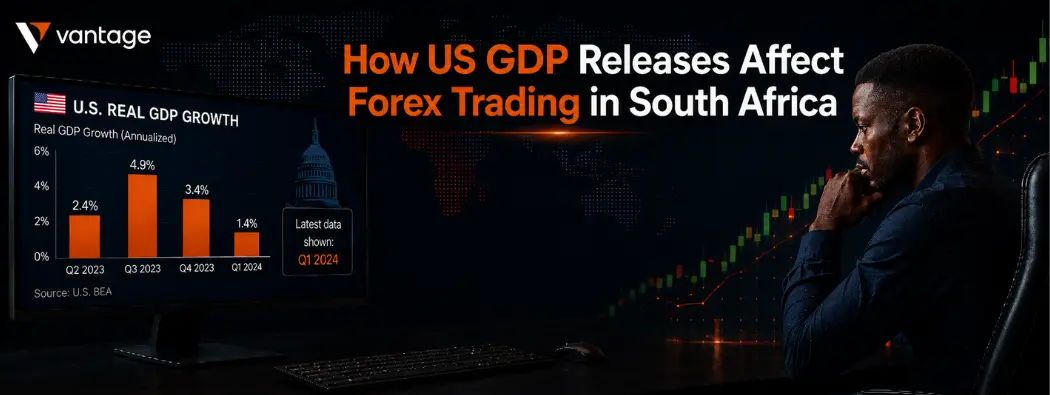
US GDP releases impact the rand. The dollar is part of USD/ZAR. These figures influence expectations for US interest rates. While a strong print typically strengthens the dollar, the rand often fluctuates based on global risk appetite, leading to significant volatility in the pair.
For a leveraged CFD trader, the bigger danger is the volatility and spread widening in the first seconds, not the headline number itself.
You have probably been here. You are holding a USD/ZAR position on a quiet Thursday afternoon; the chart is barely moving, and then, at half past two, the candle explodes.
The spread widens, your stop gets clipped, and by the time you work out what happened, the move is already gone. Somewhere on your economic calendar there was a red flag next to three letters.
That flag was the United States gross domestic product report. It moves the rand more often than most South African traders expect, and it does so through channels that are not always obvious.
Key takeways
- US GDP moves the rand because the dollar sits on one side of USD/ZAR, and the figure shapes expectations for US interest rates.
- The move comes from the surprise against the forecast, not the headline number on its own.
- The release lands at 8:30 a.m. US Eastern time, which is about 2:30 p.m. SA time in the American summer and 3:30 p.m. in their winter.
- The rand can travel either way, because it doubles as a global risk gauge, so read both the dollar and the risk mood.
- GDP measures broad growth each quarter. NFP reports jobs monthly. CPI tracks monthly inflation and is most important in today’s inflation-focused market.
Disclaimer: The content here is educational and not financial advice. CFDs are complex instruments and carry a high risk of rapid loss of capital due to leverage. Trade only with a broker authorised by the FSCA. Check their license on the FSCA register before funding your account. Also, never risk money you can’t afford to lose.
What US GDP is and why do traders watch it?
Gross domestic product is the total value of goods and services a country produces over three months. The US version is reported as an annualised growth rate.
It shows how quickly the world’s largest economy is expanding or contracting. Why should a forex trader in South Africa care? Because the dollar sits on one side of most pairs you trade, including USD/ZAR.
When the number lands, traders reassess the US economy and reprice the dollar. Every dollar pair moves with it.
There is a deeper reason too. Growth shapes what the market expects from the Federal Reserve on interest rates. Higher rates make a currency more attractive to hold. A strong figure can support the dollar by raising the odds of a rate rise.
Here is the part most beginners miss. The market has already priced in the forecast before the release.
So the move comes from the gap between the actual and expected numbers, not the headline itself.

The GDP release and when it lands in SA
The US does not report GDP quarterly. It reports the same quarter three times, a month apart, and each one can move your charts.
The first is the advance estimate, built on early data. The second fills in the gaps a month later. The third arrives a month after that and is treated as the final release for the year under review. Every GDP report released by the US is a fresh chance for the USD/ZAR rate to shift. This shift affects the exchange rate and the economic outlook for traders in South Africa
Each release drops at 8:30 a.m. US Eastern time. For us, that usually means around half past two in the afternoon, South African time. During the American winter, it lands an hour later, around half past three our time. We do not change our clocks, but they do.
So the danger window is mid-afternoon, not the US morning. The next US GDP release is the second-quarter advance estimate, due on 30 July.
Put it in your calendar in SA time and set a reminder, then decide your plan well before it lands. Do not let a number you knew was coming catch you mid-trade.
Why a GDP surprise moves the dollar
Picture the days leading up to a big GDP release. Analysts publish a forecast, and the big players position for it well in advance. By the time the number lands, the expected figure is already baked into the dollar’s price.
So when the actual print matches the forecast, the dollar barely flinches. The fuel for a move is the gap between what was expected and what actually arrived.
Here is the mechanism. A stronger-than-expected number suggests the US economy has more momentum than the market assumed. That raises the odds the Federal Reserve keeps interest rates higher for longer.
Higher expected rates pull money toward the dollar, because investors get paid more to hold it. A weaker print does the opposite.
So the dollar is not really reacting to growth. It is reacting to the surprise’s effect on interest rate expectations.
One more thing worth knowing. The bigger the surprise, the bigger the move tends to be. A small miss barely registers. A large one can send USD/ZAR flying in seconds.
What it means for the rand and USD/ZAR and Other Key Instruments
When a US GDP number lands, it directly hits the USD/ZAR. So the release matters to your charts even though it has nothing to do with South Africa.
Strong US data lifts the dollar; EUR/USD, USD/JPY and other key instruments should react, and the rand should weaken. Clean and tidy.
The rand is one of the most liquid and heavily traded emerging market currencies. Global funds use it as a quick way to take risk on or off. So the rand is not only a local currency. It doubles as a global risk gauge.
That gives a US GDP release two opposite pulls on the pair at once. The first is the rate pull. Strong US growth supports the dollar and argues for a weaker rand, pushing USD/ZAR up.
The second is the risk pull. A strong, upbeat global mood sends money into higher-yielding markets like ours. That demand can strengthen the rand and pull USD/ZAR down, even while the dollar is firm elsewhere.
On any given release, one pull wins. Sometimes the rate story dominates, and the rand weakens, just as expected.
Other times the risk mood takes over, and the rand strengthens despite a strong dollar. The move that “should not” happen is the one that runs your stop.
Do not forget the rand has its own central bank too. A hawkish SARB can offset dollar strength, because the pair reflects both sides at once.
So when you read a US print, ask two questions. What does it do to the dollar, and what does it do to the global risk mood?
How to handle a release like a seasoned trader
After enough of these, most experienced local traders stop trying to be heroes. They do not gamble on a number nobody can predict. They build a plan instead.
There are three ways to play it.
You can trade the release directly, holding a position into the print and betting on direction. The upside is fast. The downside is brutal, because the first seconds bring widening spreads and prices that gap past your stop. It is the riskiest route, and not where you start.
You can fade the first move. The initial spike often overshoots, then partly reverses once the dust settles. Some traders wait for that and trade the pullback. It takes patience, and the reversal does not always arrive.
Or you can sit it out, the most underrated choice, and what plenty of seasoned traders actually do. You trim or close exposure before the release, then step back in once a clear direction forms. You miss the first move, but you skip the slippage and whipsaw too.
Whichever you pick, the risk habits are the same. Cut your position size before high-impact data. Give your stops room, because a level that works on a quiet day is far too tight here.
Respect the spread, since your stop fills at the next available price, not the one you set. And know your leverage, because it bites hardest in a violent move.
One last local reminder. The number lands in the mid-afternoon our time, so set an alert and decide on your plan well before then. And remember, the rand moves with the global risk mood, not the dollar alone.
The traders who survive these releases are the ones who chose their move before it landed.
GDP, NFP and CPI: how they differ
Three US releases lead the economic calendar. They often confuse traders who group them together. Each measures something different, and each hits the dollar in its own way.
GDP is the broad one. It tracks total US economic output. It lands once a quarter and provides three estimates, released a month apart. Because it is quarterly and gets revised, it is the slowest and most backwards-looking of the three.
NFP, non-farm payrolls, is the jobs report. It is released monthly on the first Friday and shows how many jobs the economy added or lost. It is a current read on the labour market.
Consumer Price Index
CPI, the consumer price index, is the inflation report. It also lands monthly and tracks how fast prices are rising. In a world where central banks battle inflation, this number grabs everyone’s attention.
So which moves your charts hardest? Usually not GDP. The quarterly figure is often half-anticipated by the time it lands, since the monthly data already hinted at it.
The sharper moves tend to come from NFP and CPI, because they land monthly and feed straight into rate expectations.
Right now, with inflation front of mind, CPI can be the biggest mover of the lot.
You watch all three anyway because they cover different parts of the same story. GDP captures growth, NFP the jobs market, and CPI inflation. Together they shape what the Fed does with interest rates, and rates drive the dollar, which sits on one side of USD/ZAR.
One thing that keeps traders in this game. It is not the perfect entry. It is risk management.
When a US data release lands, the market can fly in either direction within seconds. A number can spike up, snap back down, and gap clean past your stop before you blink. The move you were sure about is often the one that hurts.
The Role of Leverage
Then there is leverage. It is the feature that pulls people in, and the reason accounts blow up.
Leverage magnifies every win, but it magnifies every loss just as hard. A position that feels fine on a calm Tuesday can drain your margin in one violent candle.
Spreads make it worse. In the first seconds after a release, the spread on USD/ZAR widens quickly. Your stop fills at the next available price, not the one you set. No setup is guaranteed, however clean it looks on your chart. The market owes you nothing.
So how do you protect yourself? You build a plan before the number lands, not while it is moving.
Cut your position size ahead of high-impact data. A smaller size means a bad move stings instead of sinking you. Give your stops room, because a level that works on a quiet day is far too tight here.
Know exactly how much you stand to lose before you click, and never risk money you cannot afford to lose.
Most of all, decide your move in advance. Trade it, fade it, or sit it out, but choose before the release, not during the chaos.
The traders who last are not the bravest. They are the ones who planned while everyone else reacted.
How to start trading
You do not need a big balance or a genius strategy to begin. You need a method and some practice.
Pick one US release, GDP for instance, and sit through it with no real money on the line. Observe the rapid increase in EUR/USD and major traded pairs and the swift widening of the spread. Do that across a few releases before you risk a single cent.
Note that demo fills are usually cleaner than live ones, so your real slippage will be worse. Treat the demo as a rehearsal, not a promise.
Next, get an economic calendar and make it a habit. It shows what is coming and exactly when it lands. Filter for the high-impact US events, note the forecast, and you will stay informed.
Then watch USD/ZAR. It is your home pair, and the cleanest place to see the dollar and the rand pull against each other. Learn how it behaves around data before you touch anything exotic.
Start with small steps and progress gradually. The market will still be here tomorrow.
Frequently Asked Questions
How does US GDP affect the forex market?
A surprise in US GDP changes expectations for interest rates. This, in turn, affects the dollar. Since the dollar is part of most currency pairs, this impact shows up on your charts.
What time is the US GDP release in South Africa?
It drops at 8:30 a.m. US Eastern time. That’s about 2:30 p.m. for us in summer and 3:30 p.m. in winter.
Does US GDP affect the rand?
Yes, and rarely in a straight line. A strong US print can boost USD/ZAR. It may rise with the dollar. But if the mood is upbeat, money might flow into emerging markets, pushing it lower. The rand acts as a global risk gauge.
Should I trade USD/ZAR during the GDP release?
There’s no one right answer. It depends on your plan and how much risk you can handle. In the first seconds, spreads widen, slippage occurs, and gaps can trigger your stop.
What is the difference between GDP, NFP and CPI for forex?
GDP is the quarterly growth figure, NFP is the monthly jobs report, and CPI is the monthly inflation read.
References
-
- What is Gross Domestic Product? : https://www.bea.gov/resources/learning-center/what-to-know-gdp
- US GDP release schedule, dates and 8:30 a.m. ET timing: https://www.bea.gov/news/schedule
- Interest rates as the primary driver of exchange rates, Nasdaq: https://www.nasdaq.com/articles/how-do-interest-rates-affect-currency-exchange-rate
- Peer-reviewed evidence on the rand’s central role in transmitting global shocks, Journal of Risk and Financial Management: https://doi.org/10.3390/jrfm19030230
- CPI, the official measure and its monthly release: https://www.bls.gov/news.release/cpi.htm