





 Updated
The Hang Seng Index, commonly referred to as the HSI, is a significant stock market index that monitors the performance of the largest and most liquid companies listed on the Hong Kong Stock Exchange (HKEX).
If you are interested in investing in the HSI, this article outlines its performance trends, provides an outlook on its future trajectory, and equips you with the knowledge you need to make informed investment decisions.
Read on to learn more about one of Asia’s leading stock market indices.
Key Points
- The Hang Seng Index (HSI) was introduced on November 24, 1969, and has become a key indicator of Hong Kong’s stock market performance. It is a free-float-adjusted, market-capitalisation-weighted stock market index that tracks 82 constituent companies representing approximately 65% of the Hong Kong Stock Exchange’s total capitalisation.
- The HSI is divided into four subindices: Commerce and Industry, Finance, Utilities, and Properties. It includes top companies like Tencent and Alibaba. Trading hours are from 9:30 am to 12:00 pm and 1:00 pm to 4:00 pm (GMT +8), with the exchange closed on weekends and national holidays.
- Trading the HSI offers exposure to leading Chinese and global companies, sector and regional diversification, and various trading instruments, such as futures and options. Its broad market representation and sensitivity to market developments make a variety of trading strategies viable, such as trend-following and news trading.
What is the Hang Seng Index? [1]
The Hang Seng Index was introduced on November 24, 1969, and has since become a key indicator of Hong Kong’s economic health. Currently, it is owned and managed by Hang Seng Indexes Company Limited, a wholly-owned subsidiary of Hang Seng Bank.
The HSI is a free-float-adjusted, market-capitalisation-weighted stock market index. This means it is calculated based on each company’s market capitalisation, which is in turn derived by excluding locked-in shares held by insiders, promoters, and governments.
The HSI comprises 82 constituent companies, which represent approximately 65% of the total capitalisation of the Hong Kong Stock Exchange. The maximum relative weighting for any single security is capped at 8% to prevent the index’s balance from becoming skewed.
As Hong Kong’s primary stock market index, the HSI holds a prominent position in the region’s financial landscape and is widely regarded as a barometer of Asian markets.

Components and Trading Hours
Divided into four subindices – Commerce and Industry, Finance, Utilities, and Properties – the Hang Seng components represent the largest and most influential companies in Hong Kong.
At the time of writing, here are the top 10 companies in the HSI by market capitalisation [2]:
| Company Name | Market Capitalisation |
| Tencent Holdings Ltd | $353.93B |
| Industrial & Commercial Bank of China Ltd | $226.49B |
| China Mobile Ltd | $185.54B |
| Alibaba Group Holding Limited | $184.03B |
| PetroChina Company Limited | $182.61B |
| HSBC Holdings plc | $155.80B |
| Bank of China Ltd | $151.64B |
| China Construction Bank Corp | $150.20B |
| China Merchants Bank Co Ltd | $98.57B |
| AIA Group Ltd | $94.91B |
Hang Seng Index (HSI) Trading Hours [3]
Morning Session: 9:30 am – 12:00 pm (GMT +8)
Afternoon Session: 1:00 pm – 4:00 pm (GMT +8)
The exchange is closed on Saturdays, Sundays, and National holidays.
Why Trade HSI?
Trading the Hang Seng Index is a popular choice for several reasons:
1. Representation of large Chinese companies
The HSI tracks the performance of many of China’s largest companies, including Industrial and Commercial Bank of China (ICBC) and Sinopec, as well as prominent global and regional players such as Alibaba. This provides traders with exposure to these significant market players.
2. Diversification across regions
Trading the HSI also provides exposure to Hong Kong and Chinese markets, enabling regional portfolio diversification. This can be a good way to potentially hedge against economic instability in other parts of the world.
3. Access to multiple sectors
The four sub-indices, Commerce and Industry, Finance, Utilities, and Properties, allow traders to gain exposure to a variety of sectors in the Hong Kong market while only trading one product. Diversifying with stocks with varying correlations helps mitigate the impact of market volatility on overall portfolio performance.
Diversify Your Portfolio with HSI
The Hang Seng Index (HSI) is a powerful product for traders looking to diversify their portfolios and implement strategic trading. Its diverse composition and dynamic nature offer several advantages.
The HSI includes sectors such as finance, real estate, technology, and consumer goods, providing sectoral diversity that mitigates the risks of investing in a single industry. For traders focused on Western markets, the HSI offers geographic diversification, reducing the impact of localised economic downturns.
Moreover, the index includes globally influential companies like HSBC and Tencent, allowing traders to benefit from these major players’ global reach.
The HSI is also helpful in hedging risks across other parts of a portfolio and is available through various derivative instruments, such as futures and options. These instruments enable traders to implement complex strategies, providing flexibility in managing risk and returns.
Additionally, the HSI serves as a barometer of investor sentiment in Asia, helping traders gauge market sentiment and make strategic decisions.
Incorporating the Hang Seng Index into a trading toolkit allows traders to achieve greater diversification, manage risk effectively, and capitalise on a wide range of strategic opportunities, making it a versatile and valuable instrument for investment strategies.
Historical Performance of the Hang Seng Index [4]
The Hang Seng Index has experienced both increases and decreases throughout its history. While there have been times of steady growth, there have also been periods of decline due to various factors such as economic recessions, financial crises, and other global events.
Here are some key moments of the Hang Seng Index’s historical performance:
Asian Financial Crisis (1997-1998)
The Asian financial crisis of 1997 led to a sharp 30.74% decline in the Hang Seng Index, which plummeted to a low of 6,850.60 points in October of that year. Widespread currency devaluations and financial instability across the region drove this downturn.
Dot-com Bubble (2000-2002)
During the dot-com bubble burst, the HSI plummeted by 67% before gradually recovering.
SARS Epidemic (2003)
The outbreak of the SARS epidemic led to a 16.66% drop in the HSI, reaching a low of 8,840.68 points.
Global Financial Crisis (2008)
The HSI experienced a significant 48.27% decrease, hitting a low of 11,015.84 points.
Political Unrest (2019)
Political unrest in Hong Kong took a toll on the index, causing a 15.42% drop and reaching a low of 25,281.30 points.
Recent Trends in Hang Seng Index
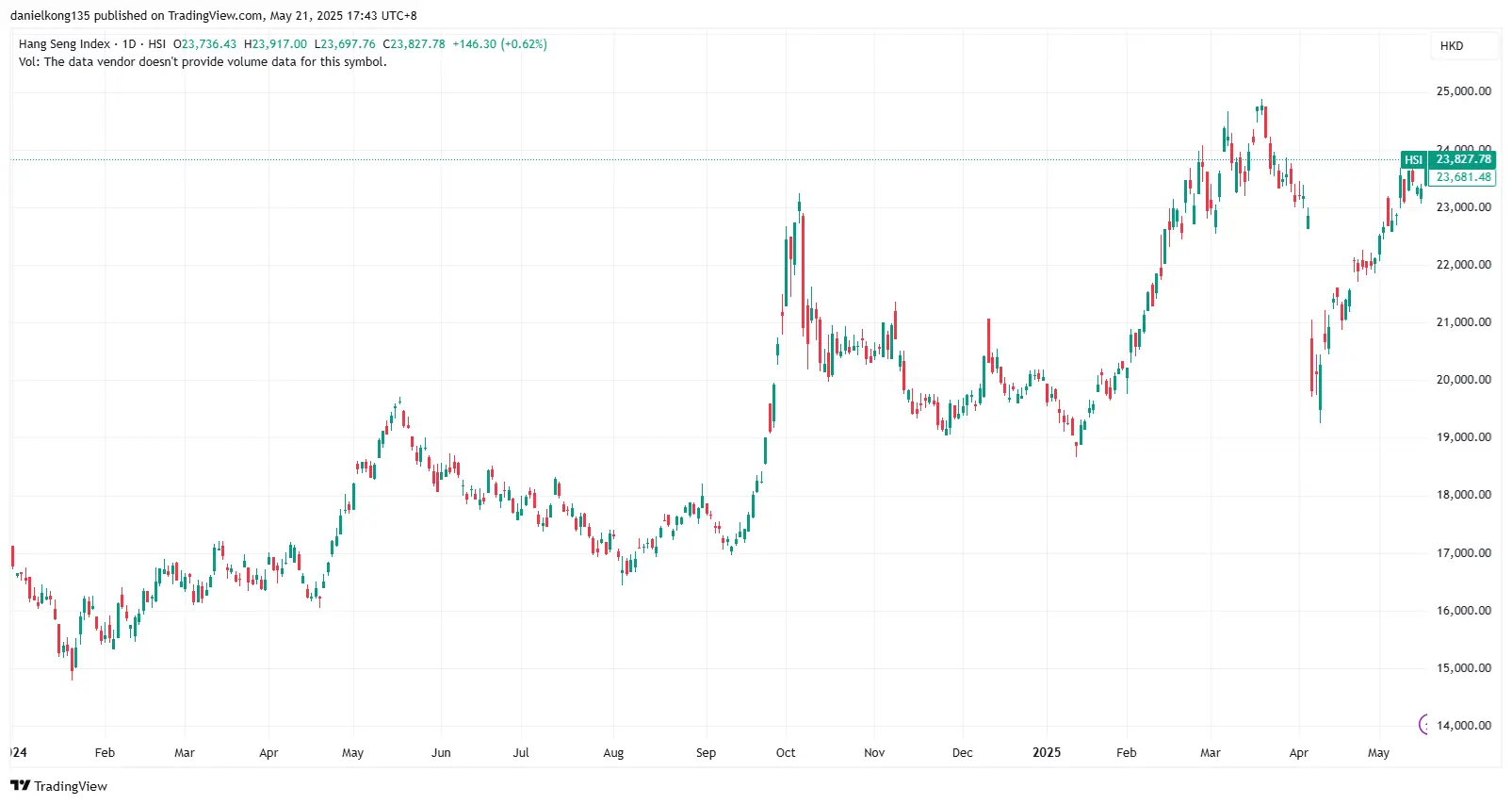
As of August 6, 2024, the Hang Seng Index is at 16,612, down about 14.94% year over year. After hitting a three-month low, Hong Kong stocks rebounded as the global market sell-off moderated.
The Hang Seng Index has fallen 15% from its May peak, reflecting ongoing challenges in China’s economy, particularly a sustained downturn in the property sector. Despite this, the index is trading at 8.2 times expected earnings for the year, making it the second least expensive among major global markets, according to Bloomberg [5].
Market Influences on Hang Seng Index
1. Economic Indicators
Economic indicators such as GDP growth, inflation rates, and changes in monetary policy by the Hong Kong Monetary Authority can influence investor sentiment and, consequently, the index. For instance, China’s PMI figures can heavily influence the Hang Seng Index, reflecting the overall health of the Chinese economy.
2. Global Market Sentiment
The Hang Seng Index is closely correlated with other major stock markets worldwide. Changes in global economic and political events, such as trade wars, geopolitical tensions, and pandemics, can significantly impact the HSI’s performance. Market sentiment and expectations play a crucial role in shaping the HSI’s direction.
3. Industry Trends
The Hang Seng Index is structured into four sub-sectors, reflecting Hong Kong’s economic pulse, and is closely watched as an indicator of Asian markets. More balanced coverage across industry groups will lead to the inclusion of more ‘new economy’ constituents, mainly technology and healthcare firms, thereby boosting the index’s overall earnings growth. The financial industry’s response to the growing demand for ESG investments has led to the emergence of Hang Seng Index funds that focus on ESG criteria.
These factors together contribute to the performance of the Hang Seng Index.
Economic and Geopolitical Factors
The HSI is a market-capitalisation-weighted index of the largest companies listed on the Hong Kong Exchange, many of which operate globally. Changes in global economic conditions and geopolitical events, such as GDP growth or political tensions, can significantly impact these companies’ profitability, leading to fluctuations in the HSI.
Understanding these HSI economic indicators is crucial for investors seeking to navigate the market effectively.
GDP growth is a key economic indicator that influences the Hang Seng Index. Positive GDP growth in Hong Kong often signals a healthy economy, which can drive the HSI higher. For instance, surging exports in 2021 indicated a turnaround in growth, potentially signaling a stock-market boom [6].
Interest rates set by central banks also impact the HSI. Higher interest rates can make borrowing more expensive, potentially slowing economic growth and negatively affecting the HSI. For example, rising local interest rates following US Federal Reserve hikes have made residential properties less attractive investments, causing downward pressure on the Index. [7].
Geopolitical events, such as tensions between the United States and China, can create market uncertainty and increase HSI volatility. These tensions have reduced trade volumes between the two economies, affecting the HSI, the primary benchmark of the economic health of both Hong Kong and China [8].
Effective Trading Strategies for Hang Seng Index
The Hang Seng Index’s dynamic nature, categorised by volatility, news sensitivity, and sectoral influence, makes it ideal for diverse trading strategies.
Here are some strategies for you to consider when trading the HSI:
1. Trend Following
The HSI often exhibits strong trends influenced by macroeconomic factors, and a trend-following strategy can help traders capitalise on these movements.
By identifying the overall trend and taking relevant trades, traders can potentially profit from sustained upward or downward movements in the index.
Traders can use technical indicators such as moving averages, trendlines, and the Relative Strength Index (RSI) to identify market trends and potential trend reversals.
2. Swing Trading
Swing trading is about capturing short- to medium-term gains over a few days to several weeks by taking advantage of price fluctuations within a broader trend.
The Hang Seng Index is well-suited for swing trading because its cycles are influenced by economic data, corporate earnings reports, and geopolitical events, making its movements more predictable.
Traders can hold positions for days or weeks, depending on the size of the swing they want to profit from. However, this strategy can be risky if sudden market events occur.
3. Day Trading
Day traders aim to profit from meaningful price movements that happen within a single trading day. Due to the HSI’s high liquidity and volatility, day traders can capitalise on multiple trading opportunities arising from short-term price fluctuations, making it an attractive index for day trading.
In practice, day trading requires positions to be closed by the end of the trading day, eliminating risks associated with holding positions overnight. For this reason, day trading the HSI is likely less risky than strategies that keep positions open in between trading days. The latter can be especially risky during periods of high market volatility, such as during earnings announcements.
4. News Trading
The HSI is sensitive to market news, especially that related to the Hong Kong or Chinese economy, trade relations, and local political developments.
Given the index’s responsiveness to economic indicators, geopolitical events, and corporate announcements, news trading allows traders to capitalise on rapid price movements triggered by breaking news.
By staying informed and reacting swiftly to market-moving events, traders can exploit short-term volatility and potentially generate substantial profits.
Read more about the popular strategies for trading indices.
Risk Management in Hang Seng Trading
Given the HSI’s inherent volatility and sensitivity to market factors, traders need to understand risk management in HSI trading.
As a prime stock market index, the HSI may experience significant price swings, leading to both substantial gains and losses in a short period.
To potentially safeguard investments, traders can consider doing the following:
1. Set Stop-Loss orders
Implementing stop-loss orders allows you to exit positions at predetermined price levels automatically. This helps limit potential losses and prevents emotional decision-making during volatile market conditions.
2. Manage position sizes
Determining the appropriate position size for each trade based on your risk tolerance and account size. Avoid risking too much capital on a single trade, and adhere to strict position-sizing rules to prevent significant losses.
3. Use Risk-Reward ratios
Evaluate potential trades based on risk-reward ratios to ensure that potential rewards outweigh potential risks. Aim for trades with favourable risk-reward profiles to increase the likelihood of long-term success.
4. Monitor and review your trades
Regularly review your trading performance and adjust your risk management approach as needed. Learn from both successful and unsuccessful trades to refine your strategy over time.
How to Trade the Hang Seng Index
Like all market indices, the HSI cannot be traded directly. However, traders may choose from several financial instruments to trade the Hang Seng Index or include it in their portfolio.
Futures and options
You can trade the Hang Seng Index indirectly through a variety of financial derivatives such as futures and options. This method allows you to speculate on the index’s price movement from a single position.
Hang Seng-related ETFs
Exchange-Traded Funds (ETFs) offer investors a simple way to gain exposure to the Hang Seng Index. This is achieved by such funds mimicking the same basket of securities that make up the HSI, effectively tracking the index. Some of the ETFs that track the Hang Seng Index include:
- iShares MSCI Hong Kong ETF (EWH)
- Lion-OCBC Securities China Leaders ETF.
Indices Contract for Differences (CFDs)
Index contract for differences (CFDs) is a method of speculating on financial markets without owning the underlying assets. When trading CFDs, you’re predicting whether an asset’s price will rise or fall. You can trade CFDs on the Hang Seng Index, allowing you to speculate on its price movements.
Listed Shares
You can also trade individual shares of companies listed on the Hang Seng Index. While this allows you to gain exposure to the price movements of top-performing Hong Kong companies, you may not be able to fully replicate the index’s performance due to capital constraints and other factors.
Start Trading the Hang Seng Index with Vantage through CFDs
Trade the Hang Seng Index with Vantage CFDs to potentially capitalise on the Hong Kong market without directly owning underlying fund units or individual company shares. Benefit from advantageous features like tight spreads and affordable trading costs, starting from as low as $0 per trade.
Manage risk effectively by utilising tools such as negative balance protection, price alerts, and stop losses, acknowledging the possibility of losses. Stay updated with real-time news alerts through our mobile app and trading platform, enabling swift responses to market changes and ensuring trading flexibility from wherever you are.
Open a live account today and discover the Vantage advantage in trading the Hang Seng Index through CFDs.
References:
- “What is the Hang Seng Index (HS)? Definition and Statistics – Investopedia”. https://www.investopedia.com/terms/h/hangseng.asp. Accessed 31 July 2024.
- “Top Hang Seng Companies by Market Cap and Stocks in 2024 – Disfold”. https://disfold.com/stock-index/hang-seng/companies/. Accessed 15 May 2024.
- “Securities Market – HKEX”. https://www.hkex.com.hk/Services/Trading-hours-and-Severe-Weather-Arrangements/Trading-Hours/Securities-Market?sc_lang=en. Accessed 10 June 2024.
- “A Historical Analysis of Hang Seng Index Performance – BobMensch”. https://www.senatormensch.com/hang-seng-index-performance-history/. Accessed 15 May 2024.
- “Hong Kong stocks survive panic sell-off, rebound from 3-month low as Japan recoups losses – South China Morning Post”. https://www.scmp.com/business/china-business/article/3273333/hong-kong-stocks-rebound-april-lows-japan-equities-recover-global-sell-eases. Accessed 6 August 2024.
- “50 years of GDP history signals a Hang Seng surge – Bloomberg”. https://www.bloomberg.com/professional/insights/trading/50-years-of-gdp-history-signals-a-hang-seng-surge/. Accessed 15 May 2024.
- “Are US interest rates high enough to beat inflation? The Fed will take its time to find out – Yahoo!Finance”. https://uk.finance.yahoo.com/news/us-interest-rates-high-enough-121919424.html?guce_referrer=aHR0cHM6Ly93d3cuYmluZy5jb20v&guce_referrer_sig=AQAAAMEqF1nn6i8iTTPSH7UCA5VVa_NyskxHFYz05DA64ajEUmy4IAs2xfGZf52OC2g7gzh2PcI5uJE3kv8g9EfKkqsKgMjEO2pWtE7w4U_th2oMp_2DnohHTXaodcT0l-YMnyLzd9J95G0P-Pn1lsSl_kBrGaxGL5sOtqvamErLdkLe&guccounter=2. Accessed 15 May 2024.
- “Hong Kong’s economy struggles to get back on its feet – East Asia Forum”. https://eastasiaforum.org/2024/01/03/hong-kongs-economy-struggles-to-get-back-on-its-feet/. Accessed 15 May 2024.