






 Updated
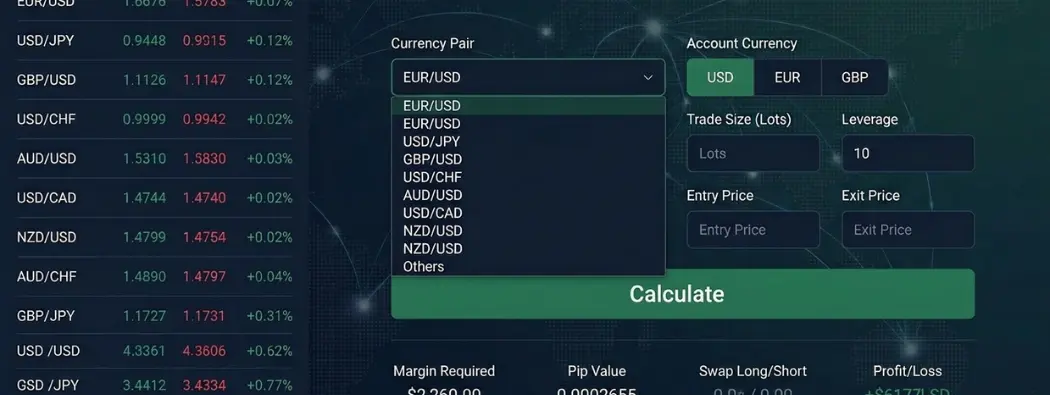
A forex profit calculator helps estimate the potential result of a trade before or after it is placed. It does the math for you, but you still need to understand the numbers you enter.
Forex profit and loss can look confusing at first. A small price move may lead to a small gain, a large gain, or a large loss. The result depends on four main factors: price movement, trade direction, position size, and trading costs. It uses inputs such as the currency pair, account currency, lot size, entry price, exit price, and trade direction to show the possible result in monetary terms.
In forex trading, the calculator is often used to indicate how pip movements may reflect the likely level of impact. The result is an estimate, not a market forecast, and may differ from the final trade outcome due to execution conditions and trading costs.
Key takeaways
- Forex profit depends on price movement, trade direction, lot size, and costs. A calculator gives an estimate, not a guaranteed result.
- Key inputs include currency pair, trade direction, entry and exit prices, lot size, and pip value. The lot size table is useful for beginners.
- Buy trades profit when price rises. Sell trades profit when the price falls. The same pip move can represent different amounts of money depending on the lot size.
- Pips show price movement. Profit or loss depends on pip movement, pip value, and lot size.
- Lot size controls the value of each pip. A standard lot, a mini lot, and a micro lot yield very different results for the same pip move.
What Is Forex Profit and Loss?
A forex profit and loss shows how much money a trade gains or loses after a price movement. If you buy a currency pair, you make a profit when the price rises. You lose money when the price falls.
If you sell a currency pair, you make a profit when the price falls. You lose money when the price rises.
For example, if you buy EUR/USD at 1.0800 and close the trade at 1.0850, the price moved 50 pips in your favour. Whether that equals $5, $50, or $500 depends on your lot size.

What Is a Forex Profit Calculator?
A forex profit calculator is a tool that estimates a trade’s profit or loss. Most calculators ask for:
- Currency pair
- Account currency
- Trade direction
- Lot size
- Entry price
- Exit price
- Sometimes leverage, spread, or commission
After you enter these details, the calculator shows the estimated profit or loss. The calculator is useful because pip values vary across currency pairs and account currencies. For example, EUR/USD, GBP/JPY, and USD/ZAR do not all calculate profit in the same way.
What are the Inputs Needed to Calculate Forex Profit?
- Currency pair: A currency pair shows two currencies traded against each other. In EUR/USD, the euro is the base currency, and the US dollar is the quote currency.
- Trade direction: A buy trade means you expect the pair to rise. A sell trade means you expect the pair to fall.
- Entry price: The price at which you open the trade.
- Exit price: The exit price is the price at which you close the trade.
- Lot size: Lot size shows how large your trade is.
Common lot sizes include:
| Lot Type | Units |
| Standard lot | 100,000 units |
| Mini lot | 10,000 units |
| Micro lot | 1,000 units |
A larger lot size increases the value of each pip.
6. Pip: A pip is a standardised unit of price movement in many currency pairs. For many major pairs, one pip is the fourth decimal place, such as 0.0001. For JPY pairs, one pip is often the second decimal place, such as 0.01.
How to Calculate Forex Profit and Loss Manually
The basic formula is: Profit or loss = pip movement × pip value
For a buy position: Pip movement = exit price – entry price
For a sell position: Pip movement = entry price – exit price
After the pip movement is known, the result is multiplied by the pip value. The pip value depends on the currency pair, lot size, and account currency.
Example of a Buy Trade
A trader opens a buy position on EUR/USD.
| Detail | Value |
| Entry price | 1.0800 |
| Exit price | 1.0850 |
| Trade size | 1 standard lot |
| Pip Movement | 50 pips |
| Pip value | $10 per pip |
Calculation: 50 pips × $10 = $500. The estimated profit is $500 before trading costs.
Example of a Sell Trade
A trader opens a sell position on EUR/USD.
| Detail | Value |
| Entry price | 1.0800 |
| Exit price | 1.0850 |
| Trade size | 1 standard lot |
| Pip Movement | 50 pips against the position |
| Pip value | $10 per pip |
How do you effectively use a Forex Profit Calculator?
A forex profit calculator speeds up the process. Here is a simple step-by-step method.
- Choose your currency pair: Select the pair you want to trade, such as EUR/USD, GBP/USD, USD/JPY, or XAU/USD. Each pair may have a different pip value.
- Select your account currency: Choose the currency your trading account uses. For example, your account may be in USD, EUR, GBP, NGN, KES, or ZAR. This matters because the trade result may need to be changed into your account currency.
- Choose buy or sell: Pick the trade direction. Choose buy if you expect the pair to rise. Sell if you expect the pair to fall.
- Enter your lot size: Enter the trade size. A micro lot gives a smaller pip value. A standard lot gives a larger pip value. For newer traders, lot size is one of the most important inputs. It can turn the same pip move into very different results.
- Enter your opening price: Add the price where the trade starts.
- Enter your closing price: Add the price where the trade ends. For planning, you can enter your target price or stop-loss price.
- Review the result: The calculator will show your estimated profit or loss. Use the result to check whether the trade makes sense for your account size and risk limit.
How Do Pips Affect Forex Profit?
Pips affect forex profit, as they indicate how many pips the pair has moved above or below your entry price. The greater the pip movement, the greater the profit (or loss), depending on trade direction and position size.
Your forex profit depends on 3 main factors: pip movement, pip value, and lot size. Pip Movement represents the Number of Pips that have been gained or lost. The pip value indicates the equity gained or lost per pip. Lot size indicates the volume of the trade.
Here’s a basic formula estimating profit or loss for any given trade:
Profit or loss = number of pips × pip value
For example, a 30-pip gain with a pip value of $1 equals $30. A 30-pip gain with a pip value of $10 equals $300. The same market move can produce different results because the lot size is different.
What is the Role of Lot Size in Profit and Loss Calculation?
Lot size has a major effect on forex profit and loss. A 50-pip move does not have the same value across all position sizes. For many USD-quoted major pairs, the approximate pip values are:
| Detail | Value |
| 1 standard lot | $10 per pip |
| 1 mini lot | $1 per pip |
| 1 micro lot | $0.10 per pip |
A standard lot has a higher pip value than a mini or micro lot. As a result, the same pip movement can produce very different profit or loss amounts.
Example of Lot Size Impact
Assume a currency pair moves 50 pips in favour of a trade.
With a standard lot, the pip value may be about $10 per pip. The estimated profit would be: 50 × $10 = $500
With a mini lot, the pip value may be about $1 per pip. The estimated profit would be: 50 × $1 = $50
With a micro lot, the pip value may be about $0.10 per pip. The estimated profit would be: 50 × $0.10 = $5
Does leverage change Forex profit?
Leverage is essentially a loan that the broker provides to an investor. It does not directly change the basic formula for forex profit. Profit and loss are still based on price movement, pip value, lot size, and trade direction. However, leverage can indirectly affect profit and loss by allowing larger positions to be opened.
Leverage affects the amount of margin required to open a trade. Higher leverage reduces the margin needed for a larger position. As a result, a trader may open a bigger lot size than would be possible without leverage.
A larger lot size increases pip value. For example, a 10-pip movement on a micro lot may have a small monetary effect. The same 10-pip movement on a standard lot creates a larger result.
Leverage can increase both potential profit and potential loss through larger exposure. A profitable move may produce a higher return when the position size is larger. A losing move may also create a larger loss for the same reason.
What are the Common Mistakes in Forex Profit and Loss Calculations?
Several errors often appear when traders estimate forex profit and loss. Common examples include:
- Confusing pips with points: A common mistake is treating pips and points as the same unit. A pip is a standard unit of price movement in many currency pairs. A point may refer to a smaller price change, depending on the platform.
- Using the wrong lot size: Lot size directly affects pip value. A standard lot, mini lot, and micro lot do not produce the same result from the same pip movement.
- Ignoring account currency conversion: Lot size directly affects the pip value and, therefore, profit and loss. Lot size errors are especially common when traders compare different accounts, symbols, or position sizes.
- Leaving out spread or commission: Spreads affect the final result because trades often open or close at prices that include the spread or commission.
A position may appear profitable based on chart movement, but the spread can reduce the net result. In smaller trades, the effect may be limited. In larger trades, the effect can be more visible.
Also, some forex accounts charge commission on each trade. Profit and loss calculations that only measure price movement may not reflect the full result. - Treating all currency pairs as if they have the same pip value: Currency pairs do not always have the same pip value. Pairs involving different quote currencies or yen-based pricing may require different calculations.
- Overlooking swap fees on overnight positions: Swap fees may apply when a position is held overnight. The amount depends on the currency pair, the position direction, and the broker’s conditions.
A profit and loss estimate that excludes swaps may differ from the final account result. Longer holding periods can make swap fees more important in the total calculation.
What are Gross Profit vs Net Profit in Forex?
Gross profit is the gain from price movement alone. It is based on the number of pips gained, the pip value, and the lot size.
A basic formula is:
Gross profit = number of pips gained × pip value
For example, a trader opens a buy position on EUR/USD. The price moves 40 pips in favour of the trade. If each pip is worth $5, the gross profit is:
40 × $5 = $200
The $200 figure shows the trade result before costs. It does not include spread, commission, swap fees, or currency conversion charges.
Net profit is the amount remaining after deducting trading costs from gross profit. It gives a more complete view of the final result.
A basic formula is:
Net profit = gross profit – trading costs
Using the earlier example, assume the gross profit is $200. If total trading costs are $12, the net profit becomes:
$200 – $12 = $188
Net profit is often lower than gross profit because forex trades may include several costs.
Common Costs That Affect Net Profit
The spread is the gap between the bid and ask price. The commission may apply to certain account types. Swap fees can apply when a position remains open overnight. Slippage can also affect the final result if an order is filled at a different price than expected.
Conclusion
A forex profit calculator helps traders translate price movements into clear monetary values. It shows how entry price, exit price, lot size, and pip value affect profit and loss.
Still, the calculator is only one part of trade planning. Traders also need to consider spread, commission, swap fees, slippage, leverage, and account currency conversion. A good trade is not only about possible profit. It is also about knowing the possible loss before the trade starts.
Frequently Asked Questions
How do I calculate profits in forex?
Forex profit is found by measuring how many pips a trade gains, then multiplying that figure by the pip value. The final amount depends on the lot size, currency pair, account currency, and trade direction.
What is a Forex profit calculator?
A Forex profit calculator is an online tool that estimates the possible profit or loss from a currency trade. It usually works with details such as entry price, exit price, lot size, account currency, and trade direction.
How do I calculate profits in forex?
Forex profit and loss is calculated by comparing the entry price with the exit price. The price difference is converted into pips, then multiplied by the pip value.
How do pips affect forex profits?
Pips show how far a currency pair has moved. More pips in the favourable direction can increase profit, while more pips against the position can increase loss.
How does lot size affect forex profits?
Lot size controls the money value of each pip. A larger lot size gives each pip a higher value, while a smaller lot size gives each pip a lower value.
Does leverage increase forex profit?
Leverage does not change the number of pips gained or lost. It can increase profit or loss by allowing a larger position size with a smaller margin amount.
How do I calculate profit on a sell trade?
Profit on a sell trade occurs when the exit price is lower than the entry price. The pip gain is calculated by subtracting the exit price from the entry price, then multiplying the result by the pip value.
What is the difference between gross and net Forex profit?
Gross Forex profit is the result before trading costs are included. Net Forex profit is the amount left after deducting costs such as spreads, commissions, and overnight fees.
Can I calculate Forex profit before opening a trade?
The estimated Forex profit can be calculated before opening a position. The estimate is based on the planned entry price, target exit price, lot size, currency pair, and pip value.
Is a Forex profit calculator result guaranteed?
A Forex profit calculator gives an estimate rather than a fixed result. Final profit or loss may differ due to spread changes, commissions, swap fees, slippage, and currency conversion.
Risk Warning: CFDs are complex financial instruments and carry a high risk of rapid loss of money due to leverage. You should ensure you fully understand the risks involved and carefully consider whether you can afford to take the high risk of losing your money before trading.
Disclaimer: The information is provided for educational purposes only and doesn’t take into account your personal objectives, financial circumstances, or needs. It does not constitute investment advice or a recommendation. We encourage you to seek independent advice if necessary. No representation or warranty is given as to the accuracy or completeness of any information contained within.
This material may contain historical or past performance figures and should not be relied on. Furthermore, estimates, forward-looking statements, and forecasts cannot be guaranteed. The information on this site and the products and services offered are not intended for distribution to any person in any country or jurisdiction where such distribution or use would be contrary to local law or regulation.
References
- https://www.investopedia.com/articles/forex/12/calculating-profits-and-losses-of-forex-trades.asp Calculating Profits and Losses on Your Currency Trades
- https://www.myfxbook.com/forex-calculators/profit-calculator Forex profit Calculator
- https://www.litefinance.org/blog/for-beginners/how-to-calculate-a-lot-on-forex/ What is Lot Size, Formula, and How to Calculate Lot in Forex
- https://www.binance.com/en/square/post/537748 – Forex Profit Calculation
- https://www.binance.com/en/square/post/19720801437026 – Forex Lot Sizes