






 Updated

CAC 40 Index stands for Cotation Assistée en Continu, which translates in English to “continuous assisted trading”. It’s a benchmark French stock market index and one of Europe’s most-watched Equity indicators.
It reflects the performance of 40 leading stocks among 100 listed on the Euronext Paris Exchange, which is home to many global brands across the luxury, energy, and industrial sectors.
For traders and investors, the CAC 40 Index is more than just a number. It shows how the French economy and European markets are performing on a daily basis.
What Is the CAC 40 Index?
The CAC 40 (Cotation Assistée en Continu) is a benchmark stock index for France. It tracks 40 large, heavily traded CAC 40 companies listed on Euronext Paris, formerly known as the Paris Bourse. In market reports, the France CAC 40 index is often used as a quick gauge of French equity moves.
This role is sometimes compared with the Dow Jones Industrial Average (DJIA) in the United States, since both are widely quoted headline indices.
The index uses a free-float market value method, which focuses on shares available to the public. It began with a base level of 1,000 on 31 December 1987, tied to an estimated market value of 370,437,433,957.70 French francs, and later moved from total market value weighting to free-float weighting in 2003.
Over time, the CAC 40 has included major brands such as L’Oréal, Renault, and Michelin. This article is written for general education and the market context. It does not provide personal investment advice; instead, it explains how the index is defined and followed
Development of CAC between 2020 and 2025
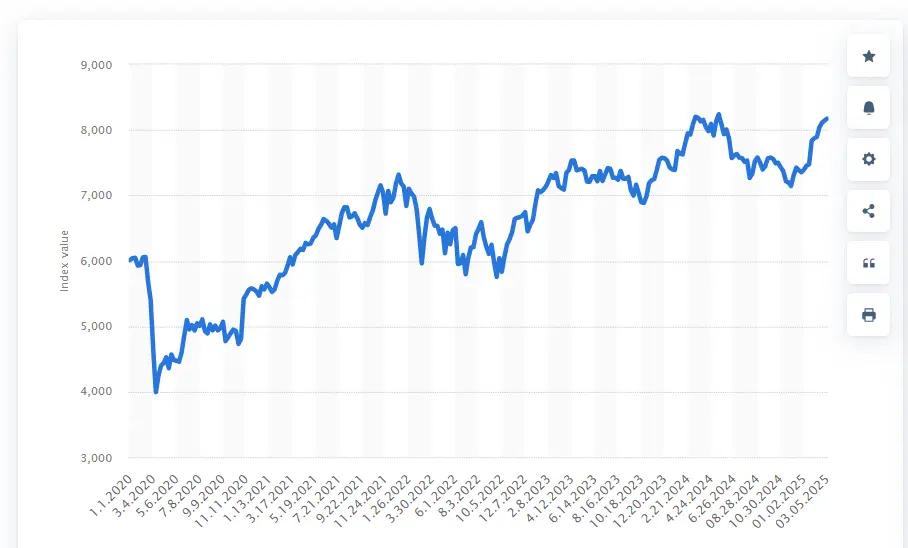
A Statista report covering 2020 to 2025 on the weekly performance of the CAC 40 showed that theindex lost around one-third of its value between February 16 and March 15, 2020, due to the economic impact of the global coronavirus (COVID-19) pandemic.
In April 2021, it recovered from the loss. Subsequently, after 3 years, around the middle of the fifth month, it peaked at over 8,200 index, followed by a downward trend, reaching 7,492 as of October 16 of the same year.
Since the start of 2025, the index has been recovering, reaching 8,173.75 index points as of March 5, 2025. Over time, the index has been regarded as the primary benchmark for France.
What Companies Make Up the CAC40?
The CAC 40 index holds 40 large, liquid stocks on Euronext Paris. They are selected based on size and trading activity. Subsequently, they are weighted by free-float market value, so large firms have the greatest influence.
That last part is key for traders. On most days, the CAC 40 follows what its heavyweights do. As of September 30, 2025, the biggest weights include Schneider Electric, LVMH, Airbus, Safran, TotalEnergies, Air Liquide, Sanofi, EssilorLuxottica, L’Oréal, BNP Paribas, and AXA. If one of these earnings gaps is present, the whole index feels it.
Here is the full member list on that same date:
- Industrials: Schneider Electric, Airbus, Safran, Vinci, Saint-Gobain, Legrand, Thales, Bureau Veritas, Bouygues, Edenred
- Luxury and consumer: LVMH, Hermès, L’Oréal, Kering, Michelin, Publicis Groupe, Stellantis, Renault, Accor
- Energy: TotalEnergies
- Materials: Air Liquide, ArcelorMittal
- Health: Sanofi, EssilorLuxottica, Eurofins Scientific
- Tech: Dassault Systèmes, Capgemini, STMicroelectronics
- Banks and finance: BNP Paribas, Société Générale, Crédit Agricole, AXA, Euronext
- Staples: Danone, Pernod Ricard, Carrefour
- Utilities: Engie, Veolia Environnement
- Telecom: Orange
- Real estate: Unibail-Rodamco-Westfield
Why the CAC 40 Moves?
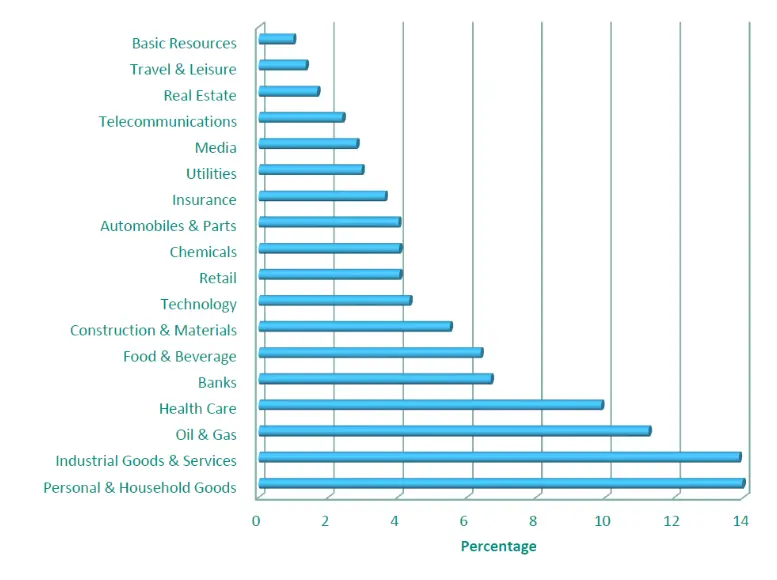
The CAC 40 movement is caused by a range of factors. But the CAC 40 has a few traits that shape its swings. It is heavy in luxury, global industry, energy, and large banks. So it can trade like a “France index” on paper. Yet it often behaves like a global earnings index.
Key Drivers of CAC40 Movement
1. Index weighting and concentration
The CAC 40 is a free-float, market-value-weighted index. In practice, this structure can leave a large share of daily moves tied to the biggest constituents, since larger free-float values carry more weight in the calculation.
2. Earnings and guidance set the tone
Quarterly results matter more than headlines. Luxury earnings can lift the index on strong global demand. Weak margins, softer sales, or cautious guidance can have a significant impact. Industrial names react to order books and supply chain news. Banks respond to net interest margins and discussions of credit risk.
3. Rates, yields, and the ECB
The European Central Bank is a major driver. Rate hikes can pressure stocks through higher discount rates. Rate cuts can support stocks, but only if growth holds up.
Watch French OAT yields and German Bund yields each day. Large yield jumps often lead to rapid declines in equity.
4. The euro can help or hurt
Many CAC firms sell globally and report in euros. A stronger euro can reduce overseas profits upon translation back into euros. A weaker euro can boost reported revenue and earnings. That is why EUR/USD swings often show up in the CAC.
5. Commodities and energy pricing
Oil moves matter because energy names carry weight. Higher oil can lift energy stocks but raise input costs elsewhere. Gas and power prices also contribute to Europe’s growth concerns.
6. Global risk mood and the US lead
The CAC 40 rarely trades in a vacuum. If S&P 500 futures slide, Europe often opens weaker. If Wall Street rallies, the CAC can catch a late bid.
Risk-off days hit cyclicals and banks first.
7. Politics and shocks
Elections, budget fights, strikes, and policy surprises move markets. Geopolitics can affect energy prices, defence companies, and risk sentiment.
How to Trade the CAC40 Index
The CAC40 is offered as an index CFD called FRA40 (France 40 Index). Its price moves up or down in line with the index, without owning the underlying shares. The steps below show how the instrument works for educational purposes:
1. Open the right setup
Learners can explore how trading accounts work, including identity checks and funding methods, using demo accounts to understand the process without using real money.
2. Find the CAC 40 instrument
On platforms like MT4, MT5, TradingView, or Vantage WebTrader, the FRA40 instrument represents the CAC40 CFD. Observing symbols, contract details (contract size, tick value, margin rate, trading sessions, swap rules) helps learners understand how index CFDs operate.
Understand order types
Orders such as Buy, Sell, Stop Loss, and Take Profit illustrate how CFD prices react to market movements. These concepts can be studied in a demo or educational environment.
Monitoring and closing positions
Observing margin levels and price swings in a demo account can teach learners about market dynamics, volatility, and risk management, without engaging in actual trading.
Ways To Trade CAC 40
As a South African trader, exposure to CAC40 is often gained through index-linked instruments. Each derivative/instrument has its pros and cons.
Derivatives, such as CFDs, Futures, Options, and ETFs, enable you to get exposure to all 40 companies from a single position.
1) Trade it with an ETF
An ETF is a listed fund that aims to track an index. It trades like a share during the exchange session. ETFs are often used for longer holding periods. They are also used where leverage is not part of the plan. At the same time, ETFs still carry market risk.
Key concepts often discussed with CAC 40 ETFs include:
- Total expense ratio (TER) and other fund fees
- Tracking difference versus the index
- Liquidity and bid–ask spreads on the listing venue
2) Trade CAC 40 futures
A futures contract is an exchange-traded derivative. It references a price level for a set expiry date.
Futures are widely used for index exposure and hedging. They can also react quickly to macro news and data releases. In contrast to ETFs, futures typically involve margin.
Important features commonly associated with index futures include:
- Contract size and tick value
- Expiry and the need to roll positions
- Initial and variation margin, which can change with volatility
3) Trade options on the CAC 40
An option is a contract that grants a right. That right is to buy or sell at a set price by a set date. Options are often used to define payoff shapes. For example, they can express direction, hedges, or volatility views. They can also be combined into spreads.
Option pricing is influenced by several inputs. A major one is implied volatility, not price direction alone. Time decay also affects the value of many options.
4) Trade CAC 40 with Contract for Difference (CFDs)
CFDs are contracts that track the index price with leverage. It commonly offers leverage through margin.CFDs are often used for short holding periods.
They can also support both long and short exposures in a single account. However, leverage increases both gains and losses.
Costs often discussed with index CFDs include:
- Spread or commission
- Overnight financing on leveraged exposure
- Dividend adjustments on some index CFD structures
Regulators in multiple markets have published risk findings. These reports often show that a majority of retail CFD accounts lose money.
What to watch before you trade
This section is educational only. It is not personal financial advice.
- ECB Decisions and Rate Expectations: The CAC 40 can react to ECB rate decisions.
It can also react to changes in rate expectations. ECB statements and decision releases are a common reference point. - EUR/USD direction and speed: A stronger or weaker euro can affect large French firms. Moves in EUR/USD can also shape risk mood in Europe.
- Bond yields, especially sharp spikes: Fast moves in bond yields can change equity pricing. This often shows up during inflation or growth surprises.
- US Futures and Global Risk Sentiment: US futures can influence Europe’s open and intraday tone. This matters when US news breaks outside European cash hours.
- Leverage Gaps and Common Risk Topics: Leverage can magnify gains and losses quickly. Price gaps can also bypass expected exit levels. Education materials often discuss position sizing and stop orders. Regulators have also highlighted high retail loss rates in CFDs.
Key Trading Strategies
Disclaimer: The following strategies are provided for educational purposes only and illustrate how traders may approach index movements. They are not recommendations to enter any trade.
The CAC 40 rewards traders who respect two forces: Macro news sets the direction, and big stocks influence index movements. Here are practical CAC 40 strategies described for educational insight:
1) Macro Day Observations
Traders can study index behavior around macroeconomic events such as ECB meetings, inflation releases, PMIs, and jobs. Observing these sessions illustrates how macro events may influence market movements.
2) Opening range patterns
The European open can show how the index reacts after overnight moves. Watching the high and low of the first 15–30 minutes can help learners understand intraday price dynamics.
3) Earnings Leadership Insights
The CAC 40 is top-heavy, with a few large stocks influencing the index. Studying how earnings reports from these companies affect the index provides insight into market leadership and index behavior.
4) EUR filter strategy
Many CAC firms earn abroad, so currency movements matter. Observing how EUR/USD fluctuations correlate with index performance helps illustrate the effect of currency strength on index behavior.
5) Mean reversion During Volatility
During periods of high volatility, indices may overshoot relative to prior support levels. Observing price reactions to sudden market movements demonstrates concepts like mean reversion and price resilience.
6) Gap and Retracements
Gaps and retracements can illustrate how overnight moves influence opening prices. Observing these patterns helps learners understand volatility and market mechanics.
Risk rules that keep you alive
- Traders often monitor key events, such as ECB announcements and inflation releases, as these can influence price movements.
- Risk management tools, such as stop levels and position sizing, are commonly used to manage potential losses.
- Carefully managing multiple positions can help illustrate the effects of market volatility.
- Key levels, including prior-day highs/lows and pivot areas, are often referenced for educational purposes.
Observing the CAC 40 can help illustrate market dynamics without implying it is “easy” to trade. Understanding the impact of news, leading stocks, and currency movements highlights the importance of awareness and discipline when studying index movements.
Frequently Asked Questions
How can I invest in the CAC 40 index from South Africa?
Investors can access CAC 40 exposure through ETFs, futures, or options listed on European markets. These instruments allow participation in the index without owning the underlying shares. Some products require converting local currency to euros.
Which sectors dominate the CAC 40 index?
Industrials and consumer discretionary carry the most weight in the CAC 40. Top names include Schneider Electric, Airbus, Safran, LVMH, L’Oréal, and Hermès. Financials and health care are also large, with energy a key driver too.
What is the impact of European market trends on the CAC 40 index?
The CAC 40 often tracks Europe-wide risk mood, since it’s a key Paris market benchmark. ECB policy shifts, bond yield movements, and EUR swings can rapidly change index direction.
Futures, options, and fund flows can illustrate how market movements may be amplified on certain days, providing an educational example of index volatility.
RISK WARNING: CFDs are complex financial instruments and carry a high risk of losing money rapidly due to leverage. You should ensure you fully understand the risks involved and carefully consider whether you can afford to take the high risk of losing your money before trading.
Disclaimer: The information is provided for educational purposes only and doesn’t take into account your personal objectives, financial circumstances, or needs. It does not constitute investment advice. We encourage you to seek independent advice if necessary. The information has not been prepared in accordance with legal requirements designed to promote the independence of investment research.
No representation or warranty is given as to the accuracy or completeness of any information contained within. This material may contain historical or past performance figures and should not be relied on. Furthermore, estimates, forward-looking statements, and forecasts cannot be guaranteed. The information on this site and the products and services offered are not intended for distribution to any person in any country or jurisdiction where such distribution or use would be contrary to local law or regulation.
References
- https://en.wikipedia.org/wiki/CAC_40 CAC 40
- https://www.investopedia.com/terms/c/cac40.asp CAC 40: What it is, How it works, and Impact
- https://live.euronext.com/en/product/index-options/PXA-DPAR/contract-specification CAC 40 Index Option