 Register
 Login
 Register




4 Popular Indices CFD Trading Strategies

Vantage Editorial Team >
Market Analyst
Vantage Editorial Team >
Market Analyst
 Updated Thu, 2022 December 8 08:27

Keywords
Popular Search


TABLE OF CONTENTS

Market Analyst
Market Analyst
Updated Thu, 2022 December 8 08:27
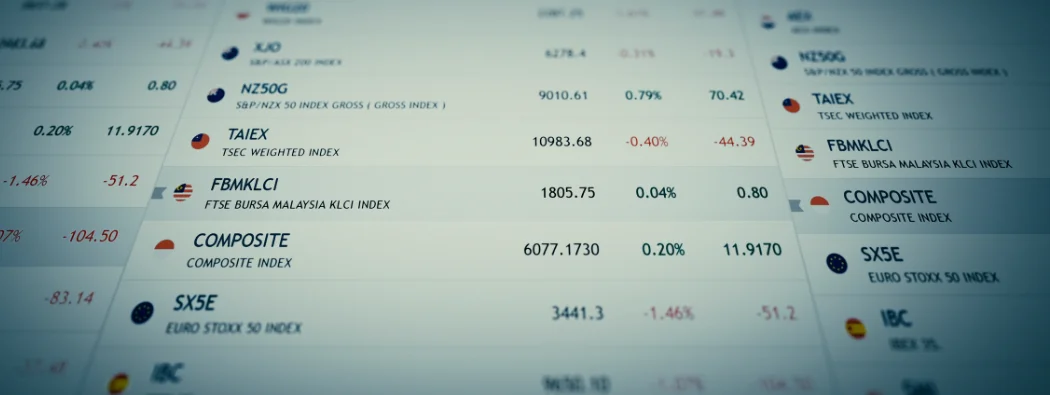
You’ve probably come across the term “stock index” when reading about economics or trading. But what is a stock index exactly? Are there any strategies or techniques to trading indices CFD, and what can we learn about it?
Let’s look at the questions below and gain an insight into each popular trading indices strategy in this article.
An index is an instrument that tracks the performance of a group of financial assets. Indices use mathematical formulas to track a specific sector or market[1].
Some broad-based indices seek to imitate a market, while other more specialised indices attempt to capture a particular market niche. Economists, investors, and analysts use them to determine how a specific sector or country’s economy functions.
Popular indices include:
There are several reasons to consider for trading indices:
First, stock indices give you immediate diversification as the index comprises a basket of securities. Whenever you purchase a stock index, the movement of that index determines the value of the money put in[2].
When trading stock indices, you don’t just rely on a single company’s success, but on the success of all constituent companies. Unless a firm has a huge weightage on the index, poor performance by a single company has a relatively low impact on the price of the overall index.
For this same reason, stock indices tend to be much less volatile than the price movement of individual company stocks. While some traders perceive volatility as a way to create trading opportunities, others avoid it because of the heightened risks, making indices an option to consider.
Here are four trading strategies you may consider using to trade indices CFD:
The Bollinger entry approach helps you to identify oversold target markets and can provide you with optimal market entry levels.
This entry method consists of three bands[3]:
As a trader, you may use the Bollinger entry method to look for price breakouts above the upper band, which also signals the uptrend’s continuation. This approach helps you enter long trades as soon as the index prices break through the upper band on the price chart.
You would need to learn the formulas and calculations involved when planning to adopt the Bollinger entry method, because the type of Bollinger band calculation you employ will influence the trading time frame.
Position trading strategy involves holding an index position for a long time – from several weeks and months, to years. It ignores short-term price volatility and gives you a more accurate picture of the index’s future trajectory.
You can consider opting for this strategy if you want to create trading opportunities from long-term price movements analysing monthly price charts and placing entry and exit orders accordingly.
The term “breakout trading technique” means recognizing a trading range in which the index price has fluctuated over time. A breakout happens when the index price swings outside this range, signalling traders to enter or quit the market[4].
This type of CFD index trading strategy involves trading indices at the market close. End-of-day traders are interested in entering or exiting a market during the last two hours of trading because it gives them a better idea of where the index values are forecast in the future[5].
This method requires you to track price action from the previous day’s price fluctuations. As an end-of-day trader, you can then speculate on how the price might go based on the price movement and choose which indicators to use in their system.
To reduce potential overnight risk, you may consider employing a risk management strategy that includes putting a limit, stop-loss and take-profit order.
Access CFD markets including forex, gold and other commodities, indices, shares/stocks, cryptocurrencies and more, at lower cost.
Follow these links to find out more information on CFD indices, including CFD indices trading and CFD trading strategies.
Start trading by opening a live account here, or practice trading with virtual currency with a demo account.
Disclaimer: The material provided here has not been prepared in accordance with legal requirements designed to promote the independence of investment research and as such is considered to be a marketing communication. Whilst it is not subject to any prohibition on dealing ahead of the dissemination of investment research we will not seek to take any advantage before providing it to our client. No representation or warranty is given as to the accuracy or completeness of this information and therefore it shouldn’t be relied upon as such. Any research provided does not have regard to specific financial situations, needs or investment objectives. Vantage accepts no responsibility for any use that may be made of these comments and for any consequences that result. Consequently, any person acting on it does so entirely at their own risk. We advise any readers of this material to seek professional advice where necessary. Without the approval of Vantage, reproduction or redistribution of this information isn’t permitted.

Discover the endless trading possibilities with our cutting-edge platform, designed to empower our traders. Practice trading the markets with a free demo account today.

Trade on the go with the Vantage All-In-One Trading App, where smooth execution and market access come together in the palm of your hand.

Are you an existing user? Login to your account to start trading 1,000+ CFD products including forex, indices, gold, shares and more.