





 Updated
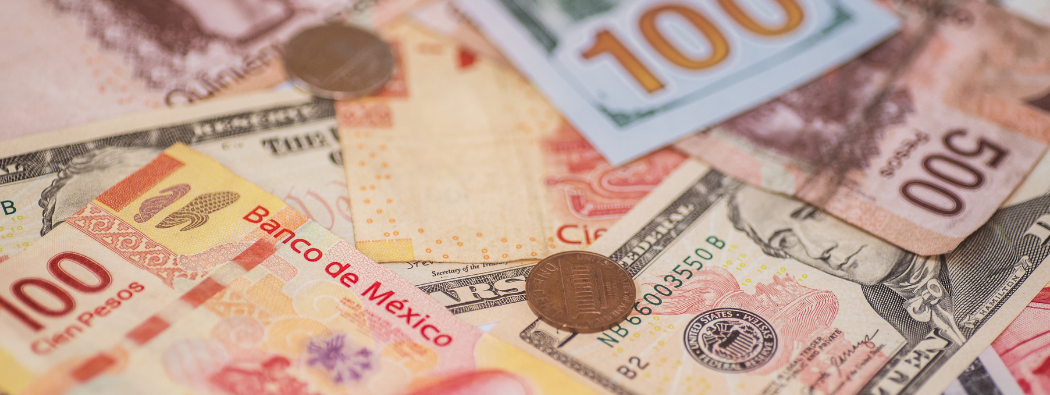
USD/MXN is considered an “exotic” currency pair because it pairs the US dollar with the Mexican peso, the currency of a less commonly traded economy.
This is not much different from any major currency pair, which also has a base and a quote currency. That means USD/MXN works in the same way.
What makes it slightly different from other pairs is its volatility and liquidity. USD/MXN makes forex trading appealing and diverse, as trade events and commodity prices influence the exchange rate. Mexico is also primarily an export-oriented economy, making it vulnerable to shifts in broader geopolitical conditions.
This guide covers key aspects of trading USD/MXN. From historical market events to the best time to trade, we cover the main areas you need to know to potentially take advantage of trading this exotic currency pair.
Key Points
- USD/MXN is an exotic currency pair involving the US dollar and Mexican peso, offering unique trading opportunities due to its volatility.
- Traders can potentially profit from USD/MXN by leveraging its price movements, either by buying low and selling high or shorting the pair.
- Effective risk management, such as using stop-loss orders and proper position sizing, is crucial to successful trading of USD/MXN.
What is USD/MXN Trading?
USD/MXN trading involves buying and selling the base currency, the US dollar (USD), against the quote currency, the Mexican Peso (MXN). The exchange rate tells you how many pesos you need to buy one US dollar.
Individuals who trade USD/MXN aim to capitalise on exchange-rate volatility and price movements. They can do this in two ways: first, by buying the pair at a low price and selling it at a higher price.
Or traders can profit from falling prices by selling the cross with the expectation of repurchasing it at a lower price later. That is known as “shorting” the pair.
USD/MXN History
The Mexican peso was initially pegged to Spain’s official currency, the Spanish dollar. The Mexican peso’s name originated from the silver eight-real coins issued by Spain in Mexico.
After gaining independence from Spain in 1821, Mexico used the peso as its currency. More recently, the 1979 oil crisis led to years of debt defaults and inflation in Mexico.
The North American Free Trade Agreement (NAFTA) was signed in 1992. At the end of 1994, the Foreign Exchange Commission, composed of officials from the Ministry of Finance and the Banco de México, decided that the exchange rate would be set by market forces, i.e., a free-floating exchange rate regime [1].
Why Trade USD/MXN?
USD/MXN is an attractive trading instrument for traders seeking higher volatility and potential profits. Here are some of the key benefits of trading USD/MXN:
- Global Macro Gauge: The peso can be heavily influenced by commodity and oil prices, which are significant exports for Mexico. These assets can sometimes serve as global macro indicators of how the broader economy is performing and where it is in the economic cycle. For example, a rise in commodity prices should increase MXN’s value.
- Carry Trade: One of the drivers of increased peso trading in recent years lies in the “carry trade”. This is where investors capture the interest rate differential by borrowing in a low-interest-rate country and buying assets in a higher-interest-rate country. Mexico’s central bank began raising rates above those of the US and other countries in 2021. Probably the most popular carry trade is MXN/JPY.
- Volatility: USD/MXN has exhibited relatively dynamic price action. Unforeseen domestic events, such as the recent election, and global geopolitical factors, can create volatility. This might enable traders to capitalise on these price moves, potentially yielding higher returns. But traders need to be comfortable with managing higher risk.
- Trading Hours: USD/MXN is available for trading 24 hours a day, 5 days a week. Like other currency pairs in the forex market, trading hours span multiple time zones. Liquidity can vary throughout the day, but buyers and sellers are active across numerous trading sessions.
- Versatility Across Trading Styles: USD/MXN can accommodate a range of trading styles. Day traders can exploit short-term, intraday price moves, which can depend on multiple factors. Position traders typically hold longer-term positions, sometimes for weeks or months, based on fundamental analysis. Swing traders seek to exploit short- to medium-term price volatility, primarily using technical analysis to identify favourable risk-to-reward metrics.
Historical Trends of USD/MXN
1994
The Mexican peso crisis was sparked by the incumbent government’s abrupt devaluation of the peso against the US dollar. This became one of the first international financial crises ignited by capital flight. [2]
The administration relied on foreign investors to purchase its debt after it embarked on an expansionary fiscal and monetary policy ahead of the elections. But political instability caused investor confidence to evaporate, eventually leading to a default.
2008
The Global Financial Crisis saw significant market volatility, with a pronounced flight-to-safety. That meant the safe-haven US dollar was heavily in demand as the world’s premier reserve currency. MXN was sold aggressively, which led to a surge in USD/MXN from 10.26 to 14.33 over a few weeks in September and October 2008.
Recent News
Mexico has benefited hugely from nearshoring in recent years. That is a growing trend that encourages the US to manufacture goods closer to home. It placed renewed focus on trade and drew increased investor attention to the rising peso. USD/MXN has sold off from over 24 to under 17 from 2020 to 2024.
But Claudia Sheinbaum’s shock election win in June 2024 has led to an 8% decline in the peso’s value. That is due to fears that the Morena party could push through some unfriendly market constitutional reforms.
USD/MXN Prediction
Caution reigns over MXN in June 2024, as the new political environment leaves significant domestic uncertainty. But on the monetary front, the central bank, Banxico, recently shifted to a more hawkish stance after raising its core inflation forecasts higher. Interest rates currently sit at 11%, even after the most recent cut. The Mexican peso has also been popular due to the risk-adjusted carry trade.
As we advance, investors will need to monitor the November US Presidential election. Who wins and whether a new trade war kicks off will be key for MXN. Investment banks project a 12-month price target of 16.50.

What Moves USD/MXN?
1. The US Federal Reserve:
The Federal Reserve is the US central bank, with three specific goals: maximum employment, stable prices, and moderate long-term interest rates. In the broadest terms, its monetary policy works by spurring or restraining economic growth. A strong economy typically sees buying in the dollar. Conversely, periods of recession or sluggish growth can weaken the USD. Key financial indicators such as employment data and inflation will contribute to currency volatility.
2. Mexico’s Central Bank (Banxico):
Decisions made by Mexico’s central bank, Banxico, regarding interest rates can affect the value of the peso.
For example, if Banxico opts for higher interest rates and a restrictive policy to curb high inflation, it increases MXN’s attractiveness to investors seeking yield. That could strengthen its position against the dollar and other currencies, leading to a decline in USD/MXN.
Conversely, lower interest rates set by Banxico may diminish the peso’s appeal, leading to a decline in its value against other currencies. That would mean USD/MXN moving higher.
As such, both the Fed and Banxico‘s interest-rate decisions are closely monitored by markets, as they directly affect currency dynamics.
US Non-Farm Payrolls:
Non-farm payroll data is an essential monthly economic indicator that significantly influences both Federal Reserve monetary policy and financial markets. The widely watched headline figure is a key marker of US economic health, measuring the net change in employment over the previous month.
The figures are important as policymakers at the Federal Reserve will use all the available data to analyse the current state of the economy. The report contains tremendous insight into the labour force that will directly impact policy, interest rates, and future economic activity. This will affect the stock market, the dollar’s value, and other financial assets.
For instance, a strong payroll report may be taken as a sign of a robust economy, which can carry inflationary pressures that will boost the dollar against other currencies. A series of similar data releases could prompt the Fed to raise interest rates, with repercussions for all markets.
Economic ties between both countries:
The close economic ties between the US and Mexico mean that financial data in the US can have a major impact on its neighbour. All things equal, a strong US economy augurs well for Mexico. Recently, “nearshoring” by American companies has had a big influence on Mexico’s economy, creating a ripple effect across diverse industries. This is a relatively new, transformative economic phenomenon in which a company delegates a portion of its production to third-party entities in nearby foreign countries. [3]
Geopolitical events and trade agreements:
A geopolitical event can catalyse currency movements, potentially favouring USD as a safe-haven asset. During periods of heightened political instability or conflict, investors often flock to the stability offered by the U.S. dollar, leading to increased demand and subsequent appreciation against currencies such as MXN.
Moreover, political events in the US and Mexico can influence the value of their currencies. Domestic political developments, including shifts in policy and uncertainty surrounding elections, can significantly affect investor sentiment and the USD/MXN exchange rate.
Trade agreements, like the North American Trade Agreement (NAFTA) and its successor, the United States-Mexico-Canada Agreement (USMCA) can also have a significant impact on USD/MXN.
Cross-border trade totalled $779.3 billion in 2022, making Mexico the United States’ second-largest trading partner. Furthermore, Mexico was the US’s biggest provider of goods and the second-largest export market. In fact, over $1.2 million in products move across the border every minute, making it the busiest in the world. Any change in trade dynamics may lead to outsized moves in the currency pair. [4]
Please read our comprehensive article on supply and demand to better understand the concept.
USD/MXN Correlations [5]
Positive Correlations
USD/CAD
USD/CAD is positively correlated with USD/MXN. This is because Canada and Mexico are heavily reliant on oil exports. When oil prices rise, the revenues of oil-exporting countries increase, improving their terms of trade and strengthening their currencies. As a result, the pairs may fall as CAD or MXN appreciates versus the US dollar. The opposite can occur if crude prices fall.
USD/CNH
Both currency pairs prominently feature the US Dollar (USD). This shared presence means that movements in USD can significantly affect both pairs. For example, if the USD strengthens due to factors like rising US interest rates or positive economic data, it can lead to a simultaneous appreciation of the USD in both the USD/MXN and USD/CNH pairs.
Negative Correlations
GBP/MXN
USD often plays a leading role in global risk aversion. When investors flock to the USD as a haven, it can strengthen against other currencies, including the GBP. This, in turn, can weaken the GBP against MXN, contributing to the negative correlation.
Mexico’s export-oriented economy relies heavily on commodities like oil. When commodity prices decline due to a global economic slowdown, MXN can appreciate against GBP, which is less directly tied to commodities. This adds another layer to the negative correlation between USD/MXN and GBP/MXN.
How to Trade USD/MXN
USD/MXN is a popular currency pair for forex traders due to its relatively high volatility compared to other pairs. Here’s an overview of how you can trade USD/MXN:
Trade USD/MXN Using Fundamental Analysis
This type of research involves analysing economic factors that influence the USD-MXN exchange rate. These can be interest rates, inflation, economic growth, and geopolitical events. Analysing central bank policies by the Fed and Banxico is crucial, as they set monetary policy that can significantly affect the exchange rate.
By focusing on economic news and events, you can use fundamental analysis to trade USD/MXN. The key is to identify how these events might influence the relative strength of the US and Mexican economies.
Other factors, like OPEC decisions, can cause volatility. Falling oil prices may represent a challenge for Mexico as an oil exporter. Traders could buy USD/MXN in anticipation that the peso will depreciate.
Trade USD/MXN Using Technical Analysis
Technical analysis involves studying historical price charts and technical indicators to identify potential trading opportunities. It focuses on chart patterns, trends, and support and resistance levels to identify potential entry and exit points.
Popular indicators you can use to trade USD/MXN include:
- Moving Averages (MA): These smooth out price movements to reveal underlying trends. Common MAs include the 50-day, 100-day, and 200-day moving averages. A price that consistently trades above its moving averages indicates an uptrend, while trading below them indicates a downtrend.
- Relative Strength Index (RSI): A momentum oscillator that ranges from 0 to 100. It is used to measure whether the currency pair is overbought (above 70) or oversold (below 30). Traders might look to buy near oversold zones, anticipating a reversal, or sell near overbought zones. Traders can also use this indicator to check divergences between the RSI and price.
- Fibonacci Retracement: Retracement levels are horizontal lines that indicate potential support and resistance levels based on the Fibonacci sequence. Traders use these levels as support and resistance to identify areas where the price might reverse direction during a retracement within a larger trend.
It’s important to remember that technical analysis doesn’t predict the future with certainty, but it can be a valuable tool for identifying trading opportunities.
Risk Management
Effective risk management is essential when trading USD/MXN. The foreign exchange market is inherently volatile, and trading MXN has historically been known for sharp price moves. Even well-tested strategies can be disrupted by predicted and unforeseen events. Here’s why risk management is important:
- Using stop-loss orders means you predetermine the maximum amount you’re willing to lose so that you can limit your potential drawdown. This helps prevent emotional decisions and protects your capital from disastrous losses, especially during periods of sharp volatility.
- A well-defined risk management plan enforces trading discipline. This is a critical skill in trading and helps prevent impulsive decisions driven by greed or fear.
- Effective position sizing limits the amount you allocate per trade. This may safeguard your trading pot and allow you to participate in the market over the long term. One large, unmanaged loss can significantly impact your ability to capitalise on future trades and may force you to stop trading.
USD/MXN Trading Strategies
There are many strategies traders use to capitalise on price movements. From short-term stochastics to long-term buy-and-hold, from sentiment to deep fundamental analysis, traders must choose a strategy that suits them and gives them a trading edge. That might depend on your risk tolerance, time horizon, personality, and trading style.
What it means to go long USD/MXN
When you go long USD/MXN, you are essentially buying USD with the expectation that its value will increase relative to MXN.
If USD appreciates against MXN, you can sell your USD at a higher price later to make a profit.
What it means to short USD/MXN
On the flip side, going short USD/MXN means you are selling US dollars with the expectation that the MXN value will appreciate relative to the US dollar.
If USD depreciates against MXN, you can repurchase USD at a lower exchange rate and pocket the difference as profit.
Understanding these basic concepts is essential to selecting a trading strategy for USD/MXN.
Day Trading
This strategy involves buying and selling positions within the same trading day, capitalising on short-term price movements. A trader will never hold overnight positions. Day traders often rely heavily on technical analysis to identify multiple entry and exit points.
Position Trading
This approach takes a longer-term perspective, holding positions for an extended period. Position traders focus on fundamental analysis to identify long-term trends.
Swing Trading
Swing traders typically hold positions for several days or weeks, aiming to capture profits from larger price “swings”. They primarily utilise technical analysis as their trading strategy.
Explore our article on ‘position trading vs swing trading’ to help you determine which strategy is more suitable for you.
Sentiment Trading
This strategy involves assessing market sentiment toward USD and MXN to determine what to buy or sell and when. Investor psychology can play a huge part in price action.
News Trading
This approach focuses on exploiting market reactions to major news events affecting the USD or MXN. News traders require swift execution to capitalise on market moves that occur in the blink of an eye.
Best Time to Trade USD/MXN
The foreign exchange market, unlike traditional stock exchanges, is open continuously 24 hours a day, 5 days a week. This means traders worldwide can benefit from forex trading hours.
For USD/MXN specifically, here are generally the best conditions:
- Europe – US session Overlap (12 pm to 4 pm GMT)
When the London trading session overlaps with the New York session, overall market liquidity (the ease with which currencies can be traded) is high. This often translates to higher trading volume and potentially greater price swings in USD/MXN. This period can also coincide with the release of key economic data from these regions, further fuelling volatility.
- End of US session (8 pm to 10 pm GMT)
Trading in USD/MXN can also be active at the end of the day, with daily closing prices important for investors when closing their books.
Choosing the best time often depends on your trading strategy and personal circumstances.
Final Thoughts
In conclusion, trading the USD/MXN currency pair presents unique opportunities and challenges given its volatility and liquidity. By understanding the historical context, key influencing factors, and effective trading strategies, traders can better navigate this dynamic market. Whether using fundamental or technical analysis, proper risk management is essential for success in trading this exotic currency pair.
Trading USD/MXN with Tight Spreads via CFDs at Vantage
Trading USD/MXN can offer different trading opportunities than other currency pairs. Higher volatility can be appealing to some traders, who use prudent risk management techniques and are comfortable with sharp price movements.
Vantage offers competitive spreads across a wide range of major and minor currency pairs.
If you want to practise different trading strategies, you can test your trading skills without risking real capital by taking advantage of our free demo trading account.
Embark on your USD/MXN trading journey via CFDs today!
FAQs for USD/MXN Trading
What is the Spread on USD/MXN at Vantage?
At Vantage, we offer competitive spreads on USD/MXN. Due to higher volatility, these spreads are often wider than those of the more traditional currency majors.
Is USD/MXN a Good Pair to Trade?
USD/MXN is considered relatively liquid, meaning there’s usually enough trading volume to execute orders without significant slippage. It can often react sharply to various factors, such as geopolitical or commodity news. Political events between the US and Mexico can also cause volatility, which traders may be able to potentially benefit from, depending on market conditions.
What are the Risks of Trading USD/MXN?
Trading USD/MXN can carry risks due to its volatility, driven by geopolitical events, market sentiment, and economic data. Unforeseen events, especially, might expose traders to potential losses.
Leverage amplifies both profits and losses, while liquidity risk during low trading volume can impact trade execution. Effective risk management, including the use of stop-loss orders and appropriately sized positions, is crucial for mitigating these risks.
What is the Best Time to Trade USD/MXN?
The best time to trade USD/MXN is typically during the overlap between the European and US sessions, and towards the end of the American session.
During these periods, traders can capitalise on the ability to access multiple markets simultaneously and have ample time to analyse and react to major economic data releases.
References
- “Foreign Exchange Market – Banxico”. https://www.banxico.org.mx/tipcamb/main.do?page=tip&idioma=en. Accessed 18 Dec 2025.
- “What Was the Mexican Peso Crisis? Causes, Recovery, and History – Investopedia”. https://www.investopedia.com/terms/t/tequilaeffect.asp. Accessed 18 Dec 2025.
- “Nearshoring in Mexico: Opportunities & challenges for law firms – Thomson Reuters”. https://www.thomsonreuters.com/en-us/posts/legal/mexico-nearshoring-legal-opportunities/. Accessed 18 Dec 2025.
- “Mexico – U.S. Trade Relation – Embamex”. https://embamex.sre.gob.mx/eua/index.php/en/economic-affairs-2022/1909-mexico-u-s-trade-relation. Accessed 18 Dec 2025.
- “How to Use Currency Correlations to Your Advantage – Investopedia”. https://www.investopedia.com/trading/using-currency-correlations-advantage/. Accessed 18 Dec. 2025.