






 Updated
Many traders become interested in swing trading because it does not require constant chart-watching. Instead of reacting to every market movement, swing traders look for opportunities that may develop over several days or weeks.
But before choosing this style, it is important to understand how it works, which markets it suits, and what risks it involves. Swing trading can be applied to forex, commodities, indices, and shares through suitable trading products, but it requires planning, patience, and risk management.
This guide explains swing trading in plain language, including common strategies, time frames, indicators, and considerations for beginners.
Swing trading is a trading style that aims to capture short- to medium-term price movements over several days or weeks. Traders often use technical analysis and risk-management tools to identify opportunities, but they must also manage risks such as overnight exposure, leverage, and market volatility.
Key Takeaways
- Swing trading focuses on price movements that develop over days or weeks.
- It can be used across forex, commodities, indices, and shares.
- Many swing traders use 4-hour, daily, and weekly charts.
- Risk management is important because positions may remain open overnight.
- Demo accounts can help traders practise before considering live trading.
What is Swing Trading?
Many traders discover swing trading when they realise they cannot watch charts all day. They want a trading style that gives them time to analyse the market, make decisions, and manage trades without needing to react to every price movement.
Swing trading is a trading approach that aims to capture short- to medium-term price movements, often over several days or weeks. Instead of opening and closing trades within the same day, swing traders typically hold positions long enough to benefit from larger market swings.
Swing trading can be used across different markets, including forex, commodities, indices, and shares, through suitable trading products. The goal is not to predict every market move but to identify potential opportunities within broader trends, ranges, or breakout conditions.

Swing Trading at a Glance
| Feature | Swing Trading |
| Typical holding period | Several days to several weeks |
| Trade frequency | Moderate |
| Time commitment | Medium |
| Common charts | 4-hour, daily, and weekly |
| Main focus | Capturing price swings within a trend or range |
| Key risks | Overnight exposure, gaps, leverage, and emotional decisions |
Compared with day trading, swing trading usually involves fewer trades and less screen time. Compared with long-term investing, it focuses on shorter market movements rather than multi-year trends.
How Does Swing Trading Work in Forex and CFDs?
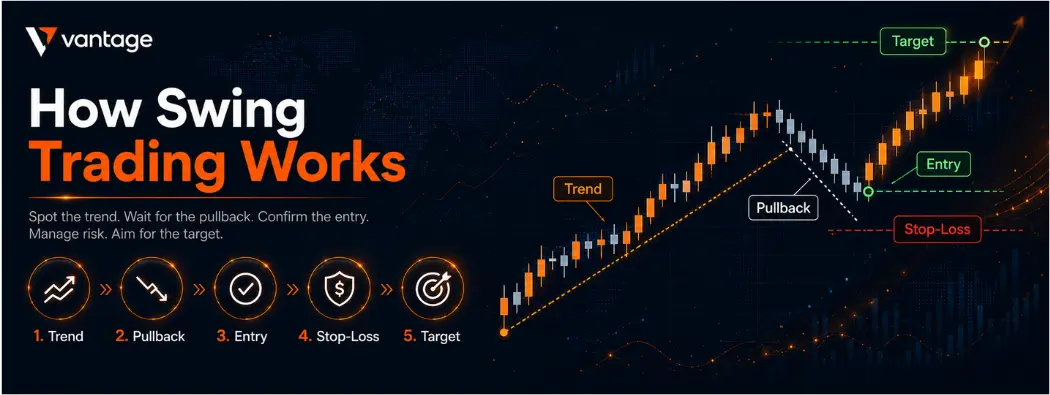
In forex markets, prices rarely move in a straight line. Even within a strong trend, there are often periods of pullbacks, consolidations, and short-term reversals. Swing traders attempt to identify these movements and capture part of a larger price swing rather than every small fluctuation.
For example, a currency pair may trend higher over several weeks while experiencing temporary declines along the way. A swing trader might look for signs that the pullback is ending before entering a position and holding it for several days if the broader trend continues.
The same concept can apply to CFDs. A Contract for Difference (CFD) allows traders to speculate on price movements without owning the underlying asset. CFDs can provide access to markets such as forex, commodities, indices, and shares through a single trading platform.
Many swing traders use a combination of chart patterns, support and resistance levels, trend analysis, and technical indicators to help identify potential opportunities. They may also monitor economic events and market sentiment because these factors can influence medium-term price movements.
Risk in Swing Trading
Swing trading in forex and CFDs involves risk. Positions are often held overnight, which can expose traders to market gaps, changing volatility, and unexpected news events. When leverage is used, both gains and losses can be amplified. For this reason, risk-management tools such as stop-loss orders and position sizing remain important.
Swing Trading vs Day Trading vs Position Trading
One of the easiest ways to understand swing trading is to compare it with other popular trading styles. The main difference usually lies in how long trades are held and how much time traders spend monitoring the market.
| Feature | Swing Trading | Day Trading | Position Trading |
| Typical Holding Period | Days to weeks | Minutes to hours | Weeks to months |
| Trade Frequency | Moderate | High | Low |
| Time Demand | Medium | High | Lower day-to-day involvement |
| Analysis Style | Technical and market context | Short-term price action | Longer-term trend analysis |
| Overnight Exposure | Yes | Usually no | Yes |
| Trading Costs | Moderate | Can be higher due to frequent trading | Typically, lower trade frequency |
| Psychological Pressure | Moderate | High | Often focused on long-term patience |
Swing trading sits between day trading and position trading. It generally requires less screen time than day trading because traders are not trying to capture every intraday move. At the same time, it usually involves a shorter holding period than position trading.
There is no universally “better” trading style. The most suitable approach often depends on factors such as available time, risk tolerance, trading experience, and personal preferences.
Readers who want a deeper comparison can explore our guides on swing trading vs day trading and position trading vs swing trading as part of their learning journey.
What Market Conditions Suit Swing Trading?
Swing trading often works best in markets that offer a balance of liquidity and price movement. Traders generally need enough volatility to create opportunities, but not so much that price action becomes difficult to manage.
Trending markets are commonly associated with swing trading. In an uptrend or downtrend, traders may look for pullbacks, continuation patterns, or breakout opportunities that align with the broader market direction.
Range-bound markets can also create swing trading opportunities. When prices move between well-defined support and resistance levels, traders may focus on potential reversals within that range. However, ranges can eventually break, creating additional risk.
Breakout conditions are another environment many swing traders watch. A breakout occurs when price moves beyond a key level of support or resistance. While breakouts can lead to strong moves, false breakouts are also common and can result in losses if risk is not managed carefully.
Market conditions that may be more challenging include low-liquidity periods, choppy price action, and unusually wide market spreads. In these environments, it can be harder to identify clear opportunities and manage risk effectively.
No market condition guarantees success. Understanding liquidity, volatility, and spread behaviour can help traders assess whether current conditions support their chosen swing trading approach.
Common Swing Trading Strategies Beginners Should Know
There is no single best swing trading strategy. Different approaches work in different market conditions, and each comes with its own strengths and limitations.
The table below introduces some of the most common swing trading strategies beginners may encounter.
| Strategy | What It Looks For | What Can Go Wrong | One Risk Control |
| Trend Pullback | Temporary retracements within a larger trend | The trend may reverse instead of continuing | Use a stop-loss below a key support level |
| Breakout Trading | Price moving beyond support or resistance | False breakouts can trigger losing trades | Wait for confirmation before entering |
| Support and Resistance | Price reacting at established levels | Levels may fail unexpectedly | Define risk before entering |
| Range Trading | Price is moving between support and resistance | A breakout can end the range | Avoid oversized positions near boundaries |
| Price Action Trading | Candlestick patterns and market structure | Signals can be subjective | Combine with broader market context |
| Moving Average Crossover | Trend changes indicated by moving averages | Signals may lag during fast markets | Use additional confirmation tools |
Many beginners search for the “best swing trading strategy,” but the reality is more nuanced. A strategy that works well in a trending market may struggle during range-bound conditions.
For this reason, experienced traders often focus less on finding a perfect setup and more on understanding when a particular strategy is or isn’t appropriate. Risk management, position sizing, and trade review are often just as important as the strategy itself.
Readers who want to explore specific methods in more detail can continue to our dedicated guide on forex trading strategies.
Best Time Frames for Swing Trading
Many beginners ask what the best time frame for swing trading is, but there is no single answer that works for everyone. The most suitable time frame often depends on the trader’s goals, available time, and preferred holding period.
Many swing traders use multiple time frames to build a broader market view. A higher time frame may help identify the overall trend, while a lower time frame can help refine entries and exits.
| Time Frame | Common Use |
| 4-Hour Chart | Identifying shorter-term swing opportunities and entry points |
| Daily Chart | Analysing broader trends and key support or resistance levels |
| Weekly Chart | Understanding long-term market direction and major trend structure |
For example, a trader may use the weekly chart to assess the overall trend, the daily chart to identify potential setups, and the 4-hour chart to look for entry opportunities.
South African traders should also be aware of market sessions, rollover times, and potential swap charges when holding positions overnight. These factors may affect swing trades that remain open for several days or weeks.
The key takeaway is that the best time frame for swing trading is often the one that supports a trader’s plan and allows them to manage positions consistently.
Useful Indicators for Swing Trading
Indicators are often used to help traders analyse trend direction, momentum, volatility, and potential reversal areas. However, indicators are tools for interpretation, not prediction. They work best when combined with broader market analysis and sound risk management.
The table below outlines some of the indicators commonly used in swing trading.
| Indicator | What It May Help Identify | Limitation |
| Moving Averages | Trend direction and potential support or resistance zones | Can lag behind price movements |
| RSI (Relative Strength Index) | Momentum and possible overbought or oversold conditions | May remain overbought or oversold during strong trends |
| MACD | Trend strength and momentum shifts | Signals can arrive after a move has already started |
| Stochastic Oscillator | Potential turning points in momentum | Can generate false signals in volatile markets |
| Fibonacci Retracement | Areas where pullbacks may pause or reverse | Levels are not guaranteed to hold |
| ATR (Average True Range) | Market volatility and stop-loss planning | Does not indicate direction |
Many traders search for the best indicators for swing trading, the best RSI settings, or the ideal MACD settings. In reality, there is no universal combination that works in every market condition.
Beginner Mistake to Avoid
One of the most common mistakes is using too many indicators at once. This can create conflicting signals and make decision-making more difficult.
A simpler approach is often more effective. Focus on understanding what each indicator measures and use it to support, rather than replace, your overall market analysis.
For a deeper understanding of momentum analysis, readers can explore our guide to the MACD indicator and other technical analysis concepts.
How to Build a Simple Swing Trading Plan
A swing trading plan helps create structure and consistency. Rather than making decisions based on emotion or market noise, traders can use a predefined process to guide entries, exits, and risk management.
A simple swing trading plan might include the following steps:
1. Select a Market
Choose a market you want to follow consistently, such as a major forex pair, commodity, or index. Highly liquid markets are often easier to analyse and monitor.
2. Identify Market Conditions
Determine whether the market is trending, range-bound, or experiencing increased volatility. This can help guide strategy selection.
3. Define an Entry Trigger
Specify what conditions must be present before entering a trade. This could include a pullback within a trend, a breakout above resistance, or a price-action signal.
4. Set an Invalidation Level
Before entering, identify the point where the trade idea would no longer make sense. This can help determine stop-loss placement.
5. Plan Risk and Reward
Decide how much capital you are willing to risk on the trade and identify a realistic target level. Many traders use a predefined risk-reward ratio as part of this process.
Example
Suppose a trader notices a major forex pair trending higher on the daily chart. After a pullback toward a support area, the trader waits for confirmation before entering the trade. A stop-loss is placed below the support level, while a target is selected based on the broader market structure.
This example is purely educational and does not represent a trading recommendation.
6. Review the Outcome
After the trade closes, record what happened and what was learned. A trading journal can help identify patterns, strengths, and areas for improvement over time.
A good swing trading plan focuses on process and discipline rather than predicting market outcomes.
Main Risks of Swing Trading
Swing trading can offer more flexibility than shorter-term trading styles, but it also comes with risks that traders should understand before placing positions.
One of the biggest considerations is overnight and weekend exposure. Because swing trades are often held for several days or weeks, prices can move significantly while markets are closed or when unexpected news is released.
Leverage is another important risk factor. While leverage can increase market exposure, it can also amplify losses. This is why position sizing and risk management are often central parts of a swing trading plan.
Traders should also be aware of swap charges or holding costs that may apply when positions remain open overnight. These costs can accumulate over time and affect overall trade performance.
Other risks include:
- False breakouts and failed trends
- Sudden increases in volatility
- Widening spreads during major events
- Correlated positions increase overall exposure
- Emotional decision-making during market fluctuations
Risk Reality Check
No strategy can eliminate risk. Even well-planned swing trades can be affected by unexpected events, market gaps, or sharp price movements.
Stop-loss orders can help manage risk, but they do not guarantee a specific outcome, particularly during periods of extreme volatility or when markets gap beyond the stop level.
Successful risk management is often less about avoiding losses entirely and more about controlling how much is at risk on each trade.
Trader Psychology Insight
Many beginners focus heavily on finding entries but spend less time planning exits. In practice, patience, discipline, and emotional control are often just as important as technical analysis. Swing trading can require traders to sit through short-term fluctuations without abandoning a well-defined plan.
Common Beginner Mistakes
Many new traders spend a lot of time searching for the right strategy but overlook the habits that often have a bigger impact on long-term performance.
Some of the most common swing trading mistakes include:
- Entering trades without a clear plan
- Risking too much on a single position
- Moving stop-loss orders after entering a trade
- Using too many indicators at once
- Ignoring correlations between related markets
- Holding positions through major news events without a risk plan
- Copying signals without understanding the underlying setup
- Overtrading after a winning or losing streak
What Beginners Commonly Misunderstand
- A good strategy cannot compensate for poor risk management.
- More indicators do not necessarily improve decision-making.
- Swing trading does not require constant market monitoring.
- A profitable trade does not always mean the process was correct.
- A losing trade does not always mean the analysis was wrong.
- Consistency often comes from following a plan rather than accurately predicting markets.
Many beginner mistakes stem from impatience or unrealistic expectations. Focusing on process, discipline, and risk control can help traders build better habits while developing their swing trading skills.
How to Practise Swing Trading on a Demo Account
A demo account can provide a practical way to explore swing trading before exposing capital to live-market risk. Rather than focusing on profits, beginners should use the demo environment to test processes, risk controls, and trade management techniques.
A simple swing trading practice checklist might include:
- Choose one or two liquid forex pairs to follow consistently
- Set up weekly, daily, and 4-hour charts
- Define a swing trading setup before entering any trade
- Record entry, stop-loss, and target levels
- Monitor spreads, swap charges, and overnight behaviour
- Review how trades perform during different market conditions
- Keep a trading journal with observations and lessons learned
- Adjust rules based on evidence rather than emotions
The goal is not to take as many trades as possible. Instead, focus on understanding how swing trading works in real market conditions and whether the approach fits your schedule, personality, and risk tolerance.
Practising on a demo account can also help traders become familiar with platform tools, order types, and risk-management features before considering live trading.
A demo-first approach often provides a safer learning path than immediately funding a live account without a tested process.
Conclusion + Next Learning Step
Swing trading is a trading style that aims to capture price movements over several days or weeks rather than minutes or hours. It can be applied across forex, commodities, indices, and other markets, but success depends on more than finding a strategy. Planning, risk management, patience, and realistic expectations all play important roles.
Before considering live trading, take time to understand concepts such as position sizing, stop-loss placement, leverage, risk-reward ratios, and market conditions. Practising on a demo account can help build familiarity with these concepts while allowing traders to test their process in a virtual environment.
Next Learning Step
To continue building your knowledge, explore our guides on demo accounts, forex trading strategies, position trading vs swing trading, MT4, MT5, technical analysis, MACD, stop-loss orders, and leverage in forex. Together, these topics can help create a stronger foundation before taking on live-market risk.
Frequently Asked Questions
What is swing trading?
Swing trading is a trading style that aims to capture short- to medium-term price movements. Trades are often held for several days or weeks rather than being opened and closed within the same trading session.
What is swing trading in forex?
Swing trading in forex involves identifying price movements that unfold over multiple days or weeks. Traders often analyse trends, pullbacks, breakouts, and support or resistance levels to identify potential opportunities
How long do swing trades usually last?
There is no fixed holding period. Many swing trades last anywhere from a few days to several weeks, depending on market conditions, strategy, and the trader’s objectives.
Is swing trading better than day trading?
Neither approach is universally better. Swing trading typically requires less screen time, while day trading avoids overnight exposure. The most suitable choice often depends on a trader’s schedule, experience, and risk tolerance.
What is the best time frame for swing trading?
There is no single best time frame. Many swing traders use a combination of weekly, daily, and 4-hour charts to analyse trends and identify potential entry opportunities.
Which indicators are commonly used for swing trading?
Commonly used indicators include moving averages, RSI, MACD, stochastic oscillators, Fibonacci retracement levels, and ATR. These tools are often used alongside broader market analysis rather than on their own.
Is swing trading profitable?
Swing trading can result in gains or losses depending on market conditions, strategy execution, and risk management. No trading style guarantees profits, so traders should approach swing trading with realistic expectations.
What are the main risks of swing trading?
Key risks include overnight and weekend gaps, leverage, market volatility, widening spreads, swap charges, false breakouts, and emotional decision-making. Risk management remains important regardless of strategy.
Can beginners practise swing trading on a demo account?
Yes. A demo account allows beginners to practise swing trading using virtual funds. It can help traders test strategies, understand platform tools, and develop a trading plan before considering live trading.
What forex pairs are often considered for swing trading?
Many traders focus on major forex pairs because they tend to offer strong liquidity and relatively competitive spreads. However, market selection should always be based on individual analysis and risk considerations.
Risk Warning: CFDs are complex financial instruments and carry a high risk of rapid loss of money due to leverage. You should ensure you fully understand the risks involved and carefully consider whether you can afford to take the high risk of losing your money before trading.
Disclaimer: The information is provided for educational purposes only and doesn’t take into account your personal objectives, financial circumstances, or needs. It does not constitute investment advice. We encourage you to seek independent advice if necessary. No representation or warranty is given as to the accuracy or completeness of any information contained within.
This material may contain historical or past performance figures and should not be relied on. Furthermore, estimates, forward-looking statements, and forecasts cannot be guaranteed. The information on this site and the products and services offered are not intended for distribution to any person in any country or jurisdiction where such distribution or use would be contrary to local law or regulation.