






 Updated
USOIL is a common trading symbol used by brokers to represent the price of U.S. crude oil, usually linked to West Texas Intermediate, or WTI. On MT4 and MT5, USOIL is often offered as a contract for difference, or CFD. That means the trade tracks price movement rather than physical ownership of oil.
For South African traders, USOIL is often viewed as a market linked to global energy prices, inflation, the U.S. dollar, and broad risk sentiment. Interest in this market often increases when oil prices receive greater media attention or when traders begin looking beyond major currency pairs to new instruments.
This article explains how USOIL appears on MT4 and MT5, how the trading process works, and which practical factors shape the experience for a South African trader. The content is educational only and is intended for general information.
Key Takeaways
- USOIL is usually a broker symbol for U.S. crude oil exposure.
It often tracks WTI crude oil, but the exact symbol can differ by broker. On Vantage, traders should look for USOUSD rather than USOIL. - USOIL/USOUSD on MT4 and MT5 is commonly traded as a CFD.
Traders are not buying physical crude oil. They are trading price movement through a platform-based CFD product. - South African traders need to check the correct symbol and product details before trading.
Symbol names, contract size, spread, swaps, margin, and trading hours may vary by broker or account type. - The article gives clear steps for finding USOUSD on MT4 and MT5.
It explains how to use Market Watch, Show All, Symbols, and the Specification window to confirm product details before placing a trade. - Risk control is central when trading crude oil CFDs.
Common mistakes include confusing WTI with Brent, ignoring contract specs, using excessive lot sizes, trading without exit levels, and overlooking spreads or swaps.

What Is USOIL?
USOIL is usually a broker symbol for WTI crude oil. WTI stands for West Texas Intermediate.
USOIL is not a universal product with one fixed structure across all brokers. The name may vary. Some platforms use USOIL, while others may use labels such as WTI, XTIUSD, or Crude Oil. The underlying idea is usually the same: the symbol reflects price movement in U.S. crude oil.
On retail trading platforms, USOIL is commonly traded as a CFD. In that form, the instrument provides price exposure without requiring storage, transport, or direct ownership of exchange-traded futures.
That distinction matters because platform-based oil products often differ from broker to broker. Symbol naming, spread, contract size, swap, margin, and trading hours may all vary.
Why South African Traders Watch USOIL
USOIL often draws interest because oil is one of the most closely watched global commodities.
Academic research on WTI crude oil shows that oil price volatility varies over time and often becomes more extreme during periods of market stress, while inventory surprises and geopolitical supply shocks remain key drivers of short-term price moves.
For South African readers, oil also has a local angle. Changes in global oil prices can affect fuel costs, inflationary pressures, transportation costs, and business sentiment. Because of that link, crude oil may feel more familiar than some other global instruments.
In trading terms, USOIL is often seen as a market that reacts clearly to news, broad trends, and short-term momentum.
Is USOIL the same as WTI crude oil?
West Texas Intermediate (WTI) is a major crude oil benchmark used to price oil, mainly in the U.S. market.
USOIL, on the other hand, is often used as a platform or search label. Many traders type “USOIL” when looking for U.S. crude oil on trading platforms, charting tools, or broker apps. In most cases, the symbol points to a CFD or cash product that tracks, or is linked to, WTI crude oil prices.
However, traders using Vantage, the current product naming is more precise. Vantage lists WTI Crude Oil Cash under the symbol USOUSD on its oil CFD page. It also lists the same product, WTI Crude Oil Cash USOUSD, in its WTI crude oil trading guide.
South African traders should not assume that every broker uses the same symbol. One platform may show USOIL, another may show USOUSD, while others may use names like WTI, XTIUSD, or Crude Oil Cash.
USOIL vs WTI vs USOUSD
| Term | What it means | What traders should note |
| WTI | The benchmark name for West Texas Intermediate crude oil. | It is the market reference behind many U.S. crude oil products. |
| USOIL | A common platform or search label for U.S. crude oil. | It may appear on some brokers, but symbol names can differ. |
| USOUSD | Vantage’s symbol for WTI Crude Oil Cash. | This is the Vantage platform symbol readers should look for on MT4 or MT5. |
How to Find USOIL or USOUSD on MT4
The name used for crude oil on MT4 often differs from one broker to another. Symbol name depends on your broker, so do not worry if you do not see “USOIL” straight away. On Vantage, the symbol traders should look for is USOUSD (listed in the table above), which is WTI Crude Oil Cash.
To find it, open your MT4 platform and go to the Market Watch window. This panel usually appears on the left side of the screen. When it is hidden, it can generally be restored through the View menu or by using the Ctrl + M shortcut on your keyboard.
Next, right-click anywhere inside the Market Watch window. You can select Show All to display all available instruments. You can also click Symbols to search by category.
In the Symbols window, look through folders such as Commodities, Energies, CFDs, Raw materials, or any similar folder used by your broker. Find USOUSD, USOIL, WTI, or another crude oil symbol. If you are using Vantage, select USOUSD, then click Show.
After the symbol appears in Market Watch, right-click it and select Chart Window. MT4 will open a live price chart for that product. From there, you can add indicators, change timeframes, and prepare your trade setup.
If the symbol does not appear, check that you are logged in to the correct account type and server. Some brokers limit certain products by account type. You can also contact the broker’s support team to confirm the exact oil symbol and whether crude oil trading is enabled on your account.
Before placing a trade, right-click the symbol and select Specification. Check the spread, contract size, swap, margin rules, and trading hours first.
How to Find USOIL or USOUSD on MT5
Finding USOIL or USOUSD on MT5 is slightly different from MT4, but the process is still simple. MT5 often provides traders with more folders, symbols, and product details, so it helps to know where to search.
Start by opening your MT5 platform and logging in to your trading account. Then open the Market Watch window. If it is not visible, click View on the top menu and select Market Watch. You can also press Ctrl + M on your keyboard.
In Market Watch, look for the + icon near the bottom of the panel. Click it and type USOUSD into the search field. If you are using Vantage, USOUSD is the symbol to look for when trading WTI Crude Oil Cash.
Another way is to right-click inside Market Watch and select Symbols. MT5 will open a larger symbols window. From there, check folders such as Commodities, Energies, Metals & Energies, CFDs, or similar sections used by your broker.
Once you find USOUSD, click the symbol and select Show Symbol. It should now appear in your Market Watch list. To open the chart, right-click USOUSD and select Chart Window.
MT5 may display more product details than MT4. You may see extra information on contract size, tick value, margin rate, swap charges, and trading sessions. Review these details before placing a trade.
If USOUSD does not appear, your account may not support oil trading. You may also be logged in to the wrong server or account type. Contact your broker’s support team and ask for the correct crude oil symbol for MT5.
USOIL Trading Hours on MT4 and MT5
USOIL trading hours on MT4 and MT5 refer to the times when a broker allows clients to open, close, or manage oil CFD positions. These hours are not universal. They may differ by broker, server time, account type, public holidays, market closures, and scheduled platform maintenance.
On Vantage, the relevant WTI crude oil cash product is listed as USOUSD. The WTI Crude Oil Cash USOUSD is available from Monday to Friday, 01:00–24:00 GMT+2.
| Country | Time zone | Local USOUSD hours based on GMT+2 |
| South Africa | SAST, UTC+2 | Monday–Friday, 01:00–24:00 |
| Nigeria | WAT, UTC+1 | Monday–Friday, 00:00–23:00 |
| Kenya | EAT, UTC+3 | Monday–Friday, 02:00–01:00 next day |
South Africa uses South Africa Standard Time, which is UTC+2. Nigeria uses West Africa Time, which is UTC+1. Kenya observes East Africa Time, which is UTC+3.
For South African traders, the GMT+2 schedule matches local time. A 01:00 platform opening time is therefore 01:00 in Johannesburg, Cape Town, Durban, and Pretoria.
For Nigerian traders, the local time is one hour behind GMT+2. A 01:00 GMT+2 opening time becomes 00:00 WAT.
For Kenyan traders, the local time is one hour ahead of GMT+2. A 01:00 GMT+2 opening time becomes 02:00 EAT. The session ends at 24:00 GMT+2, which is 01:00 the next day in Kenya.
MT4 and MT5 use the broker’s server time, not the trader’s device time. Vantage states that its trading server runs on GMT+2 as standard and adjusts to GMT+3 during daylight saving time.
Traders should confirm the current session times inside MT4 or MT5 before entering a position. The Specification window for USOUSD can show live product details, including trading sessions, spread, swap, contract size, and margin rules.
Why Can’t I Find USOIL on MT4 or MT5?
Some traders may not see USOIL on MT4 or MT5 because brokers do not always use the same symbol name. One platform may show USOIL, while another may list the same WTI-linked product as WTI, XTIUSD, Crude Oil Cash, or USOUSD.
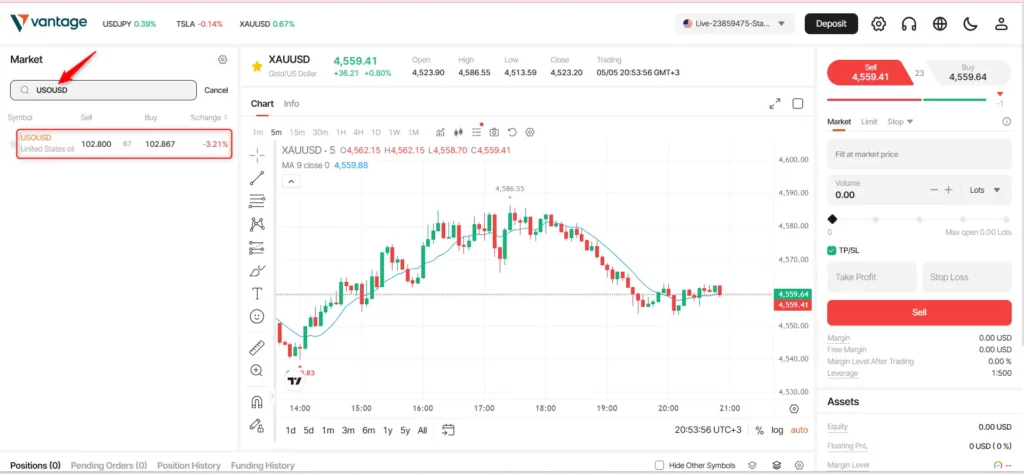
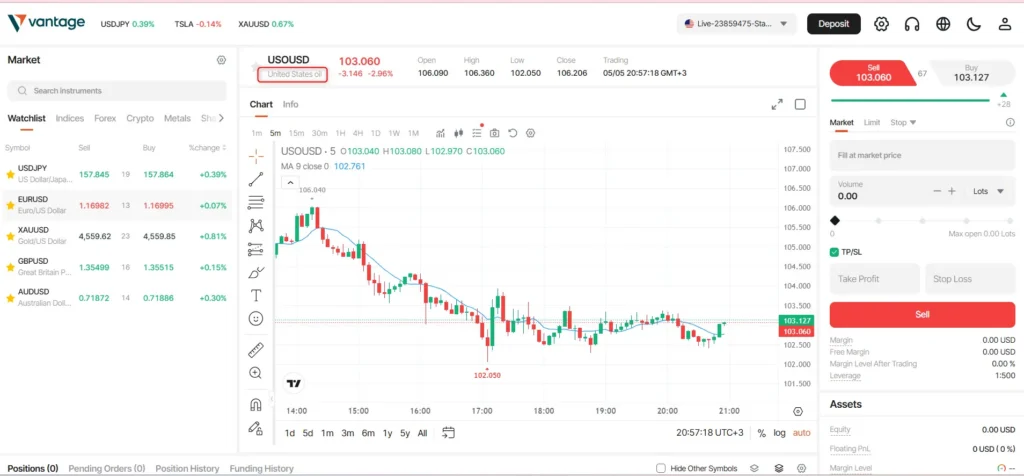
For Vantage users, the symbol to search for is USOUSD.
Possible reasons and how to fix them;
Reason 1
Wrong symbol name: The broker may not use “USOIL.”
How to fix: You may search for USOUSD, WTI, XTIUSD, or Crude Oil Cash.
Reason 2
Hidden symbol: The product is available but not shown.
How to fix: Right-click Market Watch and select Show All or Symbols.
Reason 3:
Account type issue – Your account may not support oil CFDs.
How to fix: Check product access or ask support to confirm.
Reason 4
Wrong server: You may be logged in to the wrong trading server.
How to fix: Log out, then choose the correct server in your broker.
Reason 5
Disabled instrument: The broker may have restricted trading.
How to fix: Check notices, holidays, or maintenance updates.
Reason 6
Regional access: Oil CFDs may not be offered in all regions.
How to fix: Confirm availability with your broker.
Note: If the symbol is still missing, contact platform support. Ask them for the correct oil symbol, eligible account type, and current trading status.
Common Mistakes When Trading USOIL
Trading in USOIL often involves errors stemming from platform settings, product confusion, and weak risk controls, rather than from chart analysis alone.
- Mixing up WTI and Brent crude oil: Both are major oil benchmarks, but they represent different markets and may respond differently to supply disruptions, refinery demand, shipping conditions, and regional pricing pressures. Treating them as identical can distort trade analysis.
- Ignoring contract specifications. On MT4 and MT5, oil instruments may differ across brokers in contract size, margin requirements, trading hours, spreads, and overnight swap charges. A position that appears small in terms of volume may represent greater exposure than expected.
- Excessive lot size is also a recurring problem. USOIL can show rapid price movement during active market hours or during major news events. Larger position sizes can magnify short-term price changes and increase account volatility.
- Trading without defined exit levels. When stop-loss and take-profit levels are absent, position management often becomes inconsistent, especially during fast-moving sessions.
- Spreads and swaps can materially affect the outcome of short-term and overnight positions.
Common items reviewed before opening a USOIL trade
Before you decide to trade. Use the checklist below;
- Correct symbol name
- Benchmark type, such as WTI or Brent
- Contract size and margin terms
- Spread and swap details
- Position size relative to account size
- Stop loss and take profit levels
- Market status and session hours
- Scheduled oil-related news events
Conclusion
USOIL on MT4 and MT5 typically refers to a broker-based oil CFD linked to U.S. crude oil prices. The instrument is widely used because it offers access to one of the world’s most active commodity markets through a familiar retail trading platform.
The trading process on MT4 and MT5 is straightforward from a mechanical standpoint. The deeper part lies in understanding the contract specification, the spread structure, margin, overnight costs, and the broader forces that drive oil prices. For readers exploring market structure for the first time, a demo account lets you view the symbol, pricing, and platform layout in a simulated environment. A live account is the usual next step, where full market access is available after account approval.
Frequently Asked Questions
What is USOIL?
USOIL is a commonly used broker symbol or search label for U.S. crude oil CFDs.
What is USOIL in CFD trading platform?
In CFD trading, USOIL usually refers to a crude oil CFD or similar instrument quoted against the US dollar.
Is USOIL the same as WTI?
USOIL is often used as a platform label for exposure to US crude oil. WTI is the benchmark. The exact tradable symbol depends on the broker.
Is USOIL the same as USOUSD
Not exactly. USOIL is a common search/platform term. USOUSD is the Vantage symbol for WTI Crude Oil Cash on MT4 and MT5.
How do I find USOIL on MT4?
Open Market Watch, use Show All or Symbols, then search for the crude oil symbol. On Vantage, look for USOUSD where available on the platform.
What are the USOIL trading hours?
Trading hours depend on the broker and server time. Vantage’s WTI Crude Oil Cash page lists USOUSD as Monday–Friday, 01:00–24:00 GMT+2, where current.
Do I need a USOIL pip calculator?
A calculator may help, but point value depends on symbol specs, contract size, account currency, and lot size. Check the platform specification.
Is trading USOIL risky?
Yes. Crude oil CFDs are leveraged products and can move fast. Traders should check margin, spread, swap, lot size, and risk controls before trading.
Risk Warning: CFDs are complex financial instruments and carry a high risk of rapid loss of money due to leverage. You should ensure you fully understand the risks involved and carefully consider whether you can afford to take the high risk of losing your money before trading.
Disclaimer: The information is provided for educational purposes only and doesn’t take into account your personal objectives, financial circumstances, or needs. It does not constitute investment advice. We encourage you to seek independent advice if necessary. No representation or warranty is given as to the accuracy or completeness of any information contained within.
This material may contain historical or past performance figures and should not be relied on. Furthermore estimates, forward-looking statements, and forecasts cannot be guaranteed. The information on this site and the products and services offered are not intended for distribution to any person in any country or jurisdiction where such distribution or use would be contrary to local law or regulation.
References
- https://www.cmegroup.com/markets/energy/crude-oil/light-sweet-crude.contractSpecs.html? – Crude Oil Futures
- https://www.eia.gov/finance/markets/crudeoil/ – Energy and Financial Markets: What Drives the Crude Oil Prices
- https://vantagemarektsdev.canglankeji.com/en-za/academy/20-trading-instruments-moving-on-the-iran-conflict-and-what-traders-should-know/ – Trading Instruments Moving the Iran Conflict
- https://www.investopedia.com/articles/investing/072515/top-factors-reports-affect-price-oil.asp – Key Factors Influencing Oil Prices and Economic Impact
- https://www.sciencedirect.com/science/article/abs/pii/S014098832200603X – Volatility of WTI Crude Oil Prices