






 Updated

Some CFD brokers, including Vantage Markets, offer synthetic indices trading via CFDs in South Africa, which can be explored in demo accounts for educational purposes. This trading product is becoming one of the most talked-about in the country. They appeal to local traders because they are available 24/7, follow predefined volatility patterns, and can be traded with tiny amounts.
South Africa already has one of the largest online trading communities in Africa. Reports indicate that local traders generate over $2.2 billion in daily CFD and forex volume, with nearly 190,000 people trading. This growth makes synthetic indices a natural choice for those who want markets that are always open.
Unlike traditional markets such as the JSE Top 40, which are influenced by company earnings and political news, synthetic indices follow fixed volatility rules. Some traders explore them alongside forex and other index CFDs for educational or practice purposes.
👉 In this guide, you’ll learn what synthetic indices are, how they work, and the characteristics of Vantage’s synthetic indices series (Fixed Vol, SpikeUp/SpikeDown, and FixedStep) for educational purposes.
How Synthetic Indices Work (Behind the Scenes)
Synthetic indices are built on random number generators that create one price tick per second. Each product follows a fixed volatility model, ensuring fairness and transparency. Unlike forex or stocks, prices are not influenced by central banks, earnings, or political news.
For South African traders, this can be useful for testing strategies in a controlled and educational setting. The volatility 75 index is one of the most searched terms in South Africa’s trading community. Its predictable behaviour makes it a popular choice for strategy testing.
How Synthetic Indices Generate Prices
- The algorithm assigns a pre-set volatility level (e.g., 75% or 100%).
- A random number generator produces a new value each tick, causing the price to move up or down.
- Volatility remains within expected ranges at the 95% confidence level.
Snippet-ready block:
Synthetic indices generate prices using random number models. Each tick is generated independently with fixed volatility, ensuring fair and consistent trading conditions.
Types of Price Models
| Index Type | How It Works | South Africa Relevance |
| Fixed Vol | Constant volatility, updated every second. | Popular for EA testing by SA traders. |
| SpikeUp/Down | Normal moves + sudden spikes at set intervals | Resembles news shocks such as SARB announcements for educational testing purposes. |
| Useful for beginners practising risk control. | Moves up or down by a fixed value each tick. | Useful for beginners practising risk control. |
Why It Matters for South Africa
- Traders can practice strategies on weekends, unlike in the forex market, where trading is typically limited to weekdays.
- Synthetic indices are commonly used to test expert advisors (EAs) in the absence of unexpected news.
- They are offered by only a few synthetic indices CFD brokers worldwide. Many ask, “Which broker has the volatility 75 index?” Vantage MT5 is one of the platforms available to traders in South Africa.
Trader Quote (Reddit, SA-focused):
“I trade V75 on weekends because it’s consistent and not affected by political drama. It helps me refine my strategies without stress.”
Common Question for South African Traders: Are Synthetic Indices Manipulated?
Traders can compare synthetic indices and forex using educational resources without referring to a specific broker. For more details on risk, see Vantage’s risk disclosure.
To compare synthetic indices with forex, visit Vantage’s forex trading guide. For more details on risk, see Vantage’s risk disclosure.
Want a step-by-step reference? Download our free Synthetic Indices PDF Guide for South African Traders to keep these rules on hand.

Why South Africans Trade Synthetic Indices
For many South Africans, the 24/7 availability is the biggest draw. The JSE Top 40 only trades during the day, but synthetics are available for trading at all times, including nights, weekends, and public holidays.
This makes them attractive to people with work or study commitments.“I appreciate that the Volatility 75 Index is driven by rules, not headlines. I can run my strategy every evening without surprises.” — Comment from a South African trader on a community forum.
Regulatory Note
While synthetic indices are digital, the broker offering them must be authorised in South Africa. Always confirm that a provider is listed with the FSCA as an OTC Derivatives Provider (ODP) before trading.
Read More:
- Read our Beginner’s Guide to Indices.
- Learn about contracts in our ‘How CFDs Work’ explainer.
- Explore platform setup in our MT5 trading Guide.
- Brush up on Risk Management Essentials.
- Learn the Step-by-Step Guide: Setting Up MT5 for Synthetic Indices
- Claim your free Trading Account now.
Types of Synthetic Indices
Synthetic indices are designed to mimic different market conditions. Each type has unique features that make it useful for various trading styles. In South Africa, traders often mix these products depending on strategy and risk tolerance.
| Types | Description | Widespread Use in South Africa |
| Volatility Indices (10, 25, 50, 75, 100) | Track price movements with fixed volatility percentages (e.g., V75 = 75%) | Testing strategies and trading breakouts. |
| Boom 1000/Crash 1000 | Markets with long, steady moves and sudden, large spikes (boom or crash). | High-risk, high-reward setups. |
| Boom 500/Crash 500 | Similar to Boom/Crash 1000, but with smaller and more frequent spikes. | Short-term trades. |
| Step Index | Moves in fixed “steps” every tick. | Popular with beginners. |
| Jump Indices (10, 25, 50, 75, 100) | Include random “jump” events in addition to normal movement. | Strategy stress testing |
| Range Break Indices (100, 200) | Break out of ranges after set tick counts. | Breakout trading practice |
| Daily Reset Indices (Bull & Bear) | Reset daily to 1,000 points, like leveraged ETFs. | Intraday directional trading. |
Popularity in South Africa
Surveys and discussions within the trading group indicate that the Volatility 75 Index (V75) is by far the most widely traded synthetic index in South Africa. Many traders refer to it [V75] as a highly volatile synthetic index, which is often explored in demo accounts for learning position sizing and risk
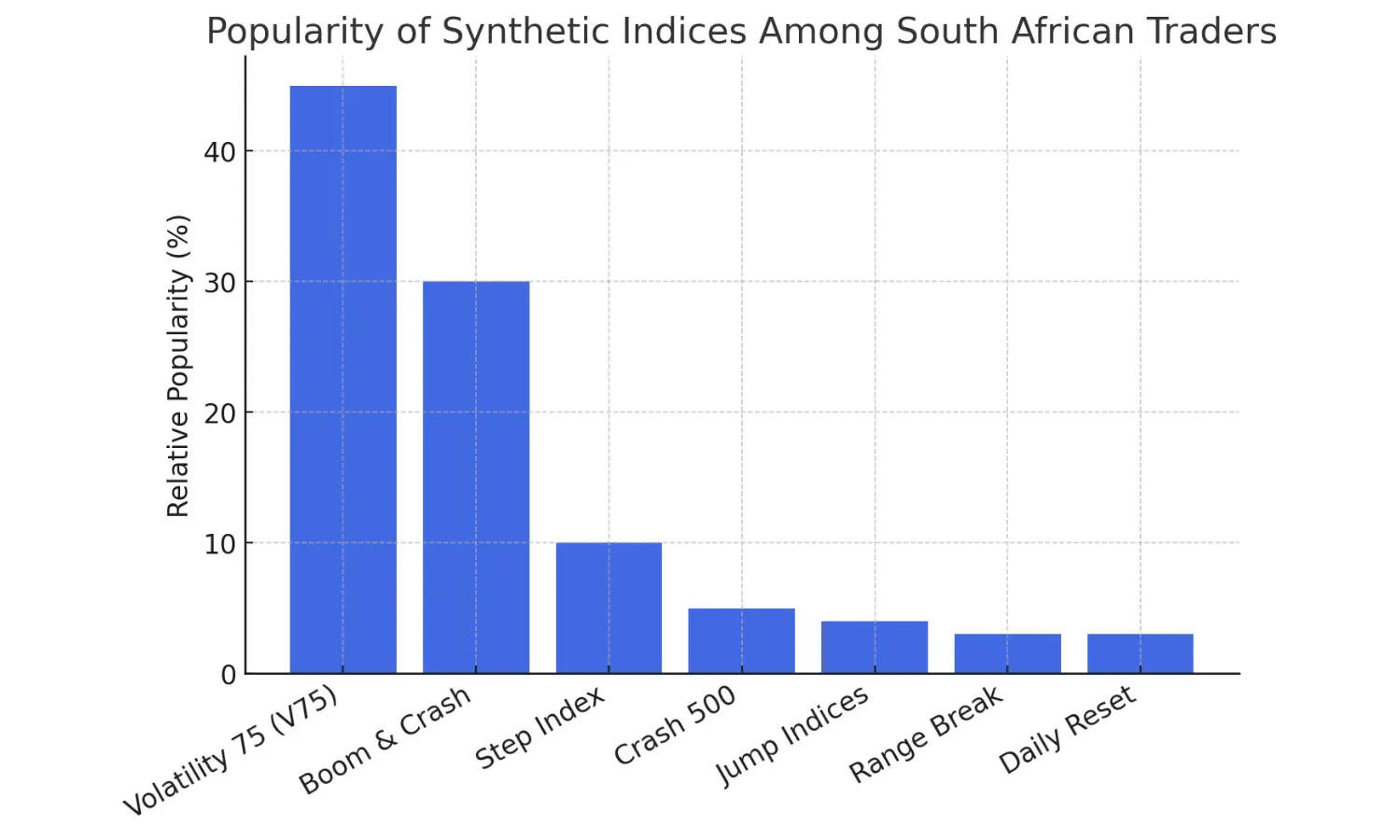
Surveys and discussions within the trading group indicate that the Volatility 75 Index (V75) is by far the most widely traded synthetic index in South Africa. Many retail traders refer to it as “the king of synthetics” due to its sharp price movements and substantial profit potential.
Synthetic Indices Products
Vantage offers three unique synthetic index series: Fixed Volatility, SpikeUp/SpikeDown, and Fixed Step. These CFD products are exclusive to Vantage, giving South African traders access to instruments often searched for on Google, such as the Volatility 75 Index and Boom and Crash.
Fixed Vol Index Series (Predictable Volatility Trading)
Definition: Fixed Vol indices maintain a constant level of volatility. Prices update every second.
- Volatility 75 Index (V75): Fixed at 75% volatility. Popular with South African traders.
- Volatility 100 Index: Fixed 100% volatility. Best for advanced, high-risk strategies.
- Volatility 25/50: Lower volatility, with steady movement for swing setups.
Why it matters: In fundamental markets, volatility fluctuates daily and is tracked by metrics such as the VIX. Fixed Vol indices keep volatility stable, making them ideal for testing.
Snippet highlights:
- V75: fast, high-risk trading.
- V100: extreme volatility for pros.
- V25/V50: slower pace for testing.
Trader voice (Quora):
“Some traders report that experimenting with different lot sizes in Fixed Volatility demo environments helps them understand volatility and risk management.”
👉 Traders can practice V75 on demo accounts for educational purposes using MT5 or similar platforms.
Test V75 on the Vantage Demo Account.
SpikeUp & SpikeDown Index Series (Boom and Crash Simulation)
Definition: Spike indices fluctuate normally most of the time, but create significant spikes up or down at regular intervals.
- Boom 1000: Sharp upward spikes.
- Crash 500: Sharp downward drops.
- Boom 500 / Crash 1000: Variants with different spike timing.
Why it matters: These indices simulate market shocks, such as when the South African Reserve Bank makes a surprise interest rate move. They help traders practice placing stop losses and recovering from gaps.
Snippet highlights:
- Boom = upward spikes.
- Crash = downward spikes.
- Variants = different frequencies.
Trader voice (Reddit):
“Boom 1000 is the only product where one candle can change your whole position. It keeps you disciplined.”
👉 Traders can practice Boom and Crash CFD indices on demo accounts for educational purposes using MT5 or similar platforms.
Trade boom-and-crash indices on Vantage MT5 or the Vantage App with regulated protection.
FixedStep Index Series (The Step Index Alternative)
Definition: FixedStep moves by a fixed step up or down each tick. No spikes. No long trends. Just steady movement.
- Best for grid trading.
- Suitable for money management testing.
- Safer for beginners.
Why it matters: It functions like a consolidation market in the forex market, where price moves remain unstable for hours. This provides a calm environment for South African traders to practice in.
Snippet highlights:
- Equal moves each tick.
- Suitable for testing grids.
- Low stress for new traders.
Trader voice (Nairaland):
“Beginners often start with simpler synthetic indices to practice risk management before exploring more volatile instruments.”
Start with the Step Index on a Vantage Demo Account before trading on a live account.
Why You Should Choose Trading Synthetic Indices CFDs
In 2025, synthetic indices are gaining popularity in South Africa. Some traders use them alongside forex or stocks for educational or practice purposes. Here’s why.
24/7 Market Access
Synthetic indices are traded continuously, 24 hours a day, for 7 days. You can trade on weekends, even though the official forex markets are closed.
Compared with forex trading, which follows global sessions.
Fixed Volatility Profiles
Each product has a set volatility level. For example, V75 is set at 75%, while V100 is set at 100%.
Fixed volatility enables testing of educational strategies in a more controlled environment.
No News Shocks
Synthetic indices are not linked to elections, central banks, or global politics. In the forex market, one rate decision can send prices skyrocketing. Synthetic indices avoid this.
As Bloomberg shows, global events frequently trigger significant market fluctuations.
Strategy Testing Without Surprises
South African traders frequently utilise synthetic indices to evaluate Expert Advisors (EAs). Constant volatility enables them to fine-tune their risk management.
Trader voice (SA forum):
“I tested my EA on Step Index before moving to V75. It gave me confidence with risk.”
CFD Trading With Small Barriers
Some synthetic indices CFDs allow traders to start with a low margin, meaning positions can be opened with smaller amounts in demo accounts for educational purposes.
Risk note: CFDs are complex. You can lose money quickly if you misuse leverage.
Global Appeal, South Africa at the Core
Synthetic indices are traded globally, but demand in South Africa is increasing rapidly. Google Trends shows steady growth in searches for the synthetic index in South Africa and V75 South Africa.
👉 Traders can explore FSCA-regulated synthetic indices CFDs in South Africa on demo accounts for educational purposes.
Quick Summary: Why Traders Choose Synthetic Indices
- 24/7 market access
- Fixed volatility
- No news shocks
- Safe space for strategy testing
- Trade with small entry sizes
- Popular in South Africa
Try them today on Vantage MT5, the Vantage App.
Trading Strategies for Synthetic Indices
Synthetic indices need clear strategies. South African traders often employ the V75 and boom-and-crash strategies. For educational purposes only. These examples demonstrate how some traders structure their approaches and do not constitute investment advice.
Trend Following
Definition: Trend following means trading in the same direction as the market.
- Buy when the price makes higher highs.
- Sell when the price makes lower lows.
Confirm trend with a moving average.
These strategies can be explored on demo accounts to gain an understanding of technical analysis and risk management using synthetic indices.
Breakout Trading
Definition: A breakout occurs when the price breaks through a strong level of support or resistance.
- Wait for the price to close outside the range.
- Enter the breakout direction.
- Place a stop loss just outside the broken level.
READ MORE ON: Investopedia: Breakouts.
Swing Trading
Definition: Swing trading means holding trades for days.
Swing trading: Works well on V75 and Boom/Crash. Use wider stops.
Trader voice (Reddit):
“Forum users note that practicing swing trading on V75 in demo accounts helps them understand trend patterns and risk management.”
Boom and Crash Strategy
Definition: Boom-and-crash indices experience sudden spikes at set times.
- Use small lot sizes to manage risk.
- Place stop losses far enough to survive spikes.
- Many SA traders use RSI to confirm entry zones
On the Vantage App, you can trade Boom 1000 and Crash 500 directly.
Risk Management
Definition: Risk management means protecting your account while trading.
- Always set stop losses.
- Risk only 1–2% per trade.
- Avoid chasing after spikes.
Reasonable risk control is the most important strategy for synthetic indices. Small risk keeps traders in the game longer.
Example: Volatility 75 (V75) Trading Plan
- Step 1: Observe the trend on a chart in a demo account.
- Step 2: Explore technical indicators such as RSI or MACD for educational purposes.
- Step 3: Simulate trades with small demo account positions.
- Step 4: Practice placing stop levels to understand risk management.
- Step 5: Review the effect of different risk-to-reward ratios in a demo environment.
Trader voice (Nairaland):
“Some traders on forums describe their V75 approach for educational purposes. They focus on practicing risk control and managing position sizes on demo accounts.”
Tools That Help Synthetic Indices CFD Traders
- MT5 platform or similar for charting and execution in demo accounts.
- Copy trading features are available on some platforms for educational observation
- Demo accounts to practice strategies risk-free.
Visit the Vantage Education Hub for additional trading guides and resources.
Strategy Comparison Table
| Strategy | Best Market | Pros | Cons |
| Trend Following | V75, V100 | Clear setups, strong moves | Needs patience |
| Breakout Trading | Boom, Crash, V50 | Big potential wins after range break | May fake signals |
| Swing Trading | V75, Boom/Crash | Fewer trades, big potential gains | Requires larger stops |
Popular Synthetic Indices in South Africa
A few popular options dominate synthetic indices trading in South Africa. These products are featured in many local trading groups and attract both new and experienced traders. Below are the most popular indices, along with the key features that distinguish them.
Volatility 75 Index (V75)
The Volatility 75 Index (V75) is by far the most traded synthetic index in South Africa. It simulates 75% annualised volatility, producing sharp movements and wide swings.
Many traders refer to it as the “king of synthetics” due to its popularity and high volatility, which is often explored in demo accounts for educational purposes.
But this power needs control. Poor position sizing can result in substantial losses. Traders can practice position sizing and risk management strategies in demo accounts to understand the effect of volatility safely..
“Traders discuss V75 in forums as a high-volatility instrument for learning position sizing and risk control in a demo account setting..
But this power needs control. Poor position sizing can result in substantial losses. Many South Africans trade V75 using strategies explained in “Essential Trading Strategies for Synthetic Indices” to manage risk and fine-tune entries.
Boom and Crash Indices
The Boom 1000, Crash 1000, Boom 500, and Crash 500 are widely traded on the market. They often move steadily, but can produce sudden spikes (“booms” or “crashes”). These spikes are appealing and risky. These indices are detailed in the article Types of Synthetic Indices: Features and Key Differences, where their behaviour and volatility profiles are compared.
Crash 500 Index
The Crash 500 Index offers smaller, more frequent spikes than the bigger Boom/Crash indices. Many SA scalpers prefer it because the risk can feel easier to manage.
Step Index
The Step Index moves one fixed “step” per tick. It’s predictable. It’s simpler. Beginners use it to practise stop-loss orders and margin requirements. To learn more about managing risk, refer to “Managing Risk in Synthetic Indices Trading“.
Clearing Confusion: V75 vs Real VIX
Many South Africans confuse the Volatility 75 Index with the Cboe VIX, the volatility index tied to US equity options. They are not the same. For real VIX details, see the Cboe VIX Methodology PDF.
Also helpful is What Are Synthetic Indices? A Beginner’s Guide to help you understand how Synthetic Indices differ from Indices or Markets tied to Tangible Assets.
Popularity Snapshot
| Index | Popularity in SA | Trader Profile |
| Volatility 75 (V75) | Very high | Advanced traders seeking big moves |
| Boom and Crash(1000/500) | High | Signal group followers, risk-takers |
| Crash 500 | Medium | Short-term traders |
| Step Index | Medium | Beginners learning basics |
| Others (Jump, Range Break, Daily Reset) | Low | Niche strategy testers |
For how to trade these products on the Vantage platform, read Getting Started with Synthetic Indices on MT5
Here are articles for further reading:
- How to Trade Synthetic Indices via CFDs for Execution Details.
- Synthetic Indices vs. Forex: Which Market Suits You? for comparing risk profiles and market types.
- How to Choose the Right Broker for Synthetic Indices Trading: Selecting a safe, regulated broker.
Trading Strategies for South African Traders
Synthetic indices CFD trading in South Africa depends on having a clear trading plan. Without a strategy, these markets can quickly drain your account. Below, we explore the best methods for synthetic indices, how to apply them, and the tools South Africans use to trade successfully.
Trend-Following Strategies
Trading V75 can be challenging for new traders. Many traders in South Africa rely on indicators such as moving averages, RSI, and ATR to inform more data-driven decisions.
- Entry Tip: Enter after a pullback on the moving average.
- Exit Tip: Size your stop-loss using ATR or a fixed risk-to-reward ratio (e.g., 1:2).
Grid and Martingale
These strategies stack trades as the market moves against you. They can appear profitable during ranges but are dangerous in trending markets.
- Always test in demo accounts.
- Ensure proper margin coverage to avoid liquidation.
The execution steps are explained in “How to Trade Synthetic Indices via CFDs.”
Spike-Based Tactics
How do you trade Boom and Crash successfully? Traders wait for sudden spikes and place positions in advance, using strict stop losses.
- Pro: High reward if you catch a spike.
- Con: Slippage often results in losses larger than planned.
Protect your account by following the Guidelines for Managing Risk in Synthetic Indices Trading.
Risk Management
- Always use stop-loss and take-profit.
- Apply risk-to-reward ratios (1:2 or 1:3) consistently.
- Limit exposure to 1–2% per trade.
- Keep a trading journal to track discipline and psychology.
Choosing the Right Broker for Synthetic Indices in South Africa
Picking the right broker is the foundation of synthetic indices CFD trading in South Africa. The broker you choose affects spreads, leverage, execution speed, and the safety of your funds. If you want the best broker for synthetic index CFDs in South Africa, you must look beyond the marketing.
Broker Criteria You Must Check
| Feature | Why It Matters for SA Traders |
| FSCA | It ensures compliance with South African law. Protects against unregulated offshore brokers. |
| OTC Derivatives Provider (ODP) Status | It is a legal requirement for brokers offering synthetic indices in South Africa. |
| MT5 Platform & Execution Speed | Reduces slippage on volatile markets, such as V75 |
| ZAR Deposits & Withdrawals | Saves you conversion costs and bank delays. |
| Risk control | Access to stop-loss and margin management is critical for volatile products. |
| Transparent Specs | Contract details, such as spreads, margin, and lot sizes, should be clearly stated. |
Why Vantage Markets Should Be Your Broker of Choice
When you compare brokers side by side, the numbers tell the story.
- FSCA Authorised: Always verify that your chosen broker is licensed and recognised as an OTC Derivatives Provider in South Africa.
- Spreads: Traders should review spreads and trading conditions on their chosen platform before trading live.
- Leverage: Demo accounts enable traders to safely explore leverage for educational purposes. Always understand the risks associated with leverage before trading live.
- ZAR Support: Check whether your broker offers ZAR deposits and withdrawals to avoid forex conversion charges and banking delays.
- Platforms: Ensure your broker provides a reliable trading platform, such as MT5, that supports synthetic indices for demo account practice.
Put simply, Vantage delivers regulation, tight spreads, balanced leverage, ZAR funding, and advanced platforms, the five features South African traders consistently say they need most.
That is why, when asked “what is the best broker for synthetic indices in South Africa?” the answer is clear: Vantage Markets checks every box.
Why Regulation Matters
Without FSCA authorisation, you get no legal protection, and withdrawals may be delayed. Always check the FSCA register before opening an account.
ALSO READ: How To Choose the Right Broker for Synthetic Indices Trading
Final Takeaway
If your broker cannot guarantee FSCA compliance, ZAR funding, and fast execution, you’re at risk. FSCA-authorised brokers, including Vantage, provide access to synthetic indices CFD and support ZAR deposits and withdrawals.
Common Mistakes South African Traders Make with Synthetic Indices
Even with the best broker and tools, many South Africans still lose money in synthetic indices. These mistakes to avoid in synthetic indices trading are common, but with awareness, you can trade more confidently.
Overleveraging
Many traders see high leverage as a shortcut to fast profits. In reality, it magnifies losses. With indices like Volatility 75, one wrong move can trigger a margin call and wipe out an account.
Why do traders lose money in synthetic indices? The most common reason is using too much leverage without proper position sizing.
Learn how to size trades correctly in Managing Risk in Synthetic Indices Trading.
Ignoring Stop-Loss Orders
Some traders place trades without stop losses, hoping the market will reverse. This is especially dangerous in Boom & Crash indices, where sudden spikes can exceed your balance.
👉 How can I trade synthetic indices safely? Always use stop-loss orders and aim for risk-to-reward ratios like 1:2 or 1:3.
Overtrading
The 24/7 nature of synthetic indices tempts South Africans to trade nonstop. Fatigue and emotional decisions often lead to poor entries.
Trading psychology plays a role here. Set fixed trading hours and respect them, just as you would in forex or JSE markets.
Trading without a Plan
Jumping into V75 or Step Index without a defined synthetic indices trading plan is one of the fastest ways to lose money.
What is the most common mistake in Volatility 75 trading? Trading without a plan or journal.
To build one, start with What Are Synthetic Indices? A Beginner’s Guide and move to strategy guides from Vantage Academy.
Chasing Signals Blindly
Telegram and WhatsApp groups are filled with Boom & Crash “signal sellers.” Many traders lose money by copying these signals without testing them in demo accounts.
Learn the basics yourself. For safer setups, see Essential Trading Strategies for Synthetic Indices.
Choosing Unregulated Brokers
Some offshore brokers lure South Africans with high leverage or bonuses, but they lack FSCA authorisation. Withdrawals may be delayed or denied.👉 To trade synthetic indices safely, always verify brokers in the FSCA register.
Read How To Choose the Right Broker for Synthetic Indices Trading.
FAQs: Best Time to Trade & Common Questions (South Africa)
Are synthetic indices legal in South Africa?
Yes. When offered by a broker authorised by the FSCA as an OTC Derivatives Provider (ODP). Always verify a firm on the FSCA ODP register before you trade.
What’s the best time to trade synthetic indices in South Africa?
Synthetic indices trade 24/7. The “best time” is when you can focus and follow your plan consistently; many SA traders prefer evenings or weekends. Refer to our guide on platform setup and hours in the MT5 walkthrough for more information. Getting Started with Synthetic Indices on MT5
Which synthetic index is best for beginners?
The Step Index is popular for beginners because it moves in fixed “steps,” making risk easier to practise with small sizes.
Read the full breakdown of types and behaviours here: Types of Synthetic Indices: Features & Differences
Is V75 the same as the real VIX?
No. V75 is a synthetic index with programmed volatility; VIX is a real-world volatility index built from S&P 500 options. See the official VIX methodology for details.
How do synthetic indices actually move?
They’re generated by algorithms and random number systems that create market-like volatility, without the influence of news or earnings events. This is why they trade round-the-clock. Read more here: What Moves Synthetic Indices?
What’s the safest way to start (South Africa)?
Open a demo account, learn order types on MT5, and practise risk rules (stop-loss, position sizing) before going live. Step-by-step trading and execution are covered in our CFD guide.
What’s the best strategy for V75?
Trend-following is one method that can be studied in demo accounts for educational purposes, along with other technical analysis techniques.
Read our Essential Trading Strategies for Synthetic Indices.
Can I trade synthetic indices on weekends and public holidays?
Yes. 24/7 access is a core feature of synthetic indices, which is why many South Africans fit trading around work or study.
Are synthetic indices affected by economic news (SARB, Eskom, politics)?
No. Price behaviour follows programmed volatility rather than macro headlines. Your strategy can stay purely technical.
Final Thoughts: The Future of Synthetic Indices Trading in South Africa
The future of synthetic indices in South Africa looks promising. Interest continues to grow because these markets operate 24/7 and adhere to clear rules regarding volatility. South African traders value flexibility and predictable price behaviour.
Regulation will matter more. Traders are likely to prefer FSCA-authorised ODP brokers as education improves. This supports safer trading and better funding in ZAR.
Strategies will mature. More traders will use trend-following on V75 and scalping on Step Index with strict risk controls. Review our Essential Trading Strategies guide and keep a written trading plan.
Tools will improve. Expect cleaner MT5 flows, faster execution, and better analytics. Start with the MT5 setup guide, then practise on demo.
Education is the edge. Work through the whole pathway: What Are Synthetic Indices?, Types of Synthetic Indices, and Risk Management.
RISK WARNING: CFDs are complex financial instruments and carry a high risk of losing money rapidly due to leverage. You should ensure you fully understand the risks involved and carefully consider whether you can afford to take the high risk of losing your money before trading.
Disclaimer: Synthetic indices are simulated instruments that do not reflect real-world assets. The information is provided for educational purposes only and doesn’t take into account your personal objectives, financial circumstances, or needs. It does not constitute investment advice. We encourage you to seek independent advice if necessary.
The information has not been prepared in accordance with legal requirements designed to promote the independence of investment research. No representation or warranty is given as to the accuracy or completeness of any information contained within. This material may contain historical or past performance figures and should not be relied on.
Furthermore, estimates, forward-looking statements, and forecasts cannot be guaranteed. The information on this site and the products and services offered are not intended for distribution to any person in any country or jurisdiction where such distribution or use would be contrary to local law or regulation.
References
- FSCA — Search Over-the-Counter Derivative Providers (ODP) Register — https://www.fsca.co.za/MagicScripts/mgrqispi.dll?APPNAME=Web&PRGNAME=Search_ODP fsca.co.za
- Cboe — Volatility Index® Methodology (VIX) [PDF] — https://cdn.cboe.com/api/global/us_indices/governance/Volatility_Index_Methodology_Cboe_Volatility_Index.pdf Cboe
- Finance Magnates — South Africa FX: Room for Growth or Already Saturated? — https://www.financemagnates.com/forex/south-africa-fx-room-for-growth-or-already-saturated/ Finance Magnates
- BusinessTech — South Africa is leading the FX industry in Africa – Report — https://businesstech.co.za/news/business/363084/south-africa-is-leading-the-fx-industry-in-africa-report/ BusinessTech
- Investopedia — Understanding Contracts for Difference (CFDs) — https://www.investopedia.com/terms/c/contractfordifferences.asp Investopedia
- FTSE Russell — FTSE/JSE Top 40 Index (J200) Factsheet — https://research.ftserussell.com/Analytics/FactSheets/Home/DownloadSingleIssue?isManual=False&issueName=J200 FTSE Russell Research Portal
- MetaQuotes — MetaTrader 5 Trading Platform — https://www.metatrader5.com/en MetaTrader 5
- OPOFinance — Mastering Synthetic Indices Trading Strategy — https://blog.opofinance.com/en/synthetic-indices-trading-strategy/ Opo Finance
- Bookmap — Synthetic Indices and Their Visualisation: Trading Beyond Traditional Markets — https://bookmap.com/blog/synthetic-indices-and-their-visualization-trading-beyond-traditional-markets