






 Updated
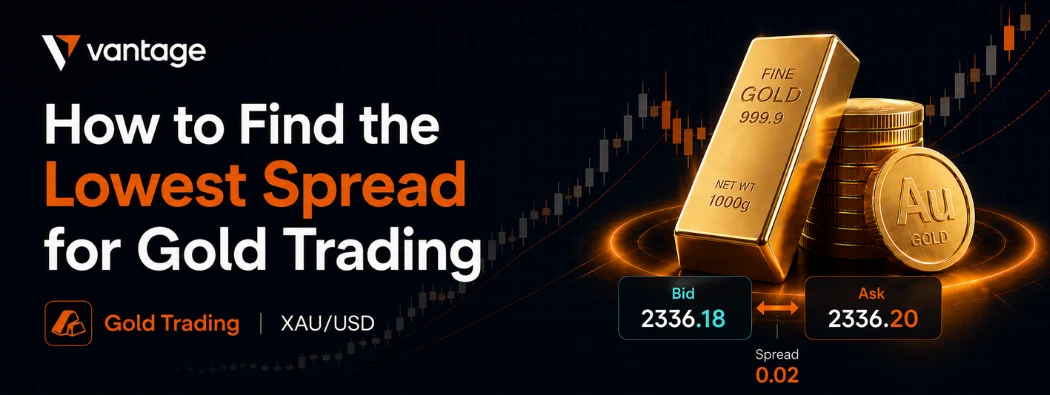
When traders look for the lowest spread in gold trading, they often start with the wrong question. They ask, “Which broker has the lowest spread on gold?” A more complete question to consider is, ‘What are the real trading costs on gold under normal market conditions?’ Understanding costs is one factor, though it does not reduce the inherent risks of trading. That shift matters because the spread you see in an ad is not always the spread you will trade. In gold, prices can change quickly due to liquidity, volatility, and global market activity.
Gold is one of the deepest and most liquid markets in the world. The World Gold Council says the market is large, global, and highly liquid, with the London OTC market accounting for about 70% of global notional trading volume. It also reports that average daily trading volumes in 2025 reached about US$114 billion on COMEX and US$51 billion on the Shanghai Futures Exchange. That depth helps support active trading, but it does not mean the spread stays low at all times.
Key Takeaways
- The spread in gold trading is the difference between the buy and sell price of XAU/USD. Understanding it is essential for South African traders to accurately assess the true cost of entering a position.
- Gold spreads are not fixed; they widen during major economic releases and narrow during peak trading hours, which, for South African traders, fall between 15:00 and 18:00 (SAST) during the London/New York overlap.
- Comparing gold trading costs means looking beyond the spread alone; commissions, overnight swap fees, and platform execution quality all contribute to the total cost of a trade.
- Account type selection matters, from demo accounts for beginners to raw-spread or ECN accounts for active traders; choosing the right account structure can directly affect trading costs and the overall experience.
- Common mistakes, such as overleveraging, ignoring risk management, and trading without a strategy, carry significant risk in a market as volatile as gold.

How Do You Find the Lowest Spread for Gold Trading?
The lowest spread for gold trading is found by comparing the average XAU/USD spread, not only the lowest advertised spread. A fair cost comparison also looks at commission, swap fees, account type, execution quality, slippage, and the time of day the trade is placed.
Gold spreads are often tighter during periods of high liquidity. They may widen during major news events, periods of low liquidity, or fast-moving market conditions.
What is Gold Spread?
Before I go into detail about what gold spread is all about, I would explain the term “spread.”
The spread is the difference between the bid and ask prices. It is one of the direct costs of entering a trade. A tighter spread means a lower entry cost. A wider spread means the trade starts further away from break-even.
Gold spread is the difference between the buying and selling prices of the gold pair (XAU/USD) in the market. It is one of the main costs traders incur when opening a position.
A narrower spread indicates lower trading costs; a wider one means a larger price movement is required before a position moves in the trader’s favour. Gold spreads vary with market conditions, liquidity, volatility, and broker pricing.
How Is Gold Spread Calculated?
Gold spread is calculated by subtracting the bid price from the ask price.
Gold Spread = Ask Price − Bid Price
In trading, gold is often quoted with two prices:
- Bid price: the price a buyer is willing to pay
- Ask price: the price a seller wants to receive
The spread is the difference between these two prices.
Example:
Assume XAU/USD is quoted as:
- Buy: 2,350.50
- Sell: 2,350.10.
The spread is: Gold Spread = Ask Price − Bid Price = 2,350.50 − 2,350.10 = 0.40.
In this example, the gold spread is 0.40. That means the ask price is 0.40 higher than the bid price. The trade starts with that price gap built into the quote.
What affects the gold spread
The gold spread is not fixed all day. It can change based on market activity and your broker. Here are the main factors:
1. Market hours: Spreads are often tighter when the market is most active. During major London and New York sessions, many traders trade gold, so liquidity is stronger.
2. News and volatility: Big economic releases can widen the spread. This happens in both the forex and gold markets. If volatility jumps, a forex broker may temporarily increase costs.
3. Account type: Some accounts offer a low spread with a commission. Others offer no visible commission but build more cost into the spread. Always check the full picture.
4. Trading platform quality: A strong trading platform can help with fast pricing, stable charts, and smoother order execution. A weak trading platform may cause slippage, which increases your actual trading costs.
How To Compare Gold Trading Costs
When comparing gold trading costs, do not look at just one number. Look at the full cost of entering, holding, and closing a trade. In my experience, many traders focus only on the spread, but that only shows part of the picture. The real cost becomes clearer when I assess all the charges together.
1. Spread
This is the first thing I believe every trader should check. As stated earlier, a narrower spread generally indicates a lower entry cost for the trader, while a wider spread increases the amount the market must move before the position becomes profitable. Spreads may change during periods of high volatility, low liquidity, or major economic announcements.
2. Commission
Some brokers claim to offer commission-free gold trading, but in many cases, they offset that by charging wider spreads. Others charge a direct commission while keeping spreads lower. For that reason, you can always compare the spread and commission together rather than treating them as separate costs.
3. Overnight fee
This is sometimes called the swap or financing charge. This matters a lot in leveraged products such as CFDs. There are cases where a broker looks cheap at first because of a low spread, but turns out to be more expensive over time due to high overnight charges.
4. Trade size and contract terms
A platform may look cost-effective on paper, but the actual cost can feel very different depending on the minimum trade size and the value of each price movement. For smaller traders, flexible position sizing can make gold trading more manageable and more cost-efficient.
5. Type of gold product
The costs are not the same across spot gold, CFDs, futures, ETFs, or physical bullion. For example, with gold ETFs, I would compare the fund’s expense ratio, the dealing fee, and the market spread. With physical gold, consider the premium over spot, storage fees, insurance, and resale value. Each product carries its own cost structure, so I compare like-for-like.
Active Trading Periods for Gold
The active time to trade gold is usually during periods of high liquidity and strong market activity. In most cases, this occurs during the London session, the New York session, and especially when both sessions overlap.
Gold is traded globally, but price activity often becomes stronger when European and U.S. markets are open. During these hours, trading volume tends to rise, spreads may narrow, and price movement is often more active. This may support trade execution, though clearer price activity during these periods does not guarantee any particular outcome. However, higher volatility during these periods can also increase the risk of rapid losses
The London session is important because London is a major center for precious metals trading. Activity often increases further when New York opens, as U.S. institutions and economic data play a major role in gold pricing. For this reason, the London/New York overlap is widely seen as the most active period for gold trading.
Quieter hours, such as parts of the Asian session or late U.S. trading hours, may show lower volatility and thinner liquidity. These periods may suit traders who prefer slower market movement, but price action is generally more limited.
London/New York Overlap
| Session or Period | Approximate Time (UTC)r | Logic | Effect on Gold |
| Asian session | 00:00–08:00 | Suggests a bullish reversal | Usually calmer trading |
| London session | 00:00–16:00 | Small body near the low, long upper wick, little or no lower wick | Better liquidity and clearer price action |
| New York session | 13:00–21:00 | The trend before it forms | Highest liquidity and stronger price movement |
| London/New York overlap | 13:00–16:00 | Both major markets are open at once | Highest liquidity and stronger price movement |
African Trading Hours for Gold
For traders in Kenya, South Africa, and Nigeria, the key gold trading windows can be mapped to local time as follows:
| Country | London session | New York session | London/New York overlap |
| Nigeria | 08:00–17:00 | 14:00–23:00 | 14:00–17:00 |
| South Africa | 09:00–18:00 | 15:00–00:00 | 15:00–18:00 |
| Kenya | 10:00–19:00 | 16:00–01:00 | 16:00–19:00 |
These times are based on the current session map, which shows London at 07:00–16:00 UTC and New York at 13:00–22:00 UTC, with local time zone offsets: Lagos UTC+1, Johannesburg UTC+2, and Nairobi UTC+3.
Trading vs investing in Gold
Gold can be used in two very different ways: trading and investing. The difference lies mainly in the goal, the time frame, and the type of product used. Trading usually focuses on short-term price movements, while investing is more often associated with long-term wealth preservation and portfolio diversification.
When I talk about gold trading, I mean trying to profit from short-term price changes. This may involve products such as futures, options, or other market instruments designed for active buying and selling. In this approach, the trader pays close attention to price action, market news, and timing. The approach involves entering and exiting the market based on short-term price movements, which carries a significant risk of loss.
For example, a trader may buy gold when the price is rising after a major economic release and close the position later that day or week if the target is reached, though losses are equally possible and not all trades will result in a gain. The focus here is not on owning gold as a store of value. It involves attempting to profit from market movement, though this carries the risk of significant losses.
Gold investing works differently. It is usually a longer-term decision based on gold’s role as a strategic asset. Many investors buy gold to help preserve value, reduce portfolio risk, or add diversification during uncertain market conditions. This can be done through physical gold or through products such as gold ETFs, which are designed to track gold’s performance with lower expenses.
For example, an investor may buy a gold ETF and hold it for several years as part of a broader portfolio. In that case, daily price swings matter less. What matters more is gold’s long-term role in balancing risk and protecting value over time.
Account Type Fit in Gold Trading
In gold trading, account type fit refers to how well a trading account matches a trader’s goals, capital size, risk tolerance, and preferred method of market access. The suitability of an account type can affect trading costs, position sizing, leverage exposure, and the overall trading experience.
- Demo account: If your aim is to learn first, a demo account is one option traders commonly use to familiarise themselves with the market before committing real capital. And this is often called paper trading.
- Cash Brokerage account: If your goal is longer-term exposure to gold, this account may be a better fit. In a cash account, you pay the full amount for what you buy, without borrowing from the broker. This can suit investors who want access to exchange-traded gold products, including physically backed gold ETFs, which the World Gold Council describes as exchange-traded vehicles invested in gold bullion.
- Margin-enabled or futures-enabled account: This account is more suitable if you plan to trade gold more actively. Margin accounts allow borrowing, which increases buying power but also raises the risk of larger losses.
- Shariah-compliant account: Religious and legal considerations may also influence the choice of account. Islamic trading accounts, for example, are structured to avoid swap or overnight interest charges in line with Sharia principles. Professional accounts may offer greater leverage and fewer restrictions, but they are typically intended for experienced traders who meet specific financial or regulatory criteria.
- Raw spread or ECN-style accounts may suit active traders seeking lower spreads, but they often charge a separate commission.
- A standard account may suit beginners or casual traders because it is often simpler to use and may have lower entry requirements. However, the spread may be wider than that of other account types.
Common mistakes in gold trading
These are the errors traders often make when buying or selling gold in financial markets. These mistakes can affect trade timing, risk control, and overall performance. They are usually linked to poor planning, weak discipline, or a limited understanding of how gold prices move.
1. Trading without a strategy
Some traders enter the gold market based only on emotion, rumors, or sudden price moves. This can lead to inconsistent decisions and increased risk of loss. A trading plan may help a trader define their approach to entry, exit, position size, and risk limits, though it does not eliminate the risk of loss.
2. Ignoring risk management
Gold prices can move sharply, especially during major economic releases or geopolitical events. Traders who use large position sizes or fail to set stop-loss orders may incur losses greater than expected. Risk management is therefore considered an important part of gold trading.
3. Overusing leverage
Many gold trading products allow traders to control large positions with a small amount of capital. While leverage can increase gains, it can also increase losses at the same speed. Traders who use high leverage without fully understanding the risk may lose capital quickly.
4. Ignoring market drivers and focusing on price
Gold is influenced by factors such as inflation, interest rates, U.S. dollar strength, central bank policy, and global uncertainty. A narrow focus on charts alone may cause traders to miss important market signals.
Frequently Asked Questions
What does spread mean in gold trading?
In gold trading, the spread is the difference between the buy and sell prices. It is a built-in cost you pay whenever you enter a trade.
Why should traders look for a low spread?
A lower spread reduces entry costs. However, lower spreads alone do not determine trading outcomes, and losses remain possible regardless of spread size.
How do I find the lowest spread for trading gold?
Start by comparing brokers based on their average spread on gold, not just the lowest figure in promotions. It also helps to review commissions, execution quality, and account terms.
Is the broker with the lowest spread always the best choice?
Not always. A broker may offer a tight spread but still have weak execution, poor support, or limited platform tools.
When is the spread on gold usually lower?
Gold spreads are often tighter during active market hours, when more traders are active. They can become wider during major news releases or quiet trading periods.
Can the trading platform affect my gold trading costs?
Yes, it can. A slow or unstable platform may cause delays or slippage, which can raise your total trading cost.
Risk Warning: CFDs are complex financial instruments and carry a high risk of rapid loss of money due to leverage. You should ensure you fully understand the risks involved and carefully consider whether you can afford to take the high risk of losing your money before trading.
Disclaimer: The information is provided for educational purposes only and doesn’t take into account your personal objectives, financial circumstances, or needs. It does not constitute investment advice. We encourage you to seek independent advice if necessary. No representation or warranty is given as to the accuracy or completeness of any information contained within. This material may contain historical or past performance figures and should not be relied on.
Furthermore, estimates, forward-looking statements, and forecasts cannot be guaranteed. The information on this site and the products and services offered are not intended for distribution to any person in any country or jurisdiction where such distribution or use would be contrary to local law or regulation.
References
- https://www.gold.org/goldhub/research/relevance-of-gold-as-a-strategic-asset/key-attributes-liquidity Gold’s Key Attribute – Liquidity
- https://vantagemarektsdev.canglankeji.com/en-za/academy/trading-xauusd/ 6 Tips for Trading Gold(XAUUSD)
- https://www.dailyforex.com/forex-articles/2016/03/time-to-trade-gold/56576 When to Trade Gold: Strategies for Maximum Profits
- https://vantagemarektsdev.canglankeji.com/en-za/academy/what-is-spread-in-forex-trading/ What is Spread in Forex? Guide for Traders
- https://www.tradingview.com/chart/XAUUSD/bbDRuC7D-Gold-Trading-Mistakes-That-90-of-New-Traders-Make/ Gold Trading Mistakes That 90% of New Traders Make
- https://www.investopedia.com/terms/g/gold-option.asp Understanding Gold Options: Types, Mechanisms, and Trading Insights