






 Updated
With the prices of both gold and stocks rising significantly in recent months, the debate over trading gold vs. stocks remains a hot topic among investors.
In this article, we will take a deep dive into the performance of gold vs stock market and discuss the features and merits of both investment assets. Understanding the differences is essential for anyone deciding whether to buy gold or stocks in 2026.
Gold price update (late Jan–early Feb 2026)
Gold hit a record $5,594.82/oz last Thursday.
It then dropped fast, before rebounding to about $4,767/oz on Tuesday.
A big driver was higher futures margin needs, which can force fast selling.
Key Points
- In 2025, both gold and stocks showed exceptional performance: gold surged approximately 50% year-to-date amid economic uncertainties and geopolitical tensions, while major stock indices have demonstrated resilience, driven by technological advancements and corporate earnings.
- Gold offers stability and acts as a hedge against inflation, making it a less risky option for preserving wealth. Stocks, though more volatile, provide higher potential returns and dividends, making them suitable for long-term wealth building.
- Combining gold and stocks in your investment portfolio can balance stability and growth potential, allowing you to manage risks effectively and pursue diverse financial goals in a dynamic market environment.
Introduction: The Investment Landscape in 2026
In recent years, gold has once again demonstrated its resilience, reasserting its claim as a safe-haven asset. During the economic turmoil of the COVID-19 pandemic, gold prices peaked at an all-time high of $2,089 per ounce in August 2020 [1].
Even amid rising interest rates and inflation concerns, gold has held its ground, trading at an average of US$1,940.54 per ounce in 2023 – 8% higher than 2022 [2]. The asset has since rebounded to achieve extraordinary new record highs.
As of early February 2026, gold is around $4,767/oz after a sharp pullback. Late January saw a record peak near $5,594.82/oz, followed by heavy selling [3].
Meanwhile, stocks have been on a rollercoaster ride. The rapid recovery of the stock market post-2020 crash, fuelled by unprecedented monetary policies and fiscal stimulus, has been nothing short of remarkable.
The S&P 500, for instance, has climbed over 80% since the beginning of 2020 [4]. Tech giants like Apple, Amazon, and Tesla have led this charge, with their stocks soaring in the same period.
Yet, this bull market is not without its volatility.
In 2022, fears of rising inflation and geopolitical tensions triggered sharp corrections, highlighting the inherent risks in stock trading [5].
For investors asking, “Should I invest in gold or stocks?”, the year 2026 offers valuable insights. The answer depends greatly on market trends, risk appetite, and long-term strategy. As we move forward, the question becomes even more pressing: Is it better to buy gold or gold stocks? Understanding recent performance and trends in these assets can provide valuable guidance for informed trading decisions in 2026.
Gold Price Trend [6,7,8]
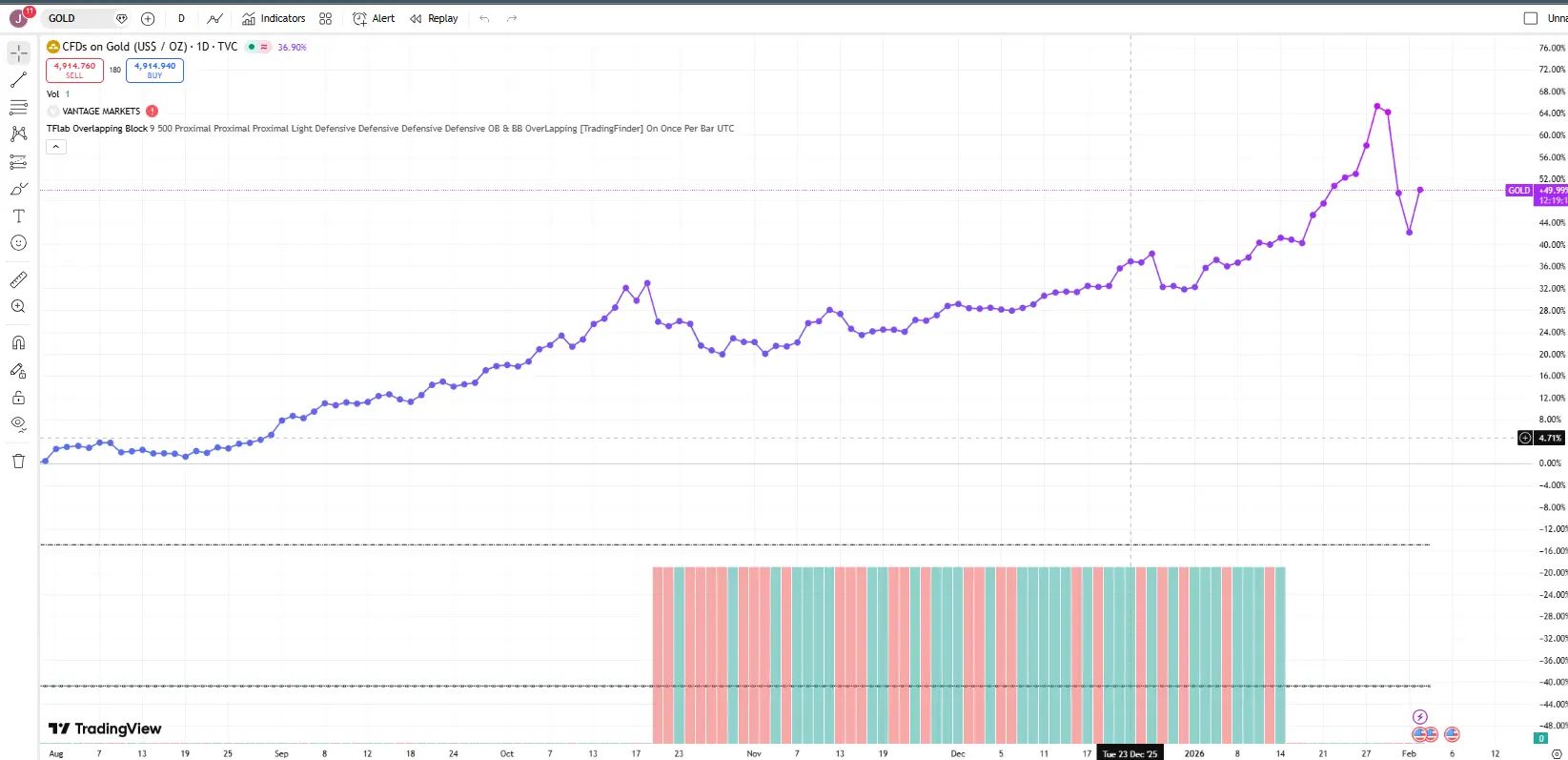
Gold’s journey throughout 2025 was marked by an extraordinary climb, with prices reaching unprecedented record highs that have exceeded even the most optimistic analyst predictions from just a year ago. This explosive performance has further intensified the debate over gold vs. stocks among traders evaluating safe-haven assets.
Historically, gold closed the year 2022 at $1,819.70 per ounce. One year later, it saw a significant increase, closing 2023 at $2,062.40. This marked a 13.3% gain. The upward trajectory has continued into 2026 with exceptional momentum.
In late January 2026, gold pushed to a new record near $5,594.82/oz. It then saw its sharpest one-day fall in decades on Jan 30. The move was linked to a new Kevin Warsh nomination shock and higher CME Group margin needs
The consistent rise in gold prices reflects the asset’s enduring appeal amid ongoing economic and geopolitical uncertainties. Multiple factors have converged to drive this extraordinary performance:
- Escalating geopolitical tensions globally
- Robust central bank purchasing despite record-high prices
- Federal Reserve interest rate cuts are reducing the opportunity cost of holding gold
- Weakening US dollar as monetary policy shifted
- Strong safe-haven demand amid economic uncertainty
- Sustained physical demand from key markets like China and India
Looking ahead, major investment banks have raised their forecasts significantly for 2026:
- J.P. Morgan sees gold reaching $6,300/oz by end-2026.
- Deutsche Bank reiterated a $6,000/oz 2026 forecast.
These predictions underscore the bullish sentiment surrounding gold, as it remains seen as a hedge against inflation and a safe-haven asset during times of geopolitical uncertainty.
The anticipation of continued Federal Reserve rate cuts has further fuelled expectations of a sustained rise in gold prices. As investors seek stability amid uncertainty, gold’s allure remains strong, suggesting a promising outlook for the precious metal heading into 2026.

Stock Price Trend
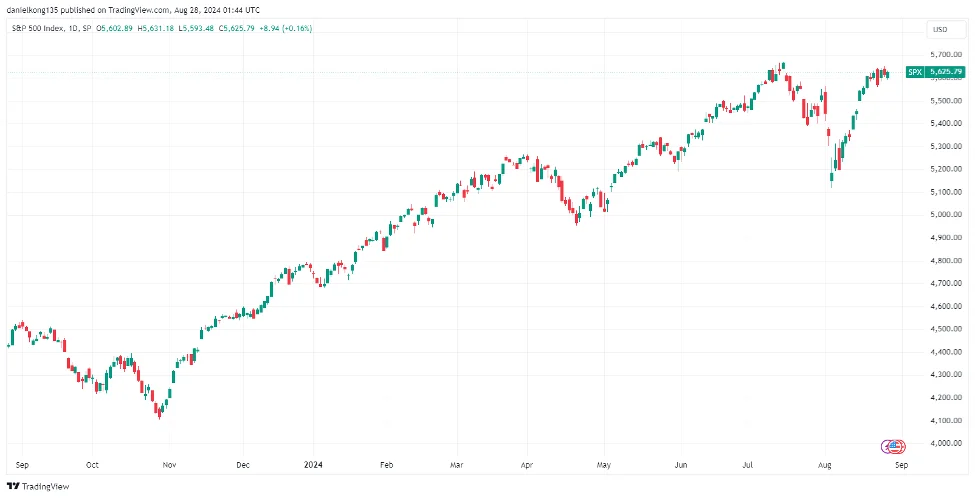
To compare the performance of gold against stocks, let’s take a closer look at the S&P 500. The S&P 500 serves as a barometer for the broader U.S. stock market and is often used as a proxy for the health of the economy. It demonstrated resilience throughout 2025, though its performance has been more measured than gold’s explosive gains, an observation that often shapes the gold vs. stock market debate.
Following the remarkable run in 2024, when the index continued to reach new heights, closing above 5,000 for the first time in history [10], the market faced a more complex environment in 2025. This milestone was achieved on the back of a strong start to 2024, defying many analysts’ expectations that economic concerns would dampen market performance.
In 2024, the index saw significant growth with an average closing price of 5,077.77 [10], driven by better-than-expected corporate earnings. About 78% of S&P 500 companies that reported first-quarter 2024 earnings announced positive earnings-per-share surprises [11]. The 2026 landscape has presented different dynamics. While the stock market has maintained resilience, it has faced headwinds from:
- Economic uncertainty regarding growth trajectories
- Federal Reserve policy shifts from rate hikes to rate cuts
- Geopolitical tensions are impacting investor sentiment
- Concerns about corporate earnings sustainability
However, the market has found support from:
- Continued strength in technology stocks, particularly AI-related companies
- Adaptation to the new interest rate environment
- Innovation driving sector-specific growth
- Long-term investor confidence in economic fundamentals
The index’s performance has been bolstered by significant contributions from technology stocks, particularly those in the high-growth area of artificial intelligence (AI), which have led gains in both the S&P 500 and the technology-heavy Nasdaq.
As we move through 2026, the stock market continues to balance growth opportunities with macroeconomic challenges, offering selective opportunities for investors who can navigate the evolving landscape between gold and stock investments.
Difference between Gold and Stocks
When it comes to investing in gold vs. stocks, they represent fundamentally different asset classes, each with its own characteristics and investment profiles. While both have shown strength, there are essential differences between gold vs stock investors should take note of.
Potential Returns
- Gold
Gold’s price is influenced by a variety of factors, including currency values, interest rates, and geopolitical events. While it doesn’t generate cash flow, it can provide significant returns during periods of high inflation or economic instability. For instance, between 2008 and 2012, gold prices increased by over 10% [13]. In 2025, gold demonstrated exceptional returns, surging approximately 50% year-to-date – one of its strongest performances in modern history.
- Stocks
Stocks represent ownership in a company, and their returns come from both price appreciation and dividends. The average annual return for the S&P 500, which is a good proxy for the US stock market, has been about 10% before inflation over the last century [14]. However, this includes periods of significant downturns and recoveries.
Risk level for each asset
- Gold
Due to its unique status as both a rare commodity and a universally accepted medium of exchange, gold carries lower risk than stocks. During times of severe uncertainty, there is a historical tendency for gold to rise in popularity as investors seek safety. However, it’s not entirely risk-free; gold prices can be volatile in the short term and are also affected by mining supply and demand.
- Stocks
Stocks are considered a higher-risk investment. They can be affected by market sentiment, economic cycles, and company-specific news. Stocks are also driven by important discoveries, as evidenced by the dot.com bubble and the latest hype around AI. Thus, stock volatility can lead to both greater losses and potentially greater gains than gold.
Period of investment
- Gold
Gold is often viewed as a long-term investment. It doesn’t expire or become obsolete, and many investors hold gold for years or even decades as part of their portfolio.
- Stocks
The optimal holding period for stocks varies. While some traders engage in short-term trading, the most successful stock investors, like Warren Buffett, advocate for a long-term approach, holding undervalued stocks for several years or more to realise substantial gains.
Dividend earning
- Gold
Gold itself does not produce any income. It does not pay dividends or interest. The only financial gain investors can realise from gold is through price appreciation when they sell their holdings.
- Stocks
Many stocks, especially those of well-established companies, pay regular dividends. These can provide a steady income stream and can be reinvested to purchase more shares, compounding the investment’s growth over time.
Macroeconomic Impacts on Gold and Stocks
Understanding how macroeconomic factors influence gold vs stocks is crucial for making informed investment decisions. Each asset class responds differently to economic changes, providing opportunities for strategic portfolio allocation.
Macroeconomic Factors Affecting Gold
Interest Rates
Gold has an inverse relationship with interest rates. When the Federal Reserve cuts rates, as it did in 2025, gold becomes more attractive because:
- The opportunity cost of holding non-yielding gold decreases
- Lower rates typically weaken the US dollar, making gold more affordable for international buyers
With the Fed cutting rates to 3.75%-4.00% in 2025 and markets pricing in an 85% chance of further cuts, gold has surged to record highs.
Inflation and Currency Values
Gold serves as a traditional hedge against inflation and currency devaluation:
- When inflation rises, gold tends to maintain purchasing power
- A weaker US dollar makes gold cheaper for foreign buyers, increasing demand
- Central banks increase gold purchases to diversify away from fiat currencies
Geopolitical Tensions
Gold thrives during periods of uncertainty:
- Wars, political instability, and trade disputes drive safe-haven demand
- Towards the end of 2025, geopolitical tensions between Russia and Ukraine and in the Middle East have significantly contributed to gold’s 50% surge
- Investors flee to gold when traditional assets become riskier
Central Bank Policies
Official sector purchases provide substantial support:
- Central banks worldwide continue to increase their gold reserves
- Diversification away from dollar-denominated assets
- Strategic reserve building amid global uncertainty
Macroeconomic Factors Affecting Stocks
Corporate Earnings and Economic Growth
Stock valuations are fundamentally tied to company profitability:
- GDP growth drives revenue expansion and profit margins
- In 2024, about 78% of S&P 500 companies reported positive earnings surprises
- Economic slowdowns can pressure corporate earnings and stock prices
Interest Rates and Borrowing Costs
Interest rates impact stocks differently from gold:
- Higher rates increase corporate borrowing costs, reducing profitability
- Rate cuts can stimulate economic activity and boost stock valuations
- The discount rate used to value future cash flows changes with interest rates
Consumer Confidence and Spending
Consumer behaviour directly impacts corporate revenues:
- Strong consumer spending supports retail, technology, and service sector stocks
- Weak confidence can trigger market corrections
- Employment levels and wage growth influence spending patterns
Technological Innovation
Breakthrough developments create growth opportunities:
- AI and technology advancements drove significant gains in 2025.
- Innovation can create entirely new market sectors
- First-mover advantages can generate substantial returns
Market Sentiment and Investor Psychology
Emotions play a larger role in stock markets:
- Fear and greed can drive significant price swings
- Market corrections like those in 2022 demonstrate volatility risks
- News cycles and social media can amplify market movements
Comparative Impact Analysis
The 2025 market environment illustrates these dynamics perfectly:
- Gold has benefited from Federal Reserve rate cuts, geopolitical uncertainty, and safe-haven demand, resulting in a 50% gain.
- Stocks have shown resilience but more modest gains, balancing growth opportunities against economic uncertainties and policy shifts.
Understanding these macroeconomic drivers enables investors to anticipate how different scenarios might impact each asset class and adjust their portfolios accordingly.
Which Asset is More Beginner-Friendly?
For investors just starting their journey, understanding which asset offers a more accessible entry point is crucial for building confidence and achieving early success.
Gold: Simplicity and Stability for Beginners
Why Gold May Be Easier to Start With:
Simpler Concept to Understand
- Gold is a tangible asset with intrinsic value that’s universally recognised.
- No need to analyse complex financial statements or business models
- The long-term store of value proposition is straightforward
- Single asset focus rather than choosing among thousands of individual stocks
Lower Emotional Stress
- Generally, less day-to-day volatility compared to individual stocks
- Provides emotional stability during the learning phase
- A clear safe-haven narrative is more straightforward to grasp
- Less susceptible to company-specific news and surprises
Fewer Decisions Required
- Don’t need to research individual companies or industries
- No need to analyse quarterly earnings reports
- Simpler portfolio management with fewer moving parts
- Clear macroeconomic drivers (interest rates, inflation, geopolitics)
Beginner Challenges with Gold:
- No income generation (dividends or interest)
- Requires understanding of macroeconomic factors
- Storage and security considerations for physical gold
- Limited growth potential compared to stocks over very long periods
Stocks: Growth Potential with Learning Curve
Why Stocks May Appeal to Beginners:
Accessibility and Fractional Investing
- Modern platforms allow starting with very small amounts
- Fractional shares make expensive stocks accessible
- Wide variety of investment options at all price points
- Easy to build diversified portfolios gradually
Abundant Educational Resources
- Extensive learning materials, courses, and analysis tools available
- Historical data showing average 10% annual returns over the long term
- A large community of investors sharing strategies and insights
- Professional research and analyst recommendations are readily available
Income Generation Opportunities
- Dividend-paying stocks provide regular income
- Reinvestment options allow compounding growth
- Creates tangible returns even without selling
- Helps beginners understand investment cash flows
Index Funds Simplify Stock Investing
- S&P 500 index funds offer instant diversification
- No need to pick individual stocks initially
- Lower risk than individual stock selection
- Professional management at a low cost
Beginner Challenges with Stocks:
- Requires more research and ongoing monitoring
- Higher short-term volatility can be emotionally challenging
- Risk of significant corrections as seen in 2022
- More complex decision-making process
- Need to understand business fundamentals and market dynamics
Recommendation for Beginners
Start with a Hybrid Approach:
For most beginners, the optimal strategy combines elements of both:
- Begin with Gold Allocation (10-20% of portfolio)
- Provides stability and confidence-building
- Acts as insurance during the learning phase
- Simple to understand and monitor
- Reduces overall portfolio volatility
- Add Broad Market Index Funds (70-80% of portfolio)
- S&P 500 index fund for instant diversification
- Captures overall market growth without stock picking
- Lower stress than individual stock selection
- Historical performance provides confidence
- Gradually Expand Knowledge
- Learn about individual stocks over time
- Understand sector dynamics and opportunities
- Build confidence through index fund experience
- Add individual positions as expertise grows
- Maintain Risk Management
- Never invest money needed in the short term
- Dollar-cost averaging reduces timing risk
- Regular portfolio review and rebalancing
- Continuous education and learning
The Verdict: While gold offers simplicity and emotional stability, making it beginner-friendly, combining index fund stock investing (for growth) with a gold allocation (for stability) provides the ideal beginner foundation. This approach balances ease of understanding with growth potential while appropriately managing risk.
Gold or Stocks: Which to Trade?
The investment landscape of 2026 presents a compelling case for both gold and stocks, each with its unique advantages and considerations. The decision on which to trade can be informed by the differences in performance, risk, and potential returns that we’ve discussed.
Gold demonstrated exceptional strength throughout 2025, particularly as a hedge against inflation and economic uncertainty. Gold set a fresh record near $5,594.82/oz in late January 2026. Prices then pulled back hard, showing why risk controls matter.
Stocks, as reflected in the performance of the S&P 500 and other major indices, continue to offer the allure of long-term growth potential and dividends. Despite facing a more challenging environment than the previous year, the stock market’s resilience and growth potential make it suitable for those seeking to build wealth over the long term, particularly through technological innovation and corporate earnings growth.
So, should you trade gold or stocks? The answer is: Why not both? Diversifying your portfolio with a mix of gold and stocks can provide a balanced approach, leveraging gold’s stability and stocks’ growth potential. This strategy allows you to:
- Hedge against different market conditions: Gold performs well during uncertainty, while stocks thrive in growth periods
- Balance risk and reward across asset classes: Reduce volatility through diversification
- Capture opportunities in both safe-haven and growth assets: Position for multiple scenarios
- Reduce overall portfolio volatility: Smooth out returns over time.
- Pursue multiple financial objectives simultaneously: Preservation and growth.
Consider These Allocation Strategies:
Conservative Approach (Risk-Averse Investors)
- 30-40% Gold / 60-70% Stocks
- Prioritises capital preservation
- Suitable for those nearing retirement or with lower risk tolerance
Balanced Approach (Moderate Risk)
- 20-30% Gold / 70-80% Stocks
- Balances growth and stability
- Appropriate for most long-term investors
Growth-Oriented Approach (Higher Risk Tolerance)
- 10-20% Gold / 80-90% Stocks
- Maximises growth potential
- Suitable for younger investors with longer time horizons
Whether you’re inclined towards the enduring value of gold or the dynamic opportunities in the stock market, Vantage offers a platform to trade both through CFDs. Open a live account with Vantage today and take advantage of the diverse investment opportunities available in 2025. Diversify your portfolio, manage your risks, and trade gold or stock CFDs with confidence.
Conclusion
In conclusion, the debate between gold vs stocks is not about which asset is superior, but rather about how each can play a distinct role in a well-rounded investment strategy. Gold, with its steady allure and extraordinary 2025 performance, offers security and acts as a hedge against inflation, making it a valuable component for those seeking stability in their portfolio. Gold’s strong run continued into 2026, hitting $5,594.82/oz before a sharp correction.
Stocks, on the other hand, offer the promise of growth and dividends, appealing to those with a longer time horizon and a higher risk appetite. With historical average returns of 10% annually, stocks remain essential for long-term wealth building.
As we look ahead in 2026, the economic landscape continues to evolve, and with it, the strategies for trading and investment. By understanding the inherent qualities and historical performance of both gold and stocks, along with their responses to macroeconomic factors, investors can make informed decisions that align with their financial goals and risk tolerance. The optimal approach for most investors combines both assets, leveraging gold’s stability with stocks’ growth potential. This diversification strategy provides resilience across various market conditions while positioning portfolios for long-term success.
Sign up for a Vantage live trading account today and get started to trade both gold and stocks CFDs by speculating on their price changes without having to own the underlying product.
Frequently Asked Questions
Is it wise to buy gold in 2026?
Buying gold in 2026 may be wise if economic uncertainty, inflation, or geopolitical risks remain elevated. Gold often acts as a defensive asset, helping diversify portfolios and protect purchasing power.
How do gold and stocks perform during economic uncertainty?
During economic uncertainty, gold typically rises as investors seek safety, while stocks often experience higher volatility or declines. Gold’s stability can help offset equity market losses and balance overall portfolio risk.
Is gold a better investment than stocks?
Gold isn’t universally better than stocks; it depends on goals. Gold protects wealth and reduces risk, while stocks historically provide higher long-term growth. Many investors combine both for diversification and stability.
References:
- “Has Gold Been a Good Investment Over the Long Term? – Investopedia”. https://www.investopedia.com/ask/answers/020915/has-gold-been-good-investment-over-long-term.asp. Accessed 12 Feb 2026.
- “Gold Demand Trends Full Year 2023 – World Gold Council”. https://www.gold.org/goldhub/research/gold-demand-trends/gold-demand-trends-full-year-2023. Accessed 12th Feb 2026.
- “Gold, silver stage comeback after two-session rout”. https://www.reuters.com/world/india/gold-rebounds-more-than-3-after-sharp-selloff-2026-02-03/ Accessed 13th February, 2026.
- “Stock market returns since 2020 – S&P 500 Data”. https://www.officialdata.org/us/stocks/s-p-500/2020. Accessed 29 August 2024.
- “Stocks rebound after Dow, S&P 500 and Nasdaq all enter ‘correction’ territory – CBS News”. https://www.cbsnews.com/news/stock-market-rebound-s-p-500-dow-nasdaq-correction-inflation-2022-01-24/. Accessed 7 June 2024.
- “2024 Gold Price Prediction, Trends, & 5-Year Forecast – GoldSilver”. https://goldsilver.com/blog/gold-price-forecast-predictions/. Accessed 7 June 2024.
- “Gold price forecast for spring 2024: Here’s what experts predict – CBS News”. https://www.cbsnews.com/news/gold-price-forecast-for-spring-2024-heres-what-experts-predict/. Accessed 7 June 2024.
- “Gold Prices – 100 Year Historical Chart – Macrotrends”. https://www.macrotrends.net/1333/historical-gold-prices-100-year-chart. Accessed 7 June 2024.
- “Past performance suggests S&P 500 has further to go after record high – Financial Times”. https://www.ft.com/content/6810f509-feaf-4f4f-ab96-5784b94fa8f8. Accessed 7 June 2024.
- “S&P 500 Index – 90 Year Historical Chart – Macrotrends”. https://www.macrotrends.net/2324/sp-500-historical-chart-data. Accessed 7 June 2024.
- “The S&P 500 Just Hit a New Record. History Says This Will Happen Next. – The Motley Fool”. https://finance.yahoo.com/news/p-500-just-hit-record-103000599.html. Accessed 7 June 2024.
- “Wall Street revamps 2024 S&P 500 targets after record-setting stock-market rally – MorningStar”. https://www.morningstar.com/news/marketwatch/20240325111/wall-street-revamps-2024-sp-500-targets-after-record-setting-stock-market-rally. Accessed 7 June 2024.
- ” Gold prices during and after the Great Recession – Beyond the Numbers”. https://www.bls.gov/opub/btn/volume-2/pdf/gold-prices-during-and-after-the-great-recession.pdf. Accessed 7 June 2024.
- “Historical Average Stock Market Returns for S&P 500 (5-year to 150-year averages) – Trade That Swing”. https://tradethatswing.com/average-historical-stock-market-returns-for-sp-500-5-year-up-to-150-year-averages/. Accessed 7 June 2024.
- “Reuters (Feb 3, 2026): record high $5,594.82/oz and rebound Levels”. https://www.reuters.com/world/india/gold-rebounds-more-than-3-after-sharp-selloff-2026-02-03/. Accessed 3 February 2026.
- “Clearing Advisory (Jan 30, 2026): gold futures margins raised (effective)”