






 Updated
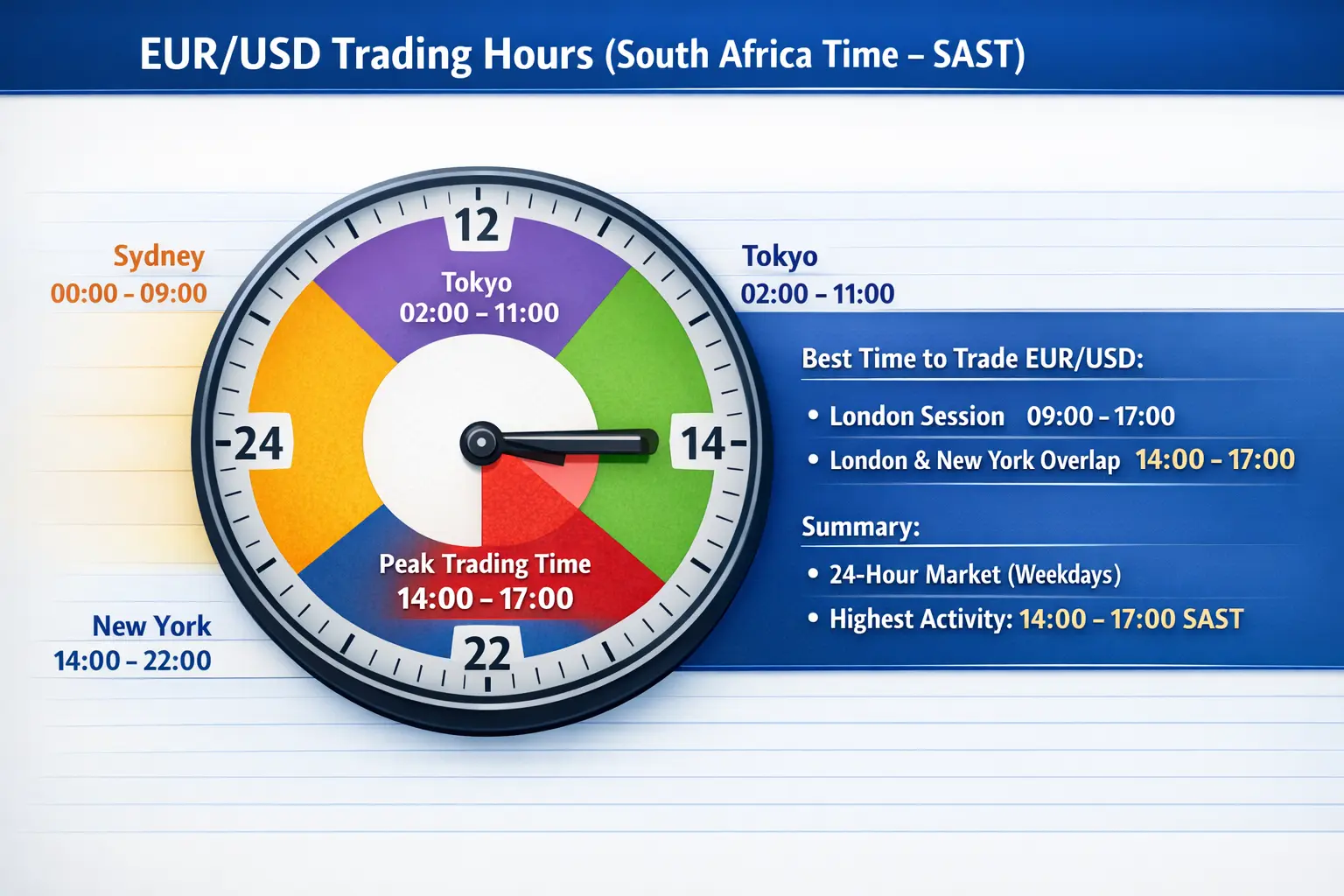
Many traders learn to trade EUR/USD but still struggle to identify the actual EUR/USD trading hours in South Africa. EUR/USD, a currency pair, is the EUR-US dollar exchange rate and is one of the most traded forex pairs in the world.
That heavy activity matters because liquidity often rises when big centres are open, which can affect spreads and price swings. This article explains how the EUR/USD market activity varies across trading sessions in South African Standard Time (SAST).
South Africa remains on UTC+2 year-round, while London and New York shift with daylight saving time. As a result, the “busy hours” can move by about an hour during the year. In practice, EUR/USD activity often increases during the London session and can be higher during the London–New York overlap (about 15:00–18:00 SAST, when the overlap is 13:00–16:00 UTC).
There is no single perfect time that guarantees profit. Some windows bring more movement and liquidity, which can suit or clash with different styles and schedules.
Risk note: Forex/CFDs trading is high risk. This is education, not financial advice.
EUR/USD Trading Sessions Mapped to South African Time (SAST)
EUR/USD may trade 24 hours a day, yet it does not feel active all day.
In South Africa, the busiest windows often land in late morning and evening.
The exact clock time may shift slightly when Europe or the US changes daylight saving time.
Below is a simple map of the main EUR/USD windows into SAST (UTC+2).
These are approximate hours, meant to stay easy to use.
- London session: about 09:00–18:00 SAST
(sometimes closer to 10:00–19:00 SAST, depending on the season) - London–New York overlap: about 15:00–18:00 SAST
(often shifts to 14:00–17:00 SAST in parts of the year) - Late US session: about 18:00–23:00 SAST
(tends to thin out as New York heads toward the close)
What does each window typically look like for EUR/USD?
London open can bring the first “real” push of the day. Europe digests overnight moves, fresh data, and new headlines. Liquidity often improves, allowing the price to travel farther in less time. Breaks outside the earlier range also occur more frequently here.
During the London–New York overlap, EUR/USD often shows faster price changes. London and New York trade at the same time, so the flow stacks up. That mix can support clean trends, but also sharp reversals. Big US releases and central bank headlines can add fuel.
How EUR/USD Typically Behaves by Session
EUR/USD can trade around the clock, yet it changes by session. The currency pair reacts to activity, data flows, available liquidity, and volatility.
For South Africa, that matters because the busiest EUR/USD hours often land mid-day. (around 1 PM to 4 PM GMT). Times can shift by about an hour when Europe or the US changes its time zone.
Tokyo Hours
Asian session (Tokyo hours) often feels like the market is catching its breath. EUR/USD activity is usually lighter than in London or New York. Price can drift in a tighter range, with smaller swings and slower follow-through. That said, major headlines or surprise data can still jolt the pair.
In SAST, this window occurs early in the morning, often before work starts. For many people, it aligns with quick chart checks rather than lengthy screens.
European Hour
As Europe opens, the London session often brings the first real burst of energy. Both the euro area and the UK are active, so EUR/USD volume tends to rise. The London open can produce sharp moves as traders price in overnight news. Range breaks become more common, and trends can build faster than in Asia.
In South Africa, London hours usually overlap with the workday and extend into the late afternoon. That can make it easier to follow tasks across meetings and daily workflows.
London–New York overlap
Next comes the London–New York overlap, often a period of higher EUR/USD market activity.
Liquidity is usually strongest because both centres trade simultaneously.
This period is often associated with larger price movements and faster reversals, which can increase both volatility and risk.
Key US releases can add fuel, causing prices to change within minutes. An event calendar helps track those time slots.
In SAST, the overlap typically occurs mid-afternoon through early evening. That timing often aligns better with an after-work focus than late-night trading.
After the overlap, the late US session often quiets down. Flow thins out, activity drops, and moves can look choppy or uneven. Spreads may widen slightly at times, especially as liquidity fades.
Still, unexpected headlines can trigger spikes even during quieter hours. In South Africa, this window lands in the evening and late at night. For many forex traders, it competes with their free time and family time.
EUR/USD Trading Windows in South Africa
Note: The examples below illustrate how different schedules may view EUR/USD activity by session and are not recommendations to trade or adopt any specific trading approach.
EUR/USD can show strong moves, but watching it all day often creates noise. In South Africa, a more straightforward approach is to align trading hours with real-world hours and keep them consistent. The profiles below are examples, not a one-size plan.
Also, session times may shift slightly when Europe or the US changes its time zone.
1. Example schedule: after-work hours during the London–New York overlap
This trader works a standard day and prefers a short, focused session. As a result, the early evening in SAST can feel practical, since it often catches part of the London–New York overlap, a period widely linked with higher liquidity in EUR/USD.
A routine may centre on 15M (15-minute) to H1 (1-hour) charts, with simple rules and a clear “stop time,” which can help reduce fatigue when making decisions when the price accelerates.
2. Early morning planner/swing trader (higher timeframes)
This trader checks the market before work, then manages positions with less screen time.
Early morning SAST is often quieter for EUR/USD, which can suit planning. The focus tends to be on H4 (4-hour) and D1 (Daily) charts: marking key levels, reviewing the prior day’s range, and updating risk on open trades.
Instead of chasing movement, time is spent preparing for what London might do later. A defined “check-in” window helps prevent the day from becoming a constant monitoring.
3. Flexible or remote worker (mid-London “shift”)
When a schedule is more flexible, a mid-London window can feel like a clean “work block.” Liquidity often improves as Europe settles in, and EUR/USD can show more follow-through than earlier hours. Many traders describe this as easier to track because it can be treated as a shift with a start and end, rather than a full-day watch.
4. Part-time trader who prefers quieter conditions (selective windows)
This trader values calmer price action and fewer fast swings.
Early London or the late US session can feel more manageable, though risk still matters, and headlines can hit at any time. The key is choosing one window and accepting what it gives. Skipping the rest of the day often protects both capital and attention.
Across all profiles, the same theme keeps showing up: a defined window often supports better focus, while chasing moves outside that window usually leads to rushed choices.

Does Day of the Week Matter for EUR/USD?
Some EUR/USD traders talk about a “weekly rhythm.” Monday can feel slower, mid-week can feel louder, and Friday can feel lighter. Research shows that volatility can vary by day, but the pattern is inconsistent enough to be unreliable.
Monday often starts with the market digesting the weekend. Liquidity can build gradually, and EUR/USD may take time to settle into a range. Still, one headline can change everything, even early in the week. In South Africa, the “reset” phase often occurs in the late morning and afternoon SAST, when London flow begins to dominate.
Then mid-week (Tuesday to Thursday) tends to carry more scheduled risk for EUR/USD. Euro-area and US releases often cluster here, and central bank events can also occur midweek. The ECB’s calendar lists policy meetings and press events throughout the year, which can quickly shift expectations.
On the US side, the BLS publishes an employment release schedule that outlines the timing of major data releases. In SAST, these drivers often hit during London hours and the London–New York overlap, when EUR/USD is commonly more active.
By Friday, the tone can shift again. Some traders notice slower follow-through later in the day, as positions get trimmed ahead of the weekend. Even so, it helps to treat “quiet Friday” as a tendency rather than a promise. Unexpected news can hit at any time, on any day. This is where personal data matters. A trading journal can reveal which days and time windows actually matched your focus, schedule, and results.
Timing EUR/USD Around Economic News and Events
For EUR/USD, timing often follows the data calendar, not the clock.
This pair is most sensitive to scheduled eurozone and US data releases, as well as policy signals from the ECB and the Fed. When those events hit, the price can jump from slow to fast without warning.
The recurring drivers usually fall into a few groups:
- ECB meetings and press conferences are listed on the ECB meeting calendar.
- Federal Reserve events, including FOMC meetings and related materials on the Fed’s FOMC calendar page.
- Eurozone data, such as inflation, GDP, employment, and sentiment, are tracked on Eurostat’s release calendar.
- US data, such as jobs and inflation, with job release dates published by the BLS.
For day-to-day planning, many traders keep a single economic calendar open because it consolidates eurozone and US releases in a single view.
Around major releases, two broad approaches often show up. One group prefers to stay flat in the minutes before and after significant events. The idea is simple: spreads can change, prices can gap, and a clean setup can turn messy.
Another group trades the event, but usually with smaller exposure and realistic expectations. Fast moves, wider swings, and slippage can be part of the deal when liquidity shifts quickly.
In South African time, the “timing problem” becomes real. Many high-impact US releases and Fed communications land in the late afternoon or evening SAST, often overlapping with after-work hours. Meanwhile, ECB events can occur earlier, drawing attention into the late morning or early afternoon.
Session timing also shifts slightly throughout the year because Europe and the US change their clocks, while SAST remains fixed. A steady routine often includes a quick calendar scan and a written “news rule” inside the trading plan.
RELATED READINGS: Best Time To Trade Forex in South Africa
Common Mistakes South African Traders Make with EUR/USD Timing
South African traders often hear that the EUR/USD “moves best” during the busy windows. The mistake is thinking that more movement automatically means better trading. In practice, timing only helps when focus, tools, and risk controls are steady. Most common mistakes are;
- Trading late into the night to catch more action is a common trap. When energy drops, reaction time and patience often drop with it. A more sustainable pattern tends to be one defined window that fits real life, rather than a clear endpoint.
- Ignoring load-shedding and internet reliability can turn a good setup into a bad one. Power cuts and connection drops are most frequent during peak overlap hours. Many traders reduce this risk by planning around published schedules or using alerts from tools such as Eskom’s schedule portal or apps like EskomSePush.
- Jumping in right before major news with no plan is another timing error. EUR/USD can reprice quickly around ECB and Fed moments, and spreads or slippage can change fast. Some traders avoid the minutes around high-impact releases, while others participate with smaller exposure and wider expectations.
- Switching sessions each week can also hinder progress. When the trading window keeps shifting, it becomes hard to learn what works. A routine often gives cleaner feedback, mainly when notes track the same hours for several weeks.
Finally, Fear Of Missing Out (FOMO) when EUR/USD moves outside the chosen window often leads to chasing. A calmer alternative is to treat those moves as “missed by design,” then review them later for learning.
Frequently Asked Questions
When is EUR/USD typically more active in South African time?
Periods of higher EUR/USD market activity in South Africa often align with the London session and the London–New York overlap, although activity can change at any time.
Is it better to trade EUR/USD during the London session or the London–New York overlap?
London often influences early-day activity, while the overlap is commonly associated with higher trading volumes and faster price changes. Overlap hours can lead to faster moves but also sharper reversals, especially near major US events.
Can I trade EUR/USD before or after my day job in South Africa?
Many traders in SAST plan in the early mornings and overlap in the evenings. The practical fit depends on energy and focus, not just the clock.
Is the Asian session worth trading for EUR/USD?
EUR/USD can trade during Asia, but it is often quieter than the later hours. Price may stay range-bound unless a major surprise hits.
Which days of the week are usually most active for EUR/USD?
Some traders notice lighter Mondays, more decisive mid-week action, and thinner Fridays. Still, EUR/USD can move hard on any day when news or policy shifts hit. It helps to treat “day-of-week effects” as tendencies, not rules.
How do economic news releases affect the best time to trade EUR/USD?
EUR/USD often responds most to eurozone and US releases, including inflation, GDP, jobs, and sentiment. Central bank days can also change the pace.
Is it safe to trade EUR/USD during high-impact news?
High-impact releases can bring wider swings, quick price gaps, and slippage. Some traders avoid the minutes around the release, while others trade it with a smaller size and wider expectations. The point is that risk changes when conditions change.
RISK WARNING: CFDs are complex financial instruments and carry a high risk of losing money rapidly due to leverage. You should fully understand the risks involved and carefully consider whether you can afford to take the high risk of losing your money before trading.
Disclaimer: The information is provided for educational purposes only and doesn’t take into account your personal objectives, financial circumstances, or needs. It does not constitute investment advice. We encourage you to seek independent advice if necessary. The information has not been prepared in accordance with legal requirements designed to promote the independence of investment research. No representation or warranty is given as to the accuracy or completeness of any information contained within.
This material may include historical or past performance figures and should not be relied on. Furthermore, estimates, forward-looking statements, and forecasts cannot be guaranteed. The information on this site and the products and services offered are not intended for distribution to any person in any country or jurisdiction where such distribution or use would be contrary to local law or regulation.
- https://www.timeanddate.com/time/zones/sast South Africa Standard Time – SAST Time Zone (Standard Time)
- https://www.sciencedirect.com/science/article/abs/pii/S0275531906000262 Day of the week effect on foreign exchange market volatility: Evidence from Turkey
- https://www.investopedia.com/articles/forex/11/why-you-need-a-forex-trading-journal.asp 4 Reasons to Keep a Forex Trade Diary: Improve Your Trading Skills
- https://www.investopedia.com/terms/o/overtrading.asp Overtrading: Definition, Causes, Types, and Ways to Avoid
- https://www.fca.org.uk/news/press-releases/fca-highlights-continuing-concerns-about-problem-firms-cfd-sector FCA highlights continuing concerns about problem firms in the CFD sector
- https://www.investopedia.com/articles/trading/09/risk-management.asp Risk Management Techniques for Active Traders
- https://www.linkedin.com/pulse/time-frame-forex-trading-how-choose-right-one-your-style-l9pwf/ Time Frame in Forex Trading: How to Choose the Right One for Your Style?