





 Updated
The EUR/ZAR(EUR to ZAR) currency pair is considered an “exotic” currency pair. Such pairs are thus known because in forex trading, they are typically much less traded than popular pairs such as EUR/USD, GBP/USD or USD/JPY.
As an exotic pair EUR/ZAR can face liquidity constraints and higher volatility, but may also offer trading opportunities outside of those typically found in top-traded pairs. As such, exotic pairs are best left to experienced forex traders.
However, forex trading isn’t the only occasion to engage with both currencies. You may simply be looking to exchange one for the other for tourism purposes. To that end, this article will discuss the notable features of both currencies, as well as tips for conversion.
Key Points
- The EUR/ZAR pair is an exotic currency pair that offers trading opportunities but is known for its high volatility and liquidity challenges.
- The euro (EUR) is the official currency of the European Union and the second most important global currency, while the South African rand (ZAR) is a free-floating currency heavily influenced by commodity prices and economic conditions.
- Trading the EUR/ZAR pair requires careful consideration of geopolitical events, macroeconomic conditions, and trends in both the European and South African economies.
What is EUR? [1]
EUR is the internationally recognised three-letter notation for the euro, which is one of the top currencies in our modern day financial system. It is, also, one of the youngest, given its relatively recent recognition as a cash currency.
Currency information [2,3]
Represented by the symbol €, the euro is the official currency of the European Union (EU), a political and economic union of 27 member states mostly located in Europe. A major goal of the EU is to enhance political and economic integration among its members; to that end, the creation of a unified currency – the euro – was proposed.
Despite being only slightly over 20 years old, the euro has quickly risen in importance. Today, it is the second most important currency in the global financial system, behind only the US Dollar. At the time of writing, 1 EUR is equivalent to USD 1.12.
The euro carries many typical security features designed to thwart counterfeiting. These include colour-shifting ink used on value numerals, security threads, foil stripes and watermarks for notes. For coins, a range of milling, micro lettering and shaped and smooth edges are deployed.
The euro is available in the following denominations:
Notes:
- €5, €10, €20, €500, €100, €200, €500
Coins:
- 1 cent, 2 cent, 5 cent, 10 cent, 20 cent, 50 cent, €1, €2
History of the EUR
The EUR was first conceived in 1991 via The Maastricht Treaty, and was officially issued as a noncash monetary unit in 1999. From 2002 onwards, participating member states began issuing EUR notes and coins, ushering in its status as a cash currency.
Since then, the euro has replaced the national currencies of participating EU states, as well as those of non-EU member states.
What is the ZAR? [4,5]
ZAR is the three-letter forex code for the South African Rand, the official currency for the country of South Africa. The name of the currency is derived from “Witwatersrand,” which means “white waters ridge.” This ridge is also where Johannesburg – a major location of gold deposits in the country – is found.
Currency information
The rand is issued and managed by the South African Reserve Bank (SARB). Like many central banks, the SARB acts as a creditor when appropriate, functions as a clearing bank, and holds a significant stake in global gold reserves.
ZAR acts as the base currency for several countries on the African continent. To date, three countries – Eswatini, Lesotho, and Namibia – peg their national currencies to the rand. At the time of writing, 1 ZAR is equivalent to USD 0.057.
Printed on cotton substrate, rand banknotes are protected by security features including see-through perfect print registration, raised printing and micro-printing, and comes with features designed to help visually impaired persons identify them. Meanwhile, coins feature mico-lettering, edge reeding and inscribed groove, and latent images that are only viewable when tilted at the right angle.
The South African rand is represented by the symbol R, and is available in the following denominations:
Notes:
- R10, R20, R50, R100, R200
Coins:
- 10 cents, 20 cents, 50 cents, R1, R2 and R5. Note that minting of 1 cent, 2 cent and 5 cent coins have been discontinued, although these coins remain in circulation.
History of the ZAR
The South African Rand was introduced in February 1961, just before the formation of the Republic of South African. It succeeds the South African Pound (the official currency in use by the Union of South Africa since it was established as a British Dominion in 1910), replacing the former currency at a rate of 2 rands to 1 pound.
From its introduction and up until the end of apartheid, the rand was pegged to the US Dollar, allowing the currency to enjoy a considerable degree of stability against the US Dollar. After the end of the apartheid system of governance in the early 1990s, the rand started to depreciate as the country’s economy opened up and became increasingly linked to the rest of the world.
This currency’s fluctuating fortunes was exacerbated due to South Africa’s status as an emerging economy; such economies tend to suffer during economic uncertainty, as investors withdraw from more speculative trades in favour of safe havens (well-established assets such as the US Dollar, or gold).
This was clearly seen on three occasions in recent history. During the September 11 attacks in 2001, and fell steeply to ZAR 13 to USD 1. From 2008 to 2009, the South African currency plunged as much as 35% against the Dollar over 12 months. Finally, as a result of the Covid-19 pandemic, the rand weakened to as low as ZAR 19 to USD 1.
Historical chart of EUR/ZAR
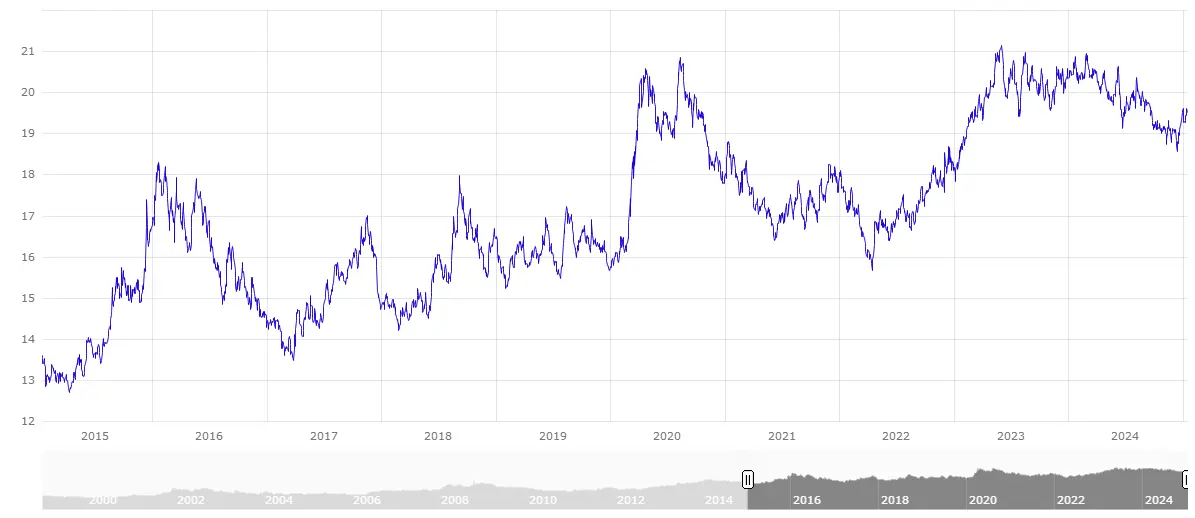
The chart above shows the 10-year history of the EUR/ZAR pair. You will note the extremely high levels of volatility seen within the period, with several dramatic spikes and plunges throughout.
Like any forex pair, the EUR/ZAR is sensitive to geopolitical developments and macroeconomic conditions. Some recent events that have impacted the currency pair include the Brexit referendum in 2016, the Great Financial Crisis of 2008, South Africa’s Eskom Electricity Crisis (also in 2008), and the global pandemic Covid-19.
Note that due to the interlinked nature of global trade, the impact of events with far-reaching consequences can further increase uncertainty, triggering even more volatility. Investors should bear this in mind when attempting to trade an exotic currency pair like EUR/ZAR.
Expected EUR/ZAR trend in 2025 [7]
Returning to the chart above, the currency pair has calmed significantly recently, trading between 19 and 21 over the past year or so. This is attributed to a rand rally, which some analysts expect to extend into 2025.
According to Investsec, the rand is expected to continue strengthening in 2024 and 2025 against the Dollar, Pound, and euro. This could lead the EUR/ZAR pair to trade flatter than usual, depending on how the EUR performs.
One factor for the rand’s continued strength is expected interest rate cuts from SARB – a reduction of 50 basis points are expected in 2024, with a further cut of 100 basis points in 2025. Other domestic factors supporting the strength of the rand include improved economic growth in South Africa and stable electricity supplies.
Externally, falling US interest rates are also expected to bolster global economic sentiment, encouraging greater investor confidence and risk appetite. These factors could benefit the South African economy, further strengthening the rand.
Frequently Asked Questions
What affects trading EUR/ZAR?
EUR/ZAR is a highly volatile currency pair that forex investors should approach with caution. Traders should monitor economic conditions and political developments in both zones and respond promptly.
Meanwhile, they should also bear in mind that global events could affect each currency differently: one is the second most powerful in the world, while the other is that of an emerging economy plagued by high crime and instability.
Where can I find a trusted forex broker to trade EUR/ZAR?
Vantage is an award-winning broker that offers tight spreads, low fees and transparent charges to the benefit of our clients. Trade EUR/ZAR CFDs with flexibility, low starting capital, and the potential to amplify your outcomes with leverage.
Why is ZAR so volatile?
ZAR volatility stems from uncertainty in three main areas. Plagued by its apartheid legacy, the country suffers from domestic political uncertainty as it forges its way forward. South Africa is also vulnerable to commodity price volatility as its economy relies heavily on exports of gold and other mining output. Thirdly, as an emerging economy, South Africa is susceptible to global uncertainty and shifting risk appetites.
Is ZAR pegged to USD?
The rand was unpegged from the US Dollar as South Africa transitioned away from the apartheid system of governance in the early 1990s. It has remained free-floating against the Dollar ever since.
Why is ZAR strengthening against the USD?
The recent strength in the ZAR against the USD is attributed to incoming interest rate cuts by the South African central bank, improving economic conditions, and continued stability in electricity supply. Furthermore, the US Federal Reserve’s rate cuts are expected to boost global investor sentiment, which could further strengthen the rand.
References
- “Euro: Currency Unit – Britannica”. https://www.britannica.com/money/euro . Accessed 19 Sep 2024.
- “9 Facts about the euro – European Commission via Medium”. https://europeancommission.medium.com/the-euro-facts-about-the-common-currency-208755dade65 . Accessed 19 Sep 2024.
- “The Euro, Our Money – European Central Bank”. https://www.ecb.europa.eu/pub/pdf/other/euroleafleten.pdf . Accessed 19 Sep 2024.
- “South African Rand (ZAR): History Of The Currency – Investopedia”. https://www.investopedia.com/terms/forex/z/zar-south-african-rand.asp . Accessed 19 Sep 2024.
- “Banknotes & Coins – South African Reserve Bank”. https://www.resbank.co.za/en/home/what-we-do/banknotes-and-coin . Accessed 19 Sep 2024.
- “South African Rand – European Central Bank”. https://www.ecb.europa.eu/stats/policy_and_exchange_rates/euro_reference_exchange_rates/html/eurofxref-graph-zar.en.html . Accessed 19 Sep 2024.
- “Rand Rally to Extend Says Investec – PoundSterling Live”. https://www.poundsterlinglive.com/zar/20812-rand-rally-to-extend-says-investec . Accessed 19 Sep 2024.