






 Updated
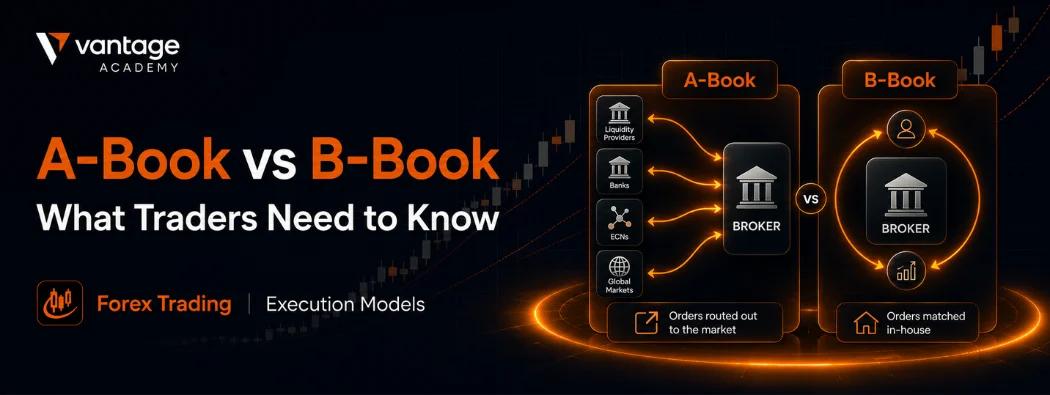
Many forex traders blame spreads, slippage, or stop-loss issues on the market. But sometimes, the real question is how the broker handles the trade behind the scenes.
This is where the terms A-Book and B-Book come in.
These two models describe how a broker manages client orders and trading risk. In simple terms, an A-Book broker sends, or hedges client trades with outside liquidity providers, while a B-Book broker keeps the trade internally and may act as the counterparty.
The difference matters because it can affect pricing, spreads, execution, slippage, and possible conflicts of interest.
Key takeaways
- Forex trades do not go through one central exchange. Brokers must manage order flow.
- A-Book brokers pass or hedge trades with outside liquidity providers.
- B-Book brokers keep trades in-house and may act as the counterparty.
- A-Book and B-Book differ in trade handling, income model, risk, and pricing.
- Many brokers use both models based on the trader’s profile and risk.
- A-Book is not always good, and B-Book is not always bad.

What Happens After You Place a Forex Trade?
When you buy or sell on a trading platform, your order does not magically appear in a central forex exchange. Forex is mainly an over-the-counter market. This means trades are handled through networks of banks, liquidity providers, brokers, and other market players.
Your broker must decide how to manage your order. It can either:
Send or hedge your trade with outside liquidity providers. Or keep the trade risk inside its own system. This is the basic idea behind the execution of A-Book and B-Book.
What Is an A-Book Broker?
An A-Book broker passes client orders to an external liquidity provider or hedges those trades outside the brokerage. These liquidity providers may include banks, prime brokers, financial firms, or other market makers. In this model, the broker acts as an intermediary, routing or hedging client orders with external liquidity providers rather than taking the opposite side as its primary risk.
With this model, the broker typically does not take on the opposite side of a trade as its primary risk. Instead, they make their money through commissions and spread markups (or both). The more trades each trader executes, the greater the broker’s profit.
In many A-Book setups, client orders are routed or hedged through liquidity providers using STP, ECN-style, or liquidity aggregation systems.
For example, if a trader buys EUR/USD, the broker may route or hedge that position with a liquidity provider. The broker’s income may come from a small markup on the spread or a fixed commission per trade.
Many traders view the A-Book model as a more transparent form of execution because it does not primarily rely on client losses as the broker’s profit. It can mitigate the direct friction between broker and trader. However, A-Book execution is not flawless. At news events, traders may be subjected to wider spreads, slippage, liquidity gaps or higher commissions.
How A-Book Brokers Make Money
A-Book brokers usually make money through:
- Spread markups
- Trading commissions
- Swap or overnight fees
- Account-related charges, where allowed
The broker’s goal is usually to increase trading volume. The more clients trade, the more the broker can earn from commissions or spreads.
This is why A-Book brokers often prefer active traders, larger accounts, and traders who use higher volume strategies.
Benefits of A-Book Brokers
The main benefit is that there is usually
- less direct conflict of interest. Since client trades are either passed to outside liquidity or hedged, the broker does not depend on client losses to the same extent as a B-Book broker might.
- A-Book brokers may also offer stronger pricing when they have access to deep liquidity. This can help traders get more market-based pricing.
- A-Book brokers often favour high-volume traders, as increased trading activity can result in higher commission-based revenue.
Drawbacks of A-Book Brokers
- 1. A-Book brokers can charge commissions. Spreads may also widen during volatile periods.
- 2. Execution may depend on liquidity providers. During major news events, the price a trader sees may change before the order is filled. This can lead to slippage.
So, while A-Book can reduce some concerns, it does not remove all trading risks
What Is a B-Book Broker?
B-Book brokers execute client trades internally. This means the broker may be on the opposite side of a trade, rather than merely sending it externally for liquidity. Because you sell, they buy, and if you are to purchase, then they will be selling, but only just within their system.
This is known as internalisation risk or warehousing. This way, they operate under a B-Book execution model, and the broker assumes price risk for this position rather than routing it to liquidity providers.
For example, if a trader buys USD/JPY, the broker may internally take the sell side of that trade. If the trader loses, the broker may profit. If the trader wins, the broker may lose.
This is why B-Book brokers are often linked to conflict-of-interest concerns.
How B-Book Brokers Make Money
B-Book brokers may make money from:
- Spreads
- Client trading losses
- Overnight fees
- Internal risk management
- Net exposure across many client trades
Benefits of B-Book Brokers
The B-Book model is not inherently bad. It can allow brokers to offer:
- Fast order execution
- Fixed or tight spreads
- Smaller trade sizes
- Low or zero-commission accounts
- Simple pricing for beginner traders
For small retail trades, internal execution can sometimes be faster and cheaper than routing every order to outside liquidity.
This is why many brokers use B-Book execution for some clients and A-Book execution for others.
Drawbacks of B-Book Brokers
- The biggest concern is conflict of interest. Because the broker may take the opposite side of client trades, traders may perceive a potential conflict of interest in how orders are handled. These concerns can include requotes, stop-loss hunting, unfair slippage, or delayed execution.
- In less regulated environments, traders may raise concerns about issues such as pricing inconsistencies, execution delays, or slippage during volatile conditions.
- Due to potential execution or pricing concerns in certain cases, B-Book brokers are sometimes viewed negatively by traders due to concerns about conflicts of interest, which can affect perception in the market.
What Are The Differences Between A Book vs B Book Brokers vs Hybrid Brokers
| Criteria | A-Book Broker | B-Book Broker | Hybrid Broker |
| Trade handling | Sends or hedges client trades with external liquidity providers. | Keeps client trades internally within the broker’s own system. | Uses both models. Some trades are sent out, while others are kept internally. |
| Counterparty | External liquidity provider, bank, prime broker, or market maker. | The broker may act as the counterparty to the client’s trade. | Depends on the trade. The counterparty may be external or the broker itself. |
| Main income source | Commissions, spread markups, swaps, and trading fees. | Spreads, swaps, and possible profit from client losses. | Commissions, spreads, swaps, and internal risk gains where trades are kept in-house. |
| Conflict of interest | Lower direct conflict because the broker does not mainly profit from client losses. | Higher possible conflict because the broker may profit when clients lose. | Varies. Some orders depend on liquidity providers, while others are filled internally. |
| Execution | Depends on external liquidity and market conditions. | Handled internally, which can allow faster order fills. | Varies. Some orders depend on liquidity providers, while others are filled internally. |
| Spreads | Often variable and may widen during volatile periods. | Can be fixed, tight, or wider depending on the broker’s pricing model. | Varies by account type, trade size, and execution route. |
| Slippage | May happen when liquidity changes or prices move fast. | Happens based on the broker’s internal pricing and execution policy. | Can happen in either direction, depending on whether the trade is sent out or kept in. |
| Best suited for | Active traders, high-volume traders, scalpers, and skilled traders who need market-based pricing. | Beginner traders, small retail traders, and traders who prefer simple pricing. | Brokers serving mixed trader types, including beginners, active traders, and larger accounts. |
What is a Counterparty?
A counterparty is the other side of a trade. If you buy EUR/USD, someone else must take the sell side. In a B-Book model, the broker may become that other side. In an A-Book model, the other side is usually an external liquidity provider.
Is A-Book Better than B-Book?
A-Book is often seen as more trader-friendly because it reduces the broker’s direct interest in client losses. For this reason, many experienced traders prefer brokers that offer A-Book, STP, ECN, or similar execution models.
But it is too simple to say A-Book is always good and B-Book is always bad.
An A-Book broker can still have high trading costs, poor liquidity, weak support, or bad execution.
A B-Book broker can remain regulated, stable, and fair if it manages risk effectively and treats clients honestly.
The better question is: Does the broker offer fair pricing, clear costs, strong regulation, smooth withdrawals, and honest execution?
That matters more than the label alone.
What is a Hybrid Broker Model?
Many forex brokers do not use only one model. They use a hybrid model. This means some trades may be handled by executing orders itself, passing the order to a third party, or both.
For example, a broker may A-Book profitable traders, large accounts, or high-volume clients. At the same time, it may B-Book smaller accounts or traders with lower risk profiles. This allows them to balance profitability and client satisfaction.
However, this is common in the retail forex market. The key issue is not whether a broker uses one model or the other. The real issue is whether the broker is transparent, fair, and properly regulated.
Pros of a Hybrid Broker Model
- It helps brokers to avoid taking too much risk on one side.
- A hybrid broker can offer different account types. Some accounts may have raw spreads and commission, while others may have wider spreads with no commission.
- Since the broker does not send every order outside, it may reduce some liquidity and execution costs.
Cons of a Hybrid Broker Model
- Trade execution in hybrid models may vary depending on account type, trade size, or internal risk policies.
- With hybrid models, trade execution may vary depending on account type, trade size, or internal risk management policies. But with pure A-brokers and pure B-brokers, the process is easy to understand.
- One trader may get A-Book execution while another trader gets B-Book execution. That may affect spread, order fills, slippage, and execution speed.
Common Misunderstandings About A-Book and B-Book Brokers
- All B-Book brokers are scams: This is not true. B-Book is a risk management model. It becomes a problem when a broker uses it unfairly or hides how it operates.
- All A-Book brokers offer perfect execution: Also untrue. A-Book brokers still depend on liquidity providers. Spreads can widen, orders can slip, and commissions can increase trading costs.
- Low spreads always mean better trading conditions: Low spreads can help, but traders should also check commissions, swaps, slippage, execution speed, and withdrawal quality.
- The broker model is the only thing that matters: It is important, but it is not the only factor. Regulation, transparency, client fund handling, platform quality, and customer support also matter.
How to Check if a Broker Uses A-Book, B-Book or Hybrid Execution Model
A broker’s execution model shows how client orders are processed after a trader places a trade. It can affect pricing, order fills, slippage, trading costs, and possible conflicts of interest. For forex and CFD traders, checking execution quality is just as important as checking spreads or account types.
Because retail forex is often traded over-the-counter, the broker may play a direct role in pricing and order execution.
- Read the broker’s execution policy: Start by reading the broker’s execution policy, order execution statement, or client agreement. Look for how orders are routed, whether trades are handled internally, and whether the broker uses liquidity providers.
- Check whether the broker acts as principal or agent: A broker acting as an agent usually routes or matches client orders with third-party liquidity providers. A broker acting as principal may take the opposite side of the client’s trade. This helps traders understand where a conflict of interest may arise.
- Look at spreads, commissions, and other trading costs: Low spreads can look attractive, but they do not always show the full trading cost. Traders should also check commissions, swap charges, overnight funding fees, inactivity fees, and currency conversion charges.
Frequently Asked Questions
Are A-Book brokers generally safer for forex traders?
A-Book brokers are often seen as safer because they usually pass or hedge trades with external liquidity providers, which can reduce direct conflict of interest. But safety also depends on regulation, execution quality, costs, and withdrawal reliability.
Can I switch between A-Book and B-Book brokers easily?
Yes, traders can open accounts with different brokers, but switching means checking fees, spreads, platform access, regulation, and withdrawal terms again. The bigger issue is not switching itself, but choosing a broker with clear execution rules.
Which forex brokers in South Africa use A-Book or B-Book models?
Many brokers in South Africa do not openly label themselves as “A-Book” or “B-Book” in simple terms. Check their execution policy for words like principal, agent, market maker, STP, ECN, or liquidity providers.
What are the risks of trading with a B-Book forex broker?
The main risk is conflict of interest, because the broker may profit when the trader loses. Other concerns include poor slippage, delayed execution, requotes, spread widening, and lack of clear pricing rules.
How do regulatory bodies in South Africa view A-Book and B-Book brokers?
South Africa’s FSCA focuses more on licensing, market conduct, client protection, and fair treatment than on simply calling brokers A-Book or B-Book. Traders should verify that a broker is authorised and check whether the firm is properly listed as a regulated entity.
Can I find a forex broker in South Africa that offers both A-Book and B-Book execution?
Yes, many retail forex brokers use a hybrid model, where some trades are sent to liquidity providers and others are handled internally. You should confirm this from the broker’s execution policy, not just from marketing claims.
What are the key differences between ECN and STP forex brokers?
An ECN broker connects traders to a network where orders can match with banks, institutions, or other market players. An STP broker sends orders straight to liquidity providers, but may not offer the same market depth or price display as a true ECN setup.
Risk Warning: CFDs are complex financial instruments and carry a high risk of losing money rapidly due to leverage. You should ensure you fully understand the risks involved and carefully consider whether you can afford to take the high risk of losing your money before trading.
Disclaimer: The information is provided for educational purposes only and doesn’t take into account your personal objectives, financial circumstances, or needs. It does not constitute investment advice. We encourage you to seek independent advice if necessary. No representation or warranty is given as to the accuracy or completeness of any information contained within.
This material may contain historical or past performance figures and should not be relied on. Furthermore, estimates, forward-looking statements, and forecasts cannot be guaranteed. The information on this site and the products and services offered are not intended for distribution to any person in any country or jurisdiction where such distribution or use would be contrary to local law or regulation.
References
- https://www.tradingview.com/chart/GC1!/jIKk0Ogd-A-Book-vs-B-Book-What-Every-Retail-Trader-Needs-to-Know/ A-Book vs B-Book: What Every Retail Trader Needs to Know
- https://www.investopedia.com/terms/e/executingbroker.asp – Understanding Executing Brokers: Role, Process, Key FAQs
- https://www.ifcci.org.my/programs/ofl/learn-forex/level-2/how-a-book-brokers-make-money – How A Book Traders Make Money
- https://www.forexfactory.com/thread/1351958-how-forex-brokers-work-stp-ecn-a-book-b-book – How Forex Brokers Work: ECN, STP, A-Book, B-Book.
- https://www.ifcci.org.my/programs/ofl/learn-forex/level-2/the-hybrid-model-used-by-forex-brokers – The Hybrid Broker Model
- https://devexperts.com/blog/a-book-b-book-and-hybrid-models-in-forex-brokerage/ – Understanding Forex Book Business Model