





 Updated
From the U.S. to Japan and the U.K., each advanced economy has its own representative stock market index. And it’s no different for Germany.
Published on the Frankfurt Exchange, the DAX (aka GER40) tracks the 40 best-performing commercial entities active in Germany. The companies chosen represent approximately 80% of the total market capitalisation traded on the Frankfurt Exchange; as such, the DAX is considered a significant benchmark of the German economy as a whole.
In this article, we’ll take a deeper look at the DAX, its key characteristics, and what to consider when trading it.
What is the DAX Index? [1]
Weighted by market capitalisation, the DAX measures the performance of the 40 largest and most liquid companies listed on the Frankfurt Stock Exchange. It was created in 1998 with an initial reading of 1,163 points and initially covered only 30 blue-chip companies. This was later expanded in 2021 to include 10 additional companies, improving the index’s coverage of the German economy.
Because of its component companies, the DAX is also sometimes known as the GER40. Its German name is “Deutscher Aktien Index”. The index is calculated from prices provided by the electronic trading system Xetra using a free-float method. This means that the market capitalisation of each component only includes readily available shares and excludes locked-in shares held by insiders, promoters, and governments.
The DAX is populated by several well-known MNCs, many of which helped drive the German economy to new heights in the wake of World War 2. Some of these include Adidas, Allianz, Bayer, and Volkswagen, spanning several major sectors and industries, from clothing and insurance to pharmaceuticals and vehicle manufacturing. A complete list of component companies will be included later in the article.
Key characteristics of the DAX index
The DAX is unique among its peers in that it does not utilise spot prices. Instead, it is updated with futures prices for the next day, even after the close of the leading stock exchange – a move rarely seen in similar indices.
The Frankfurt Exchange maintains the DAX by making necessary changes on regular review dates. Despite this, component companies may be removed at any time if they fall outside the top 45 largest companies or enter the top 25.
Trading hours of the DAX
The DAX trades during the Frankfurt Exchange hours. Due to its significance, pre-market and after-hours trading are also available.
Main trading hours
- Mon – Fri: 9:00 AM to 5:30 PM Central European Time (CET)
Pre-market and after-hours trading
- Pre-market: 8:00 AM to 9:00 AM CET
- After-hours: 5:30 PM to 8 PM CET
What companies are in the DAX? [2]
Here’s a partial list of the component companies found in the DAX. The list of the top 10 companies is ordered by market capitalisation.
As at November 2024, the DAX has a combined market capitalisation of US$1.91 trillion.
| Company | Market capitalisation (billions, USD) |
| SAP | $275.85 |
| Deutsche Telekom | $154.33 |
| Siemens | $148.41 |
| Allianz | $118.38 |
| Airbus | $114.42 |
| Munich RE | $68.68 |
| Merck KGaA | $65.13 |
| Siemens Healthineers | $59.31 |
| Mercedes-Benz | $59.23 |
| Porsche | $56.59 |
Why trade the DAX?
The DAX acts as the leading benchmark of the German stock market, focusing on several blue-chip stocks and well-established MNCs with long track records of good performance. Furthermore, many of these companies have grown into giants in their respective sectors, ranking among the top brands worldwide.
Thus, the DAX offers investors the opportunity to diversify their portfolios across multiple dimensions, including large-cap blue-chip stocks and, regionally, the German economy.
Investors seeking exposure to Germany’s economic performance can use the DAX as a convenient starting point. More experienced traders who are comfortable with higher volatility can also use the DAX as a reference to identify potential blue-chip stocks to add to their trading lists.
This is especially true since the DAX is more dynamic than other indices; instead of waiting until regularly scheduled reweighting dates, the index’s components can fall off or admit new members once the relevant thresholds are crossed.
Historical trends of the DAX
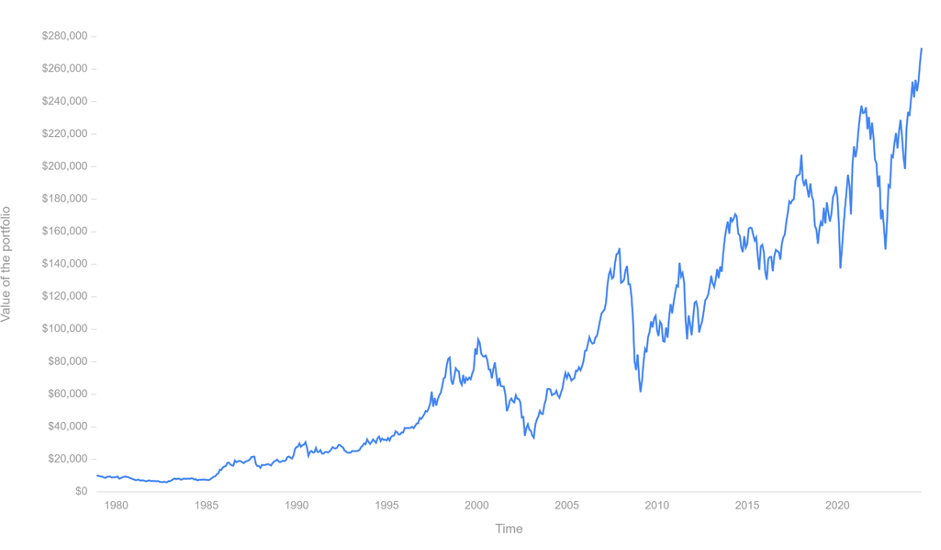
The screenshot above shows the historical performance of the DAX index. As you can see, the index, which closely reflects the state of the German economy, only began to take off in the mid-1980s.
It experienced its first significant pullback during the dot-com crash of 2000, and again during the Global Financial Crisis of 2008. Since then, the index has trended upward, even amid the global COVID-19 pandemic.
How has the DAX performed so far? [3]
Over the past 45 years, the DAX has delivered a compound annual growth rate of 7.51%. As of Nov 2024, the DAX has returned an average of 16.89%, marking 2024 as a year of better-than-average performance.
The index’s three best and worst years are as follows:
Best years:
- 1985: +102%
- 2003: +62.5%
- 2007: +36.7%
Worst years:
- 2008: -43.6%
- 2002: -33.3%
- 2001: -24%
Notably, the DAX tends to be choppier than some of its peers. It has a standard deviation of 21.8%, which is relatively high for a national index. (For comparison, the FTSE has a standard deviation of just 14.78%).
This is attributable to the relatively small number of components of just 40 stocks, as well as the market-capitalisation weighting method used in the index’s calculation.
While the DAX is performing exceptionally well at the time of writing, it is likely not for the faint-hearted, judging by the extremely long and deep drawdowns the index has experienced before.
A drawdown is a period during which the index declines from a previous peak.
The Dax had its longest drawdown, lasting 6 years and 8 months, from December 1978 to August 1985. It reached a trough of -40.1%.
Meanwhile, its deepest drawdown lasted 6 years and 2 months, from February 2000 to April 2006. The index fell by up to 64.4% during this period.
How to trade the DAX index?
As a benchmark, the DAX cannot be traded directly. Instead, traders and investors can trade the DAX via a variety of other financial instruments.
Exchange Traded Funds (ETFs)
Several ETFs track the DAX’s performance by maintaining the same mix of component companies. This allows ETFs to closely track the index as it rises and falls.
Investors can purchase shares of a DAX ETF to gain exposure to the DAX. Note that ETFs incur management fees that reduce your total returns.
In addition to providing exposure to DAX performance, ETFs offer flexibility and convenience. This is because ETFs are tradable at any time on stock markets, making them highly liquid. As they are preloaded with the top 40 stocks in the DAX, ETFs offer inherent diversification.
Some popular DAX-tracking ETFs are:
- iShares Core DAX UCITS ETF (DE)
- Amundi ETF DAX UCITS ETF DR
- Vanguard DAX UCITS ETF Distributing
Contracts-for-Difference (CFDs)
Another way to trade the DAX index is through a financial derivative known as a Contract for Difference (CFD). A CFD offers exposure to the price action of the DAX without direct ownership of any shares or components of the index.
By trading CFDs, investors can speculate on the direction that the DAX will go – up or down – and open a corresponding long or short position. Upon closing the contract, the difference between the DAX level at contract opening and the level at closing determines the profit or loss.
In addition to allowing both long and short positions, CFDs enhance capital efficiency through leverage. This allows a trader to control a larger number of positions with a smaller starting capital, enabling more advanced strategies. However, leverage will also amplify the outcome of your trade, whether it be a profit or a loss.
CFDs are highly popular and readily available, but investors should note that their complex, fast-paced nature makes them unsuitable for beginners or inexperienced investors. Care should also be taken to choose a reputable brokerage with low spreads and transparent fees to avoid excessive trading commissions.
Trading DAX futures
The DAX has come to be regarded as a reliable indicator not only of the German economy and the Eurozone as a whole, but also as a predictor of movements in the US stock market. As such, more experienced traders also trade DAX futures, which are another form of financial derivative that requires a fair level of experience.
Futures contracts are agreements to buy or sell an underlying asset at a predetermined price on a predetermined date. Commodity traders commonly use them to hedge against price volatility.
In the case of DAX futures, the contract moves up or down by a fixed dollar amount for each 1-point change in the DAX. No underlying assets are exchanged; instead, the contract is settled in cash at expiry.
Here are the key characteristics of DAX futures.
- Available in three sizes
- FDAX (EUR 25 per index point)
- FDXM (EUR 5 per index point)
- FDXS (EUR 1 per index point)
- Trading hours: Sunday to Friday, 7:00 pm to 4:00 pm ET
- Duration: Quarterly (March, June, September, December)
- Close: The third Friday of the relevant month, or the day immediately preceding in case of holiday or closure
Considerations when trading DAX futures [4,5]
It’s important to understand that the price of a futures contract is determined by market supply and demand, with investors attempting to anticipate the index’s level on the settlement date.
When trading DAX futures, a trader has to maintain a separate margin account with their brokerage. For every point that the DAX future moves, the corresponding euro amount will be either debited or credited to the margin account.
If the account’s margin is no longer sufficient, the investor faces a margin call requiring additional funds to be deposited. Failing to do so will result in the brokerage closing the position immediately.
Clearly, the full-sized FDAX, which moves at EUR 25 per index point, is too large for most retail investors or short-term traders. Typically, FDAX is only traded by institutional investors or traders with the capital to pursue a long-term strategy.
For retail investors and short-term traders, the FDAM and FDAS, with smaller lot sizes (EUR 5 per point and EUR 1 per point, respectively), may be more suitable.
With narrower price changes per index-point movement, these futures contracts allow traders to trade multiple contracts and employ wider stops, increasing the profit potential.
Analysing DAX market factors
Technical analysis of the DAX index
Technical analysis involves using charting tools and technical indicators on a DAX price chart to identify patterns, gauge market sentiment, and spot emerging trends.
Notably, the practice focuses solely on past price action as shown on the price chart, and purists have been known to eschew other sources of information as market noise that could obscure what’s really happening.
Of course, placing such faith in technical analysis alone requires a deep understanding of the practice. Proponents advise that technical analysis demands – and rewards – dedication and mastery.
Technical analysis revolves around plotting and interpreting technical indicators and charts. These can range from simple to advanced. Some popular, beginner-friendly technical indicators are:
- Trend lines. These are straight lines plotted along the tops or bottoms of a region in a price chart, crossing or joining as many points as possible. The slope of the line, as well as the direction, clearly indicates price trends – whether up, down, or sideways. When applied to DAX, trendlines can help confirm whether a trend is continuing or a change is imminent.
- Relative Strength Index (RSI). The RSI is an oscillator typically plotted beneath the main price chart. It measures the speed and change in price movements and is scored on a 0-100 scale. Conventionally, readings over 70 indicate an overbought market, while readings under 30 point to an oversold market. For the DAX, the RSI can help traders gauge bullish or bearish price momentum.
- Chart patterns. Price charts are typically displayed as bar charts, with each bar representing a trading period (e.g., a trading day). Hence, by examining patterns formed by consecutive bars, a technical analyst can be alerted to potential price movements. There are several chart patterns to learn, but each generally spans 2 to 5 bars, with 3 being the most common. They can indicate bullish or bearish trends and, as such, help investors confirm or refute trend reversals in the DAX.
Fundamental analysis of the DAX
The counterpart to technical analysis is fundamental analysis, which centres on tracking news, events and developments that can have a material impact on prices. For stock market indices such as the DAX, fundamental analysis is a powerful way to identify upcoming price movements and potential trading opportunities.
Because prices of its component stocks directly influence the DAX’s performance, fundamental analysis also involves examining market factors that could affect these companies.
These can range from internal factors such as earnings forecasts, scandals, and executive changes to external factors such as regulatory changes, consumer trends, oil production, and war.
See the next section for a more detailed discussion.
Market factors impacting the DAX index
Global economic conditions
Recall that the DAX is populated by many MNCs with exposure to overseas markets. Global economic conditions can significantly influence the performance of DAX component companies, thereby affecting the index.
For instance, German exports typically perform well during global economic expansions, when demand for high-quality German products is higher. Conversely, recent fears of a weakening US economy – coupled with Trump’s threats to impose new tariffs on imports – could lead to a drop of as much as 15% in German exports [6].
If this were to play out, several DAX components’ performance could be negatively affected, likely hampering the DAX’s performance.
Company performance
Even if the global economic outlook remains sunny for Germany, the DAX could still decline if its component stocks fall. This depends on the performance of all 40 companies tracked by the index, which could be affected by a weakening German economy.
Indeed, recent reports suggest business confidence is sinking among German companies, with the ifo Business Climate Index in September falling to the lowest level since July 2020. This was on the back of shrinking orders and dimmed business outlooks [7].
Should concerns about economic weakness in Germany materialize and companies experience weaker business outcomes, the DAX is bound to follow suit sooner or later, with lower index readings as component stocks decline.
Central bank policies
Global economic conditions, import tariffs, company performance, and business sentiment aren’t the only market factors that could affect the direction of the DAX index. Another significant factor is central bank policies.
Specifically, while the factors discussed previously exerted negative influences on the DAX, the benchmark remained cherrily buoyant, even approaching all-time highs as recently as the end of September.
Upon further analysis, this was attributed to monetary easing by several major central banks to stimulate economic activity. Rate-cut expectations from the US and China helped shore up investor confidence, keeping blue-chip stock prices high.
Most notably, weak eurozone economic data fueled further expectations of European Central Bank rate cuts, which in turn boosted investor confidence and kept the DAX resilient amid softening economic data.
This event demonstrates that when evaluating market factors in fundamental analysis, it’s essential to gain a well-rounded, balanced view of relevant data rather than relying too heavily on a single or two perspectives.
Currency fluctuations
Changes in foreign exchange rates can also affect the DAX.
This is due to the cross-border nature of many of its top component stocks; these companies will be affected if the euro appreciates or depreciates against other major global currencies.
Geopolitical events
Lastly, market indices such as the DAX can be affected by events in other regions. This is unavoidable, given the closely intertwined nature of the global economy and the multinational character of Germany’s blue-chip companies.
For example, in mid-November, the DAX fell by nearly 1 per cent, driven by renewed concerns about escalating tensions between Ukraine and Russia [8].
Trading strategies for the DAX index
Before we wrap up this article, let’s discuss some common trading strategies that may be applied to the DAX.
As a national stock market benchmark, with a relatively small set of component stocks and well-known blue-chip constituents, the DAX is well-suited to a wide range of trading strategies.
Short-term trading strategies
Day trading
As it is hosted on the electronic trading system Xetra, the DAX is calculated in real time and updated every second. This means the DAX value constantly changes to reflect the latest stock prices of its components, which themselves fluctuate throughout the trading day.
As such, the DAX is well-suited to day trading, in which traders focus on making several small trades over minutes to hours. The goal of day trading is to accumulate small profits across several short-term trades, rather than trying to capture large profits in a single trade. In this trading strategy, no positions are held overnight to avoid the risk of disruptive events or news happening outside of trading hours.
News trading
Another short-term trading strategy to consider is news trading. As its name suggests, news trading revolves around tracking relevant news and corporate announcements to identify potential trading opportunities.
Given the high-profile nature of DAX constituent stocks, investors may find news trading a viable strategy, as it is relatively easy to find and track news likely to impact the DAX.
However, as discussed above, it is also crucial to maintain a well-rounded view and, perhaps, incorporate technical analysis to test trading ideas more effectively.
Mid-term trading strategies
Swing trading
The dynamic price action of the DAX creates opportunities for investors to attempt a swing trading strategy.
In swing trading, the goal is to capture profits by entering a position just as an asset’s price is changing. The idea is to capture a portion of a potential price swing and exit just before the trend reverses.
To be successful, a swing trader must first be able to identify where the DAX is likely to move next correctly, and then set up a trade to capture profits if the move materialises. For this reason, swing traders routinely make use of technical analysis to help them find appropriate trade entry and exit points.
Mean reversion or momentum
A mean reversion trading strategy bets that any asset that has temporarily deviated from its historical average will soon return to its historical trend line. A trade is made to capture profits when the asset price returns to its mean after short-term volatility subsides.
Meanwhile, if there is reason to believe the breakout will continue, traders may instead make a momentum trade according to this new direction. The goal of a momentum trade is to capture profits if the trend continues to strengthen.
For example, higher-than-expected corporate earnings will likely cause a short-term bump in the DAX. But this could also increase investor confidence, leading to higher demand for component stocks and prolonging the DAX rally.
Long-term strategy
Buy-and-hold
The DAX is well-suited to long-term traders who favour a buy-and-hold strategy, which can be conveniently executed via a DAX-tracking ETF.
Given the index’s long-term historical performance, a sufficiently long investment horizon would benefit the investor with significant capital appreciation.
However, the DAX is also more volatile than other national indices, so investors should be prepared to accept a higher level of risk. Also, the DAX may outperform other popular indices in some years, but its overall performance may lag that of indices tracking larger companies or more component stocks.
Regularly review your DAX holdings to ensure optimal outcomes.
Risk management when trading the DAX
The main risk of trading the DAX is its volatility, with a relatively high standard deviation of over 20% [9]. Thus, it’s essential to practise proper trade sizing and avoid taking overly large trades that could wreck your trading account.
Another risk factor stems from the index’s regional character. The DAX is tied to the performance of top German MNCs, which are affected by market factors in the eurozone and globally. Thus, consider diversifying your portfolio with other indices or assets that are less dependent on regional issues or local events.
Trade the DAX with Vantage
Vantage Markets offers CFD trading for the DAX and several other leading national stock market indices. Gain exposure to the dynamic price action of Germany’s top-performing blue-chip stocks without the hassle of direct ownership.
Save on trading costs with tight spreads and transparent pricing, improve capital efficiency with leveraged trading, and benefit from our robust customer support. Hone your knowledge and skills with our in-depth educational resources across articles, guides, news, and explainers, and trade with confidence on market-leading trading platforms with powerful charting tools and capabilities.
Experience the Vantage advantage today. Sign up to start trading now!
References
- “DAX Stock Index: Definition and Member Companies – Investopedia”. https://www.investopedia.com/terms/d/dax.asp . Accessed 26 Nov 2025.
- “Largest DAX companies by market cap – Companies Market Cap”. https://companiesmarketcap.com/dax/largest-companies-by-market-cap/ . Accessed 26 Nov 2025.
- “Historical performance of the DAX index – Backtest by Curvo”. https://curvo.eu/backtest/en/market-index/dax?currency=usd#chart . Accessed 26 Nov 2025.
- “DAX future – Boerse Frankfurt”. https://www.boerse-frankfurt.de/en/know-how/lexikon/dax-future . Accessed 27 Nov 2025.
- “How to Trade DAX® Futures – StoneX Futures”. https://blog.stonexone.com/how-to-trade-dax-futures-stonex . Accessed 27 Nov 2025.
- “German industry fears tariffs after Trump’s victory as markets react – Yahoo! Finance”. https://finance.yahoo.com/news/german-industry-fears-tariffs-trumps-184308596.html . Accessed 2 December 2025.
- “German business confidence tumbles: Why is the DAX index defying gravity? – Euronews”. https://www.euronews.com/business/2024/09/24/german-business-confidence-tumbles-why-is-the-dax-index-defying-gravity . Accessed 27 Nov 2025.
- “DAX Slips As War Worries Return – Nasdaq”. https://www.nasdaq.com/articles/dax-slips-war-worries-return . Accessed 27 Nov 2025.
- “Historical performance of the DAX index – Curvo”. https://curvo.eu/backtest/en/market-index/dax?currency=usd . Accessed 2 December 2025.