






 Updated

Crude oil trading in South Africa peaks between 15:30 and 19:00 SAST, when the London and New York sessions overlap, and Brent and WTI see their highest liquidity, tightest spreads, and strongest directional moves. Within this window, the EIA Weekly Petroleum Status Report, released every Wednesday at 17:30 SAST (16:30 in winter), consistently produces the sharpest price reactions of the week when inventory data misses consensus.
Outside this window, the Asian session before 09:00 SAST carries thin volume and wide spreads, making it unsuitable for new entries. The London session (09:00–15:30 SAST) offers moderate activity, particularly around European data releases. After 22:00 SAST, liquidity thins significantly and the session is better suited to managing open positions than opening new ones.
Brent trades primarily on the Intercontinental Exchange in London; WTI on the Chicago Mercantile Exchange. Because the US and UK observe daylight saving time while South Africa remains on SAST (UTC+2) year-round, these windows shift slightly across seasons. This guide covers when crude oil can be traded in SAST, how Brent and WTI hours differ, and what traders should confirm with their broker before placing a trade.
Key Takeaways
- The best time to trade crude oil in South Africa is between 15:30 and 19:00 SAST, when the London and New York sessions overlap.
- The EIA report, released every Wednesday at 17:30 SAST (16:30 in winter), produces the sharpest price reactions of the week.
- Brent trades on the ICE in London and WTI on the CME in Chicago, meaning their active windows in SAST differ.
- Because the US and the UK observe daylight saving time while South Africa stays on SAST year-round, trading windows shift slightly with the seasons.
- CFD broker hours differ from exchange hours, so traders should verify their broker’s specific schedule before trading.
Crude Oil Trading Hours in South Africa
Crude oil instruments like Brent and WTI are generally traded almost every second of the day, i.e., 24 hours a day, five days a week, but not continuously. Trading times can depend on the exchange sessions at the Intercontinental Exchange in London and the Chicago Mercantile Exchange, broker CFD availability (when your broker allows you to trade CFDs on oil), and daily maintenance breaks.
In South Africa (SAST), most active oil trading occurs from late evening into early morning to align with trading times in the US and UK markets. Trading hours vary throughout the year, with a 1-hour difference depending on daylight saving time (when clocks are shifted forward or backwards to align with daylight hours) in the US and the UK. So, as a trader in SA, traders may find it useful to confirm their broker’s live schedule.
What Are Crude Oil Trading Hours In South Africa?
Crude oil trading hours in South Africa are the times when traders can buy or sell Brent and WTI contracts through a broker, usually via CFDs or futures-linked instruments.
Therefore, there are times when trading is available and times when it is not, and oil is not traded using a single global clock. Instead, it runs across overlapping exchanges:
- US session – the time when WTI trades are most actively traded on the Chicago Mercantile Exchange
- UK/EU session – the time when Brent is most active on the Intercontinental Exchange in London
- CFD broker platforms – this is where traders execute orders
In practice, all sessions are active at different times 24 hours a day, Monday to Friday, but with:
- A daily maintenance break is a short pause in trading activity, lasting about 30–60 minutes per day, occurring at different times for the US and UK markets.
- Reduced liquidity during off-peak hours, as there are fewer traders and price movements are slower, as they go up and down, not rapidly like in peak hours.
- Full closure over weekends from Friday to Sunday.

Core idea for South African traders
For South African traders, the relevant trading clock reflects global session hours converted into SAST.
SAST trading hours = global session hours, UK & US times converted into South African Standard Time (UTC+2)
That is where most confusion starts.
Crude Oil Trading Hours in SAST: Quick Guide Table
Below is the practical trading clock for South Africa – this is the section most traders actually need.
| Market/Instrument | Typical Trading Window | SAST Equivalent | Notes |
| WTI Crude (CME Globex) | Sun–Fri 17:00–16:00 CT (with 1h break) | ~00:00–23:00 SAST (varies with DST) | US benchmark oil |
| Brent Crude (ICE) | ~01:00–23:00 London time | ~02:00–00:00 SAST (summer), ~03:00–01:00 SAST (winter) | Global benchmark |
| CFD Broker Oil Trading | Broker-specific (often 23–24h) | Depends on server time | Must verify the platform |
| Daily Maintenance Break | 1 hour (varies) | Usually mid-day or midnight SAST equivalent | Execution paused |
| Weekend Close | Friday is closed, but open on Sunday | No trading | Market shut globally |
WTI Crude Oil Trading Hours in South Africa
WTI (West Texas Intermediate) is the US crude oil benchmark, a reference price used by other markets to value oil. It is primarily driven by trading activity on the CME Globex system.
CME WTI Trading Structure
WTI trades run from Sunday evening to Friday evening, US time, with a short daily maintenance break of about an hour.
When converting CME WTI trading time in the US to South African Standard Time:
- Trade time is typically between late night and late evening South African time – 11:00 PM to 08:00 AM SAST.
- Price movements are volatile and active; they occur during US market hours (SAST evening to early morning) – 07:00 PM to 02:00 AM SAST. During this time, liquidity and trading activity are highest.
What Matters For SAST Traders
- US session overlap = the highest activity window in crude oil trading, as liquidity (buying and selling) and volatility (pricing moving up and down) increase when US markets are open.
- US economic news and oil inventory reports (whether oil supply is rising or falling) often heavily influence price movements.
- Trading may pause during the daily break, even if charts look active
WTI Trading Hours In SAST
- Active trading is almost 24 hours a day, Monday to Friday, with short daily maintenance breaks. But no trading on weekends.
- Strong activity occurs between 07:00 PM and 02:00 AM South African time, overlapping with the US session and global markets, but may shift by 1 hour due to daylight saving time.
For full benchmark mechanics, read the WTI crude oil trading guide
Brent Crude Oil Trading Hours in South Africa
Brent crude is the global benchmark and reference price used by other markets to value international oil. It is traded mainly via ICE. Intercontinental Exchange. While US supply and storage data influence WTI, Brent reflects global supply conditions.
ICE Brent Structure
Traders across London, Singapore, and US-linked liquidity pools trade Brent crude oil, so its price is influenced by activity from multiple time zones, not just one market. Brent activity begins earlier than WTI’s but occurs during the European and US sessions.
So it’s more like:
London is the main exchange location (ICE), so trading time reflects ICE’s activities there.
Singapore is a major Asian trading hub.
US-linked liquidity pools mean US traders and institutions also actively trade Brent
Brent Trading Hours In SAST
- This is when Brent trading activity is mostly active:
- 02:00–00:00 SAST (summer adjustment)
- 03:00–01:00 SAST (winter adjustment)
Key insight
Brent often shows:
- Traders start trading activities early during the European session, as it’s when exchanges happen in real time in the Intercontinental Exchange, London (morning SAST)
- Increased volatility as US and European traders are active(evening SAST). So there is high trading volume and sharp price movements.
Read our Brent crude oil trading guide
SAST Vs GMT: Why Crude Oil Trading Hours Shift
South Africa uses SAST (UTC+2 year-round), which means South African time is usually 2 hours ahead of UTC(Coordinated Universal Time). Even though the time remains stable, global oil markets are unstable in summer and winter.
The problem comes from:
- US & UK daylight saving time changes twice a year, shifting backwards or forwards. So the time difference with South Africa is typically 1 hour during these periods.
- Exchange session adjustments are changes to trading sessions, primarily due to time zone shifts.
Core Conversion Rule
- SAST = GMT + 2 hours
But:
- New York shifts between GMT-5 and GMT-4
- London shifts between GMT+0 and GMT+1
Simple Conversion Table
| Time Zone | Example Oil Activity Time | SAST Equivalent |
| GMT | 12:00 | 14:00 SAST |
| London (winter) | 08:00 | 10:00 SAST |
| London (summer) | 08:00 | 09:00 SAST |
| New York (EST) | 14:30 | 21:30 SAST |
| New York (EDT) | 14:30 | 20:30 SAST |
What This Means In Practice
There is no such thing as a perfect time to trade. The reason is:
- Global events do not happen in real time everywhere, but when they occur in local time in SA, they differ from when they happen in Europe. Liquidity, volatility, and execution depend on the time you trade, so trading based on current market conditions may be relevant.
- Liquidity windows shift slightly due to daylight saving time changes, so peak trading activity in SA occurs at a different time than in the UK and US, even if the charts look identical.
Verifying the broker’s server time may be relevant.
Best Times To Watch Crude Oil From South Africa
The best time to watch trade – this is where many traders misunderstand the market. There is no best time to trade that makes for better trade outcomes. Traders may find it useful to monitor active volatility windows, during which price movement tends to increase.
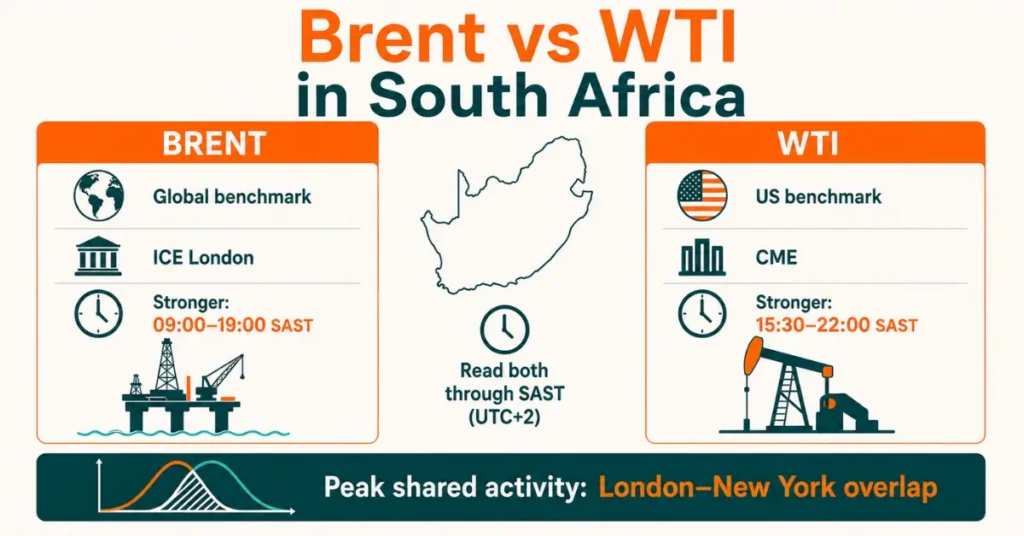
1. London Session (Morning SAST)
- Early Brent activity
- The market reacts to overnight news
- Moderate volatility
2. US Session (Evening SAST)
- Strongest WTI movement
- High liquidity
- Major news impact
3. London–New York Overlap (Key Window)
- Highest combined liquidity
- Fastest price movement
- Also, the highest slippage risk
Learn More about Trading Sessions in SAST
Important Reality Check
Higher activity does not mean better results. It also means:
- Faster price spikes occur when prices move sharply over a short period. So some traders wait for direction before acting.
- Wider spreads at times, as it costs more to enter and exit trades. Some traders avoid trading during this period due to wider spreads.
- More false breakouts as the price looks like it’s breaking out in simple terms, falling, then quickly reversing. Some traders wait for the move to confirm before acting.
Demo testing may help traders understand timing before live trading.
Oil Inventory News Times In South Africa
US inventory data heavily influences crude oil. This shows how much crude oil is stored. When the inventory number changes, it affects supply and demand and, in turn, prices. Think of it like this:
- Lower inventory readings have historically been associated with upward price pressure
- Higher inventory readings have historically been associated with downward price pressure
EIA Weekly Petroleum Status Report
The official US government report showing how much oil is in storage.
- Released: Wednesday, 10:30 a.m. ET
- SAST equivalent:
- 17:30 SAST (standard time)
- 16:30 SAST (daylight time)
API Report (Private Estimate Indicator)
A private industry estimate of US oil inventories was released before the official EIA report.
- Usually Tuesday evening US time
- SAST equivalent:
- Around 22:30–23:30 SAST
What Matters Here
These events often trigger:
- Short-term volatility spikes indicate rapid price movements following news. Some traders wait for the initial spike to settle before considering entries.
- Spread widening as the gap between buy and sell increases. Some traders avoid entering during spread-widening periods.
- Rapid liquidity shifts occur as buyers and sellers enter and exit quickly. Some traders wait for liquidity to stabilise before acting.
This is not a recommendation to trade during releases (when economic data or news are published and can move markets). It is a timing risk awareness issue.
Sources: EIA release schedule and API weekly bulletin
Broker CFD Hours vs Futures Exchange Hours
This is where most confusion happens.
Futures Exchanges (CME/ICE)
- Define official global trading sessions to set the trading hours for the market
- Include structured breaks to pause trading each day.
- Used for institutional contracts by large professional traders and institutions
CFD Brokers
- Sometimes offer extended trading hours
- May adjust for server maintenance
- May include their own daily break or rollover
What Traders May Want to Review on Their Broker Platform
Traders may want to review the following on their broker platform:
- Exact symbol trading hours
- Daily maintenance break
- Server time vs SAST
- Weekend opening time
- Holiday adjustments
- Rollover timing (swap)
Skipping this step may affect execution accuracy.
How To Test Crude Oil Trading Hours On a Demo Account
Traders may consider using a demo account to understand trading time very accurately.
Practical Testing Workflow With A Demo Account
- One starting point is opening WTI and Brent charts on the platform
- Matching platform time with SAST may be useful; using a simple time conversion, as explained above.
- Observing when charts go quiet, this usually occurs during the daily break, when trading activity is paused.
- Observing volatility(how prices move up and down) during:
- London session
- US session
- Overlap window
- Some traders make small demo trades to observe execution speed
- Monitoring how spreads (usually the buy and sell prices or the cost of entering a trade) change during the day.
What Traders May Observe
- When the broker actually allows execution
- How quickly orders fill during active hours
- Whether spreads widen during key events
Critical Warning
Demo accounts may not fully reflect real-world execution. They may be useful for observing timing but may not reflect actual fills in live market conditions.
Conclusion
There is no fixed schedule for crude oil trading in SA; timing depends on Brent and WTI trading activity, exchange systems, and broker-specific CFD hours, all filtered through SAST.
A clear understanding of trade times can help you trade effectively in SA at the right time, when the market is active.
- Understanding when WTI and Brent are active in SAST.
- Understanding GMT and daylight saving time shifts, and how to convert them to SA time.
- Traders may want to verify broker-specific trading hours and how they overlap with those of the WTI and Brent exchange systems.
- Testing execution behaviour on a demo account may be helpful before trading live.
Understanding the trading clock before focusing on the chart is a common starting point.
Sign up for a Vantage Demo account today.
Risk Warning: CFDs are complex financial instruments and carry a high risk of rapid loss of money due to leverage. You should ensure you fully understand the risks involved and carefully consider whether you can afford to take the high risk of losing your money before trading.
Disclaimer: The information is provided for educational purposes only and doesn’t take into account your personal objectives, financial circumstances, or needs. It does not constitute investment advice. We encourage you to seek independent advice if necessary. No representation or warranty is given as to the accuracy or completeness of any information contained within. This material may contain historical or past performance figures and should not be relied on.