 Register
 Login
 Register


Forex vs. Futures: Understanding the Differences (An Australian Guide for 2026)

Vantage Editorial Team >
Market Analyst
Vantage Editorial Team >
Market Analyst
 Updated Thu, 2026 July 30 08:51

 Academy All Articles Forex vs. Futures: Understanding the Differences (An Australian Guide for 2026)

Keywords
Popular Search


 Academy All Articles Forex vs. Futures: Understanding the Differences (An Australian Guide for 2026)
TABLE OF CONTENTS

Market Analyst
Market Analyst
Updated Thu, 2026 July 30 08:51
When comparing forex trading vs futures, the first thing an Australian trader needs to understand is the market structure. While both allow you to speculate on currency movements, they operate in entirely different environments.
Forex trading (Foreign Exchange) in Australia typically involves trading currency pairs via Contracts for Difference (CFDs) through an ASIC-regulated broker. Futures, on the other hand, are standardised contracts traded on centralised exchanges, such as the ASX or global exchanges like the CME.
These structural differences influence many factors including how much capital you need to start.
In the Australian trading landscape, the main distinction is execution. When you trade forex, you are often trading with a counterparty (commonly your broker). When you trade futures, you are trading on an exchange where every participant sees the same price at the same time.
These differences are crucial for Aussie traders. Forex offers the flexibility of fractional position sizing (micro lots), which may be preferred by those starting with smaller balances. Futures provide a “level playing field” with transparent volume data, which can often be preferred by institutional-style traders.
Micro futures have made futures trading more accessible in recent years by lowering the dollar value needed per contract. However, futures, including micro contracts still use standard contract sizes, fixed expiry dates and exchange margin requirements, meaning position sizing is limited to set contract tiers and positions cannot be held indefinitely.
CFDs may still be more suitable for traders who want fully flexible position sizing, exact-size positions rather than fixed contract tiers, and no fixed expiry date.
Trading costs also differ. Forex CFD costs may include spreads, commissions, and overnight financing fees. Futures costs may include brokerage commissions, exchange fees, clearing fees, market-data fees, and rollover costs.
CFDs may have lower upfront costs for smaller or short-term trades because they usually do not include separate exchange or clearing fees. However, overnight financing can make CFDs more expensive when positions are held for longer periods.
For Australians, forex trading is the most common way to hedge against or speculate on fluctuations of the AUD.
Because there is no central “Exchange” for forex, it operates 24 hours a day via a global network of banks. In Australia, retail traders usually access this market via CFDs. This allows you to trade on margin, meaning you only need a small percentage of the total trade value as a deposit. However, it is important to be aware that CFDs are high risk products that can move rapidly against you due to leverage.
When you trade the AUD/USD, you are betting on the Australian economy’s performance relative to the United States. If the RBA raises interest rates while the Fed stays on hold, an Aussie trader might “go long” on the AUD/USD expecting the local dollar to rise.
Note: For a deeper dive, see our guide on how to trade forex in Australia.
Futures are legal agreements to buy or sell an asset at a predetermined price at a specified time in the future. In Australia, while we have a robust local futures market for the SPI 200 (ASX index) and agricultural products, many currency futures traders look to the CME Group in the US for liquidity.
Each futures contract is standardised. For example, a standard Euro FX future represents exactly €125,000. Unlike forex, where you can trade 1,000 units (a micro lot), futures require you to trade in whole contracts, though “Micro Futures” have made this more accessible for retail traders in recent years.
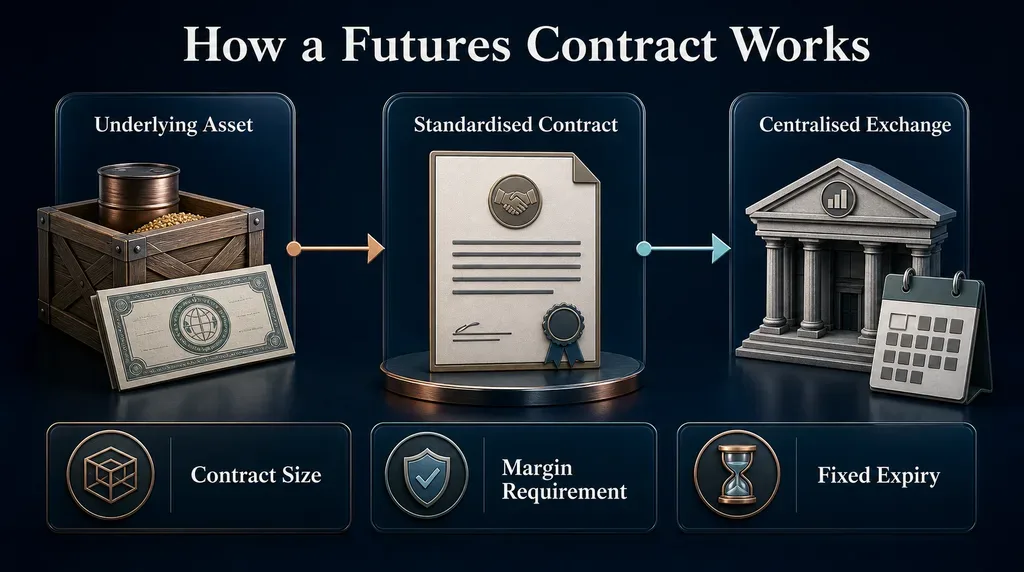
In Australia, ASIC (Australian Securities and Investments Commission) oversees both forex CFDs and futures. However, forex/CFD brokers provide a more ‘bespoke’ execution where you can choose exact position sizes. Futures execution follows price-time priority on a centralised exchange, offering transparent pricing, visible market depth and standardised contracts, with all participants filled at the same visible price on a public order book.
Australian forex traders typically look for ‘ECN-style’ accounts with raw spreads and a small commission. In futures, you pay a clearing fee and exchange fee on top of your broker’s commission. For high-volume traders, futures can sometimes be more cost-effective due to the “all-in” transparency.
If you hold a forex position past 7:00 AM AEST, you will likely incur (or earn) a swap rate based on interest rate differentials. Futures do not have daily swap fees; instead, the “cost of carry” is built into the price of the contract. However, you must ‘roll’ your contract to the next month to avoid expiry.
The Australian “Asian Session” can be quieter for some futures contracts, though major futures markets typically see renewed activity as US trading hours begin, and their transparent, exchange-based volume data lets traders see this liquidity shift in real time. The 24/5 nature of forex means that even at 2:00 PM in Sydney, the market can remain active.
According to the BIS, global forex turnover reached $9.6 trillion per day in 2025 1, reflecting the scale of the broader market, though liquidity for any individual trader can still vary by pair, broker and market conditions, and does not guarantee instant entry or exit at a given price.
Futures can still offer strong liquidity in major contracts, especially during their main trading hours, with transparent exchange-based volume and pricing. Forex CFD liquidity can vary by broker, market conditions and the specific currency pair, which may lead to wider spreads or slippage during volatile periods.
There is no “best”, only “best for you.” The choice between forex and futures depends on many factors such as individual trading objectives, market preferences and the characteristics of each product.
If you value flexibility and low capital requirements, forex may be superior. Forex provides flexible position sizing and broad market access, which some traders may prefer. If instead you value transparency and trade in large sizes, futures may be preferred. Futures trading often involves standardised contracts, exchange margin requirements and contract expiry, which may further require a higher level of product knowledge.
No. While futures were once the domain of floor traders, platforms like Vantage provide the tools for retail traders to access these markets via CFDs alongside forex.
RISK WARNING: Trading CFDs and FX involves significant risk to your invested capital. Under ASIC regulation, retail leverage is capped to protect consumers, but losses can still occur rapidly. Ensure you read the Product Disclosure Statement (PDS) and Target Market Determination (TMD) before trading.
Disclaimer: The material provided here has not been prepared in accordance with legal requirements designed to promote the independence of investment research and as such is considered to be a marketing communication. Whilst it is not subject to any prohibition on dealing ahead of the dissemination of investment research we will not seek to take any advantage before providing it to our client. No representation or warranty is given as to the accuracy or completeness of this information and therefore it shouldn’t be relied upon as such. Any research provided does not have regard to specific financial situations, needs or investment objectives. Vantage accepts no responsibility for any use that may be made of these comments and for any consequences that result. Consequently, any person acting on it does so entirely at their own risk. We advise any readers of this material to seek professional advice where necessary. Without the approval of Vantage, reproduction or redistribution of this information isn’t permitted.
Disclaimer: The material provided here has not been prepared in accordance with legal requirements designed to promote the independence of investment research and as such is considered to be a marketing communication. Whilst it is not subject to any prohibition on dealing ahead of the dissemination of investment research we will not seek to take any advantage before providing it to our client. No representation or warranty is given as to the accuracy or completeness of this information and therefore it shouldn’t be relied upon as such. Any research provided does not have regard to specific financial situations, needs or investment objectives. Vantage accepts no responsibility for any use that may be made of these comments and for any consequences that result. Consequently, any person acting on it does so entirely at their own risk. We advise any readers of this material to seek professional advice where necessary. Without the approval of Vantage, reproduction or redistribution of this information isn’t permitted.

Discover the endless trading possibilities with our cutting-edge platform, designed to empower our traders. Practice trading the markets with a free demo account today.

Trade on the go with the Vantage All-In-One Trading App, where smooth execution and market access come together in the palm of your hand.

Are you an existing user? Login to your account to start trading 1,000+ CFD products including forex, indices, gold, shares and more.